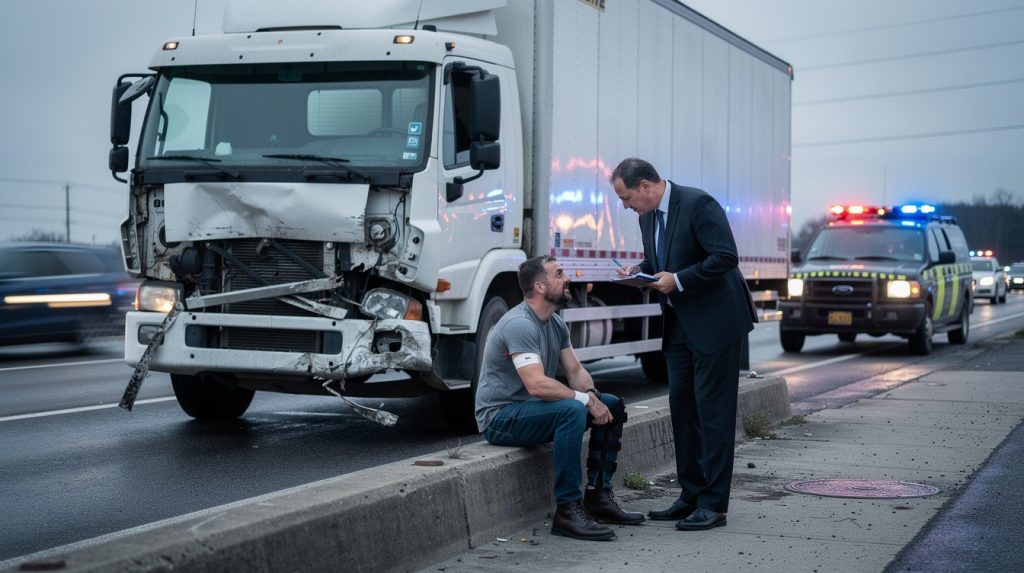
Truck accidents in Sacramento County leave victims facing medical bills, lost wages, and overwhelming stress. We at O’Brien & Zehnder Law Firm know that a Sacramento County truck injury can change your life in seconds.
This guide walks you through what happens after a crash, how to handle insurance claims, and when legal help matters. You’ll find practical steps to protect yourself and understand your options.
Understanding Sacramento County Truck Accident Statistics
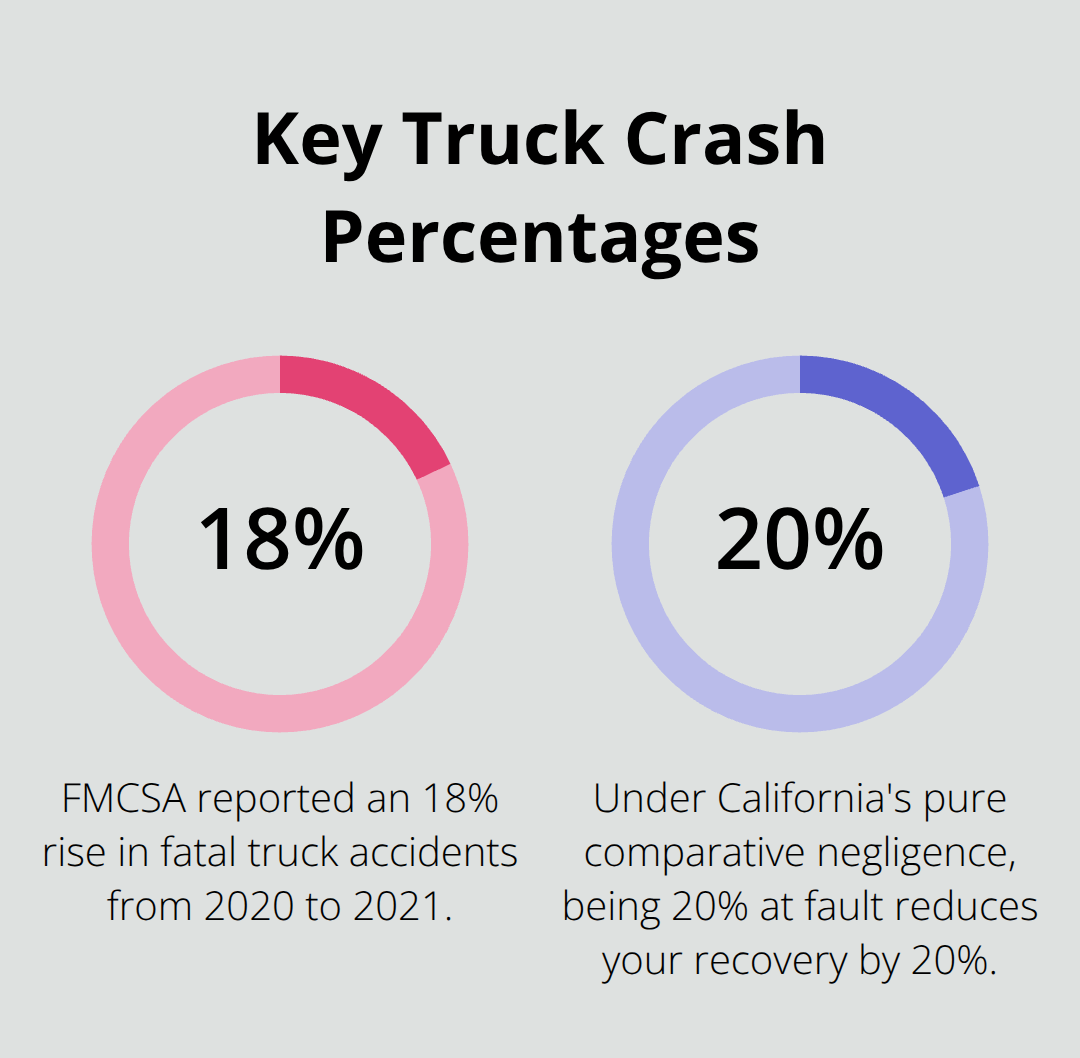
Truck accidents in Sacramento County follow predictable patterns shaped by geography, traffic volume, and driver behavior. The National Safety Council reported 5,472 deaths and more than 153,000 injuries in large-truck crashes across the United States in 2023-a stark reminder that these collisions carry catastrophic consequences. Sacramento County sits at the intersection of major freight corridors including Interstate 5 and Highway 99, making it a high-traffic zone for commercial vehicles moving goods across state lines. This geographic reality means Sacramento County residents face elevated exposure to truck accidents compared to communities off major shipping routes. The Federal Motor Carrier Safety Administration documented an 18% rise in fatal truck accidents from 2020 to 2021, indicating that the problem worsens rather than improves.
How Geography Creates Collision Risk
Sacramento’s highways carry essential commerce but create serious hazards due to vehicle mass and stopping distances. Trucks require significantly longer stopping distances than passenger vehicles, and at highway speeds, this difference becomes deadly. Head-on collisions involving trucks cause severe trauma to occupants of smaller vehicles, while rear-end crashes crush passenger cars due to the truck’s weight advantage. Jackknife crashes occur when a trailer skids during braking-often from improper technique-creating unpredictable vehicle movements that trap nearby drivers. A fully loaded tractor-trailer can weigh up to 80,000 pounds, increasing rollover risk and triggering tire blowouts or sudden loss of control.
What Causes These Crashes
Driver fatigue, distraction, speeding, cargo overload, and inadequate vehicle maintenance all contribute to Sacramento County truck accidents. When a truck crash happens on I-5 or Highway 99, multiple parties often bear responsibility: the driver, the trucking company, cargo loaders, and sometimes maintenance providers. This complexity matters because it shapes how your claim develops and what compensation you can realistically pursue.
Injuries That Change Lives
Truck accident injuries differ fundamentally from typical car crashes due to the force involved. Traumatic brain injury, internal bleeding, spinal cord damage, and severe fractures are common outcomes that may not show symptoms immediately after impact. Victims often face long-term consequences including reduced earning capacity, ongoing medical treatment, and psychological trauma. Seeking same-day medical evaluation matters-an early medical record establishes the connection between the crash and your injuries, protecting your ability to claim damages later. Understanding these injury patterns helps you recognize why truck accident claims require specialized legal attention and why the next steps you take immediately after a crash can determine your recovery outcome.
What to Do in the First Hours After a Truck Crash
Protect Yourself at the Scene
The moments immediately following a truck accident determine whether you protect yourself or inadvertently harm your claim. Call 911 if anyone is injured, then move to a safe location if possible-staying in traffic or near an unstable vehicle creates additional risk. Before anything moves, photograph the vehicle positions, road conditions, debris field, and any visible injuries. Capture wide shots showing the overall scene and close-ups of vehicle damage, license plates, and road markings.
Take photos of weather conditions, traffic signals, and sight lines that might explain how the crash happened. Exchange names, phone numbers, addresses, insurance information, and driver’s license numbers with the truck driver and any other vehicle occupants. Get contact details from witnesses-their accounts matter enormously when insurance companies dispute fault. Write down the truck’s company name, license plate, and any visible markings.
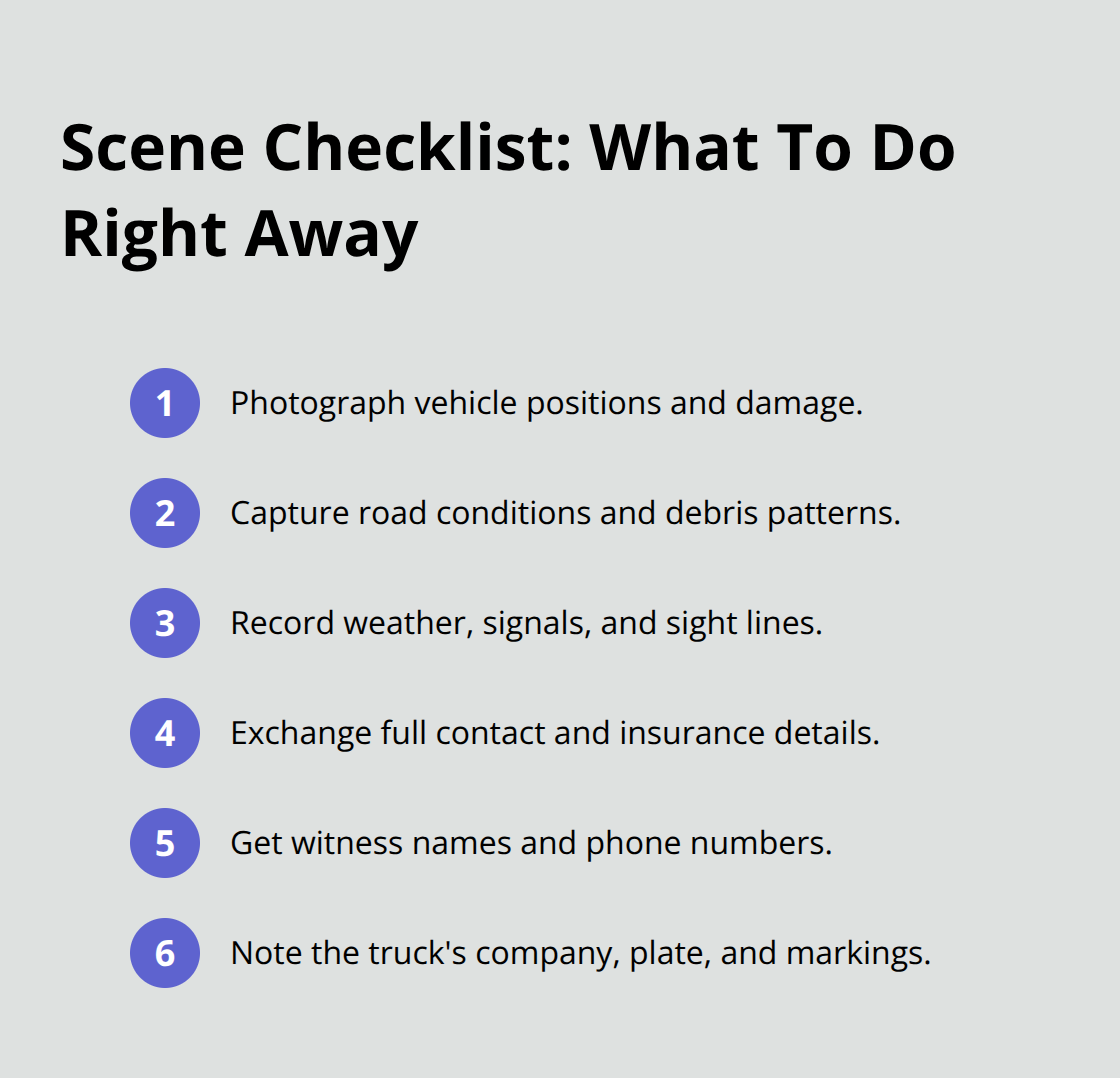
Note the exact location, time, and weather conditions in your phone immediately while details remain fresh.
Avoid Statements That Harm Your Claim
Do not admit fault or apologize for the crash; statements made at the scene can be used against you later under California’s pure comparative negligence rule, where your recovery gets reduced by your percentage of fault. Do not speak with the trucking company’s insurance adjuster without legal guidance; recorded statements made early can be weaponized to argue comparative fault. Insurance companies move quickly to protect themselves, so securing evidence early with legal help strengthens your position significantly.
Seek Medical Care and File Required Documents
Seek medical evaluation the same day, even if you feel fine. The National Safety Council data on truck injuries shows that traumatic brain injury and internal bleeding often produce delayed symptoms-waiting 48 hours to see a doctor weakens your ability to link injuries directly to the crash. File California’s DMV Form SR-1 within 10 days if the crash caused injury, death, or property damage exceeding $1,000; failing to file risks license suspension and creates a separate legal requirement from the police report.
Preserve Evidence Before It Disappears
Do not repair or dispose of your vehicle before an attorney or accident reconstruction expert documents it-preservation of the vehicle is critical evidence. Keep damaged clothing, safety gear, and personal belongings involved in the crash. Demand preservation of ELD (Hours-of-Service) data and Event Data Recorder (EDR) data from the trucking company; the FMCSA requires ELD data retention for at least six months, and this data often reveals driver fatigue or speed violations that prove liability.
Get Legal Guidance for Your Next Steps
Multiple parties often bear responsibility in Sacramento County truck crashes: the driver, the trucking company, cargo loaders, and sometimes maintenance providers. This complexity shapes how your claim develops and what compensation you can realistically pursue. We at O’Brien & Zehnder Law Firm guide Sacramento-area clients through the insurance claims process and help identify all potentially liable parties that contributed to the crash. Understanding these early decisions prepares you to navigate insurance claims and explore your legal options.
Insurance Claims and Pursuing Compensation
How Insurance Companies Attack Your Claim
Insurance adjusters contact truck accident victims within days, often before injuries fully manifest or legal representation enters the picture. This speed is intentional. The trucking company’s insurer wants a recorded statement while you remain in shock, disoriented from pain medication, or uncertain about the full extent of your injuries. Under California’s pure comparative negligence rule, any statement suggesting you shared fault reduces your recovery dollar-for-dollar by your percentage of liability. An adjuster asking how you felt before the crash or whether you were distracted isn’t making casual conversation-it’s building a case to minimize what they owe.
Insurance companies deploy predictable tactics: they offer quick lowball settlements before you understand long-term injury costs, they dispute liability by claiming the truck driver wasn’t at fault, or they delay claim processing to pressure acceptance of inadequate offers. The trucking company’s insurer knows that medical bills from a single hospitalization at UC Davis Medical Center or Mercy General Hospital can exceed $100,000, yet they’ll offer $15,000 to $25,000 hoping you accept before understanding the financial reality ahead.
Why You Must Refuse Early Settlement Offers
Decline recorded statements until legal counsel reviews the claim. Refuse early settlement proposals without legal review. Signing a release permanently bars future compensation if injuries prove more serious than initially apparent-a critical mistake when traumatic brain injury or spinal cord damage emerges weeks after the crash. The financial consequences of accepting inadequate compensation extend far beyond immediate medical expenses; ongoing treatment, lost wages, and reduced earning capacity accumulate over months and years.
What Compensation Actually Covers
Compensation in truck accident cases covers direct medical costs, ongoing treatment expenses, reduced earning capacity, lost wages, and property damage to your vehicle. Punitive damages sometimes apply when gross negligence appears evident. California allows recovery even if you share partial fault-if you were 20 percent at fault and damages total $100,000, you recover $80,000. Multiple liable parties complicate claims but expand recovery potential significantly.
Identifying All Responsible Parties
The truck driver bears responsibility for fatigue or distraction; the trucking company bears responsibility for failing to maintain the fleet, pressuring drivers to exceed safe hours, or negligent hiring and training; cargo loaders bear responsibility for overloaded or improperly secured freight affecting stability. An attorney examines FMCSA safety records, driver qualification files, Hours-of-Service violations, and Event Data Recorder data to identify all responsible parties and strengthen the claim.
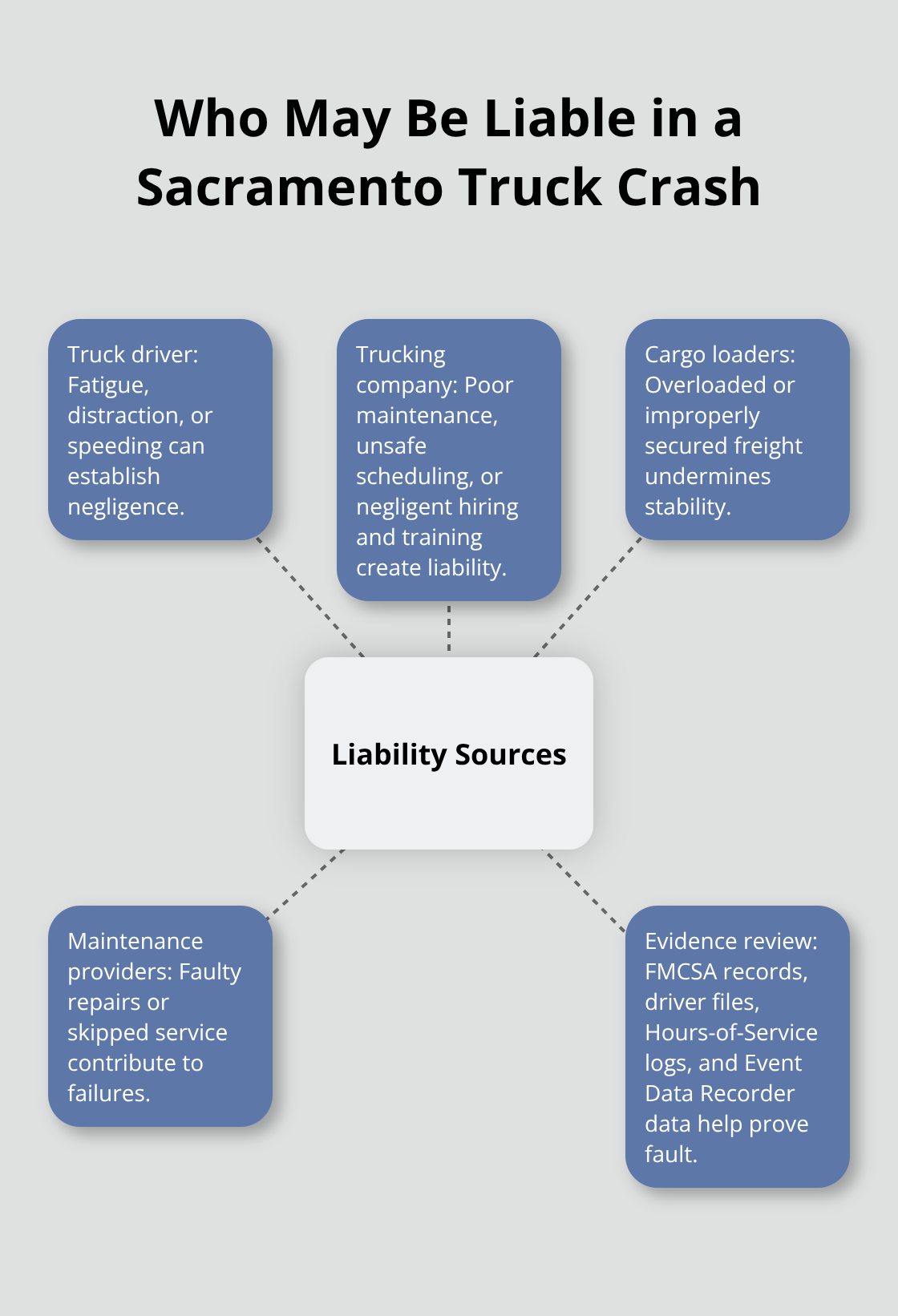
We at O’Brien & Zehnder Law Firm guide Sacramento-area clients through this process, helping them understand how multiple parties contribute to liability and what compensation they can realistically pursue.
Government Claims and Lawsuit Deadlines
Government claims require separate procedures: if a City of Sacramento vehicle or city-maintained road defect contributed to the crash, a government tort claim must be filed within six months under Government Code section 911.2, with the city having 45 days to respond. Private-party lawsuits must be filed within two years under California Code of Civil Procedure section 335.1. Contingency-fee arrangements eliminate upfront legal costs-your attorney earns fees only if recovery is achieved, meaning you pay nothing unless you win. This structure aligns the attorney’s incentive with yours: maximize your compensation.
Final Thoughts
A Sacramento County truck injury creates immediate chaos: medical emergencies, insurance pressure, and legal complexity converging at once. The steps you take in the first hours determine whether you protect yourself or inadvertently weaken your claim. Refusing early settlement offers, preserving evidence, and seeking same-day medical evaluation matter enormously because insurance companies move fast with their own financial interests in mind.
Contact O’Brien & Zehnder Law Firm for a consultation and describe what happened at the scene. We examine FMCSA safety records, driver qualification files, and Event Data Recorder data to identify all responsible parties, and we handle government tort claims when City of Sacramento involvement exists. Contingency-fee arrangements mean you pay nothing unless we recover compensation for you, aligning our incentive with yours to maximize your recovery.
Medical records from UC Davis Medical Center, Mercy General Hospital, or Methodist Hospital of Sacramento should be gathered and organized immediately. Preserve your vehicle, damaged clothing, and any personal belongings involved in the crash, and maintain a detailed timeline of all medical treatment, prescriptions, and work restrictions. The difference between accepting a lowball settlement and pursuing full compensation often exceeds six figures.