

Car accident claim deadlines in Sacramento County are strict, and missing them can cost you your right to compensation. We at O’Brien & Zehnder Law Firm know that navigating these timelines while recovering from an accident is overwhelming.
This guide breaks down every deadline you need to track, from notifying your insurance company to filing a lawsuit.
Car Accident Claim Deadlines in Sacramento County
The Two-Year Statute of Limitations
California law gives you two years from the date of your accident to file a personal injury lawsuit against the at-fault driver. This deadline, called the statute of limitations, is non-negotiable. Once those two years pass, you lose your right to pursue compensation through the courts, regardless of how strong your case is. The clock starts the moment the accident occurs, not when you discover your injuries. Some injuries take weeks or months to surface-a seemingly minor fender bender can cause delayed whiplash or internal injuries that don’t become apparent until later. California’s statute of limitations doesn’t account for your timeline of discovery.
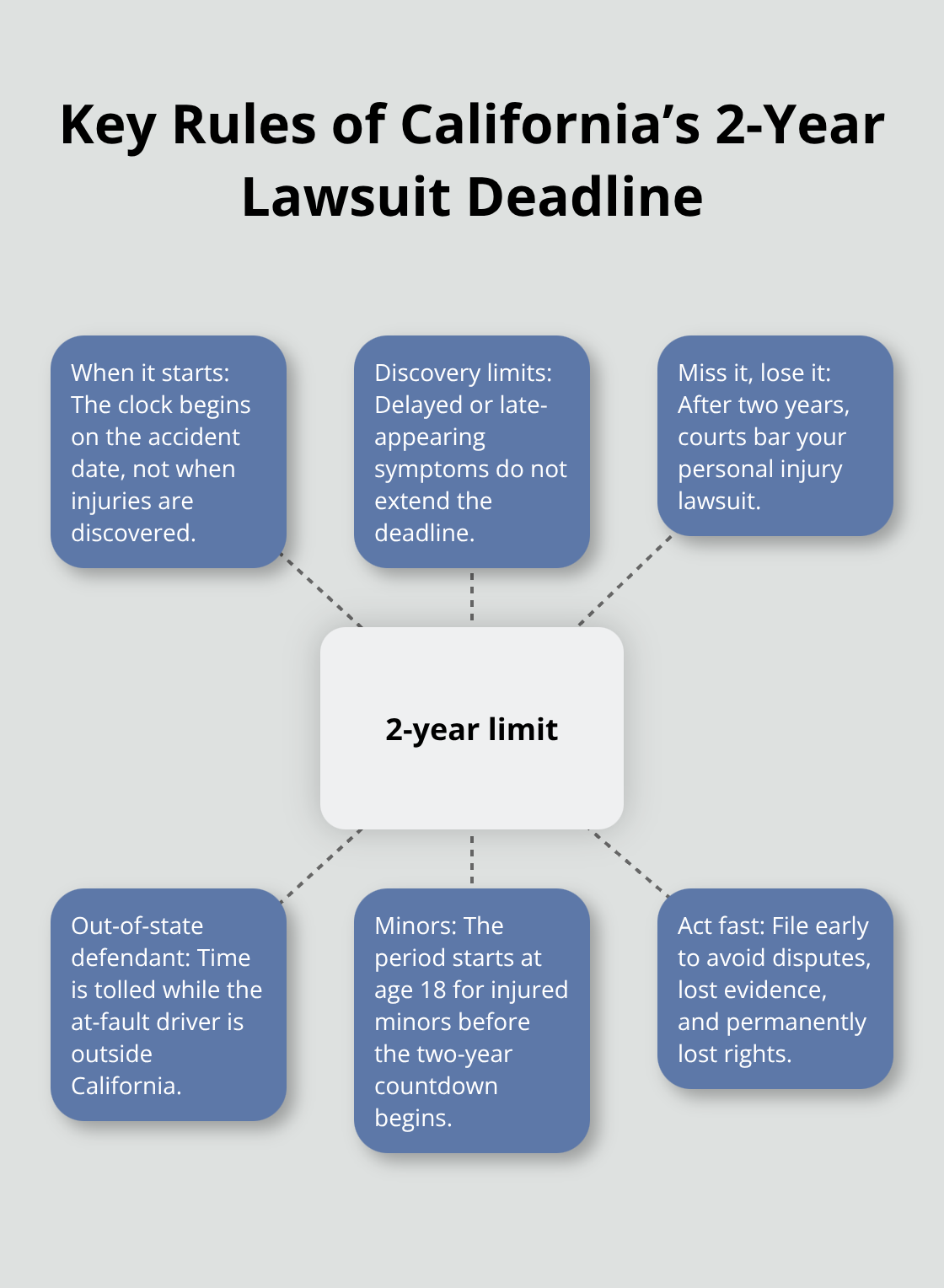
If you wait 25 months to file, you’ve already missed the deadline.
Insurance Notification Deadlines
Insurance claims operate on a different, faster schedule than lawsuits. Your insurance company requires notification within a specific timeframe, typically 30 days (though your policy language controls the exact requirement). Missing this deadline can jeopardize your entire claim. For third-party claims against the other driver’s insurance, you still have the full two years, but waiting that long weakens your position dramatically.
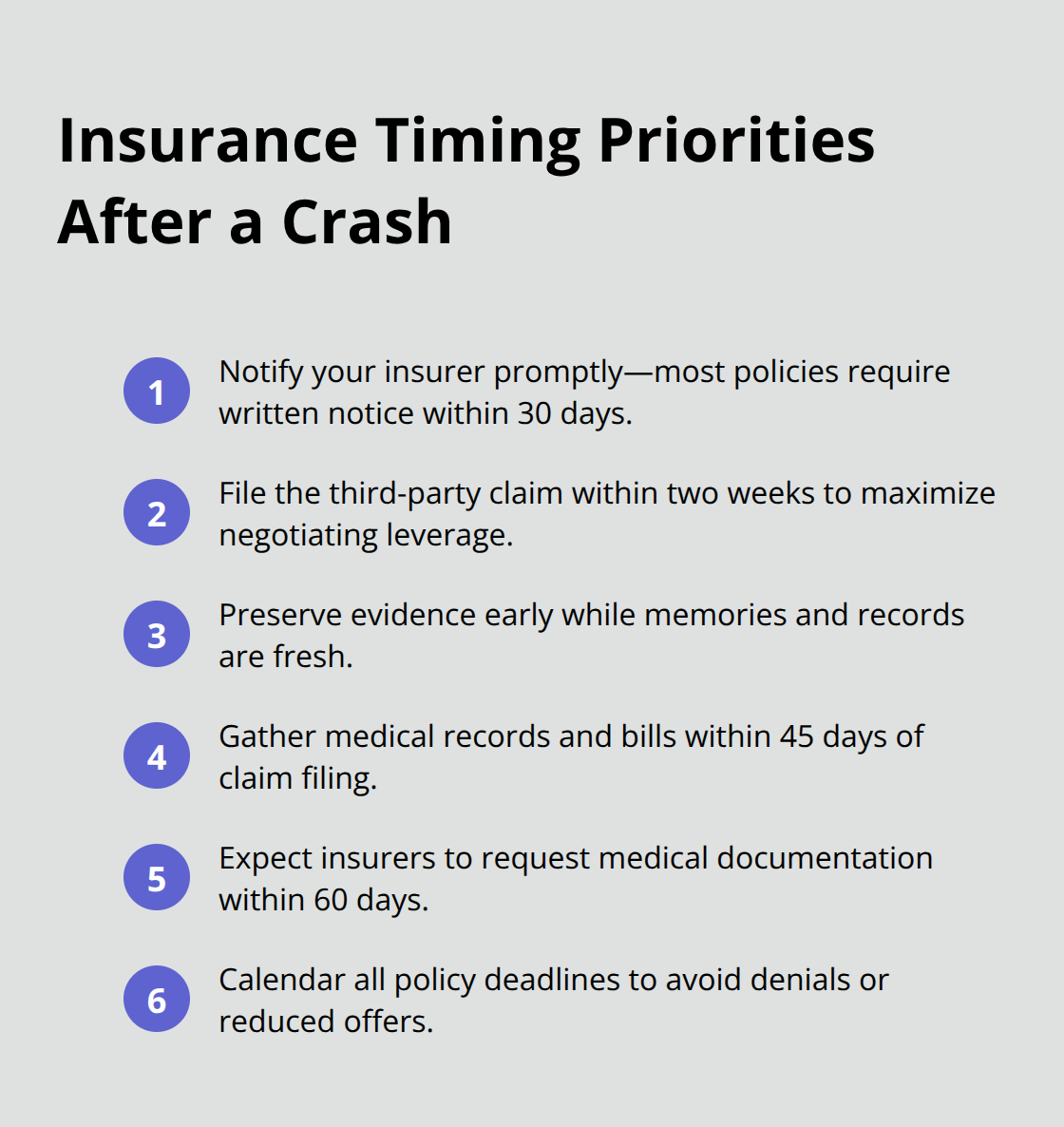
Insurance adjusters process claims more favorably when you file quickly, while evidence remains fresh and witness memories stay sharp.
Rare Exceptions That Extend Deadlines
The statute of limitations has narrow exceptions that occasionally extend the deadline. If the at-fault driver leaves California, the time they’re absent doesn’t count toward the two-year limit. If you’re a minor at the time of the accident, the clock doesn’t start until you turn 18. These exceptions are rare and highly specific to individual circumstances. Filing your claim immediately after an accident remains the safest approach rather than banking on exceptions that may not apply to your situation.
Understanding these deadlines sets the foundation for protecting your rights, but the claims process involves additional critical dates and milestones that directly impact your compensation.
Insurance Deadlines That Actually Matter
Notification Requirements in Your Policy
Your insurance policy contains specific notification requirements that differ dramatically from the two-year lawsuit deadline. California law requires you to notify your insurance company promptly, and most policies demand written notice within 30 days of the accident. Checking your policy documents immediately after an accident reveals the exact deadline rather than guessing. Waiting weeks to report the accident gives the insurance company grounds to deny your claim, claiming you failed to cooperate. Photograph your policy’s declarations page and note the notification deadline on your calendar before you need it. This simple step prevents costly mistakes when stress and injury cloud your judgment.
Third-Party Claims and Timing Strategy
For third-party claims against the other driver’s insurance, you technically have the full two years, but this timeline works against you in practice. Insurance adjusters move faster on claims filed within days or weeks of the accident. According to the National Association of Insurance Commissioners, claims filed within 30 days of an accident have significantly higher approval rates than those filed months later. Evidence deteriorates, witness contact information becomes outdated, and medical records become harder to obtain as time passes. Filing your third-party claim within two weeks gives you the strongest negotiating position with the other driver’s carrier.
Consequences of Missing Insurance Deadlines
Missing insurance deadlines creates cascading problems that compound over time. If you miss your own insurance company’s notification window, they can legally deny coverage for the accident entirely. This denial doesn’t just affect your claim-it affects your driving record and future insurance rates. Third-party claims face a different penalty: delayed filing weakens your negotiating position with the other driver’s insurance company, resulting in lower settlement offers. Insurance adjusters interpret delayed claims as weak cases where the claimant is uncertain about damages or liability. The difference between filing immediately and filing six months later often means thousands of dollars in reduced compensation.
Medical Records and Documentation Timelines
Medical documentation deadlines matter within the insurance process. Most insurance companies request medical records and treatment summaries within 60 days of your claim filing. Delaying medical treatment or failing to obtain complete documentation during this window complicates the claims process substantially. Gather all medical records, billing statements, and treatment summaries within 45 days of filing your insurance claim to stay ahead of adjuster requests. This proactive approach prevents insurers from using incomplete documentation as a reason to reduce your settlement offer.
These insurance deadlines operate independently from the court system, yet they directly influence whether you can pursue legal action if negotiations stall. Understanding how insurance timelines interact with court deadlines shapes your entire claims strategy.
Critical Dates and Milestones in the Claims Process
Medical Records and Documentation Timelines
Medical documentation deadlines determine whether most car accident claims succeed or fail, yet few people understand their actual timeline. You need to collect complete medical records within 45 days of filing your insurance claim, not whenever you finish treatment. Many claimants wait six months or longer to obtain records, assuming they have time since the statute of limitations extends two years ahead. Insurance adjusters interpret this delay as weakness and reduce settlement offers accordingly.
Start requesting medical records from every provider you’ve seen immediately after filing your claim. Call your doctor’s office, physical therapist, and any specialist you visited within the first week. Most California medical offices respond to record requests within 5 to 10 business days if you follow up persistently. The faster you compile this documentation, the faster the adjuster can evaluate your claim fairly.
Incomplete medical files give insurers a legitimate reason to underpay or deny portions of your claim. Document every treatment date, provider name, and cost in a spreadsheet as you collect records. This organization prevents gaps that adjusters will exploit during negotiations.
Settlement Negotiations and Response Periods
Settlement negotiations operate on response deadlines that most claimants ignore until it’s too late. When the insurance company makes a settlement offer, you typically have 30 days to respond, though some policies allow only 14 days. Ignoring this deadline doesn’t automatically reject the offer, but it signals disorganization to the adjuster and weakens your negotiating position.
If you reject an offer, the insurer may withdraw it entirely and restart negotiations from a lower baseline. This withdrawal leaves you in a worse position than before. Respond to every settlement offer within the stated timeframe, even if you plan to reject it. A timely rejection preserves your negotiating leverage far better than silence.
Court Filing Deadlines and Legal Procedures
Court filing deadlines create hard stops that no extension can overcome. You must file your lawsuit within two years of the accident date, and courts reject filings submitted even one day late. File your complaint at least 60 days before the two-year deadline to account for processing delays and administrative errors.
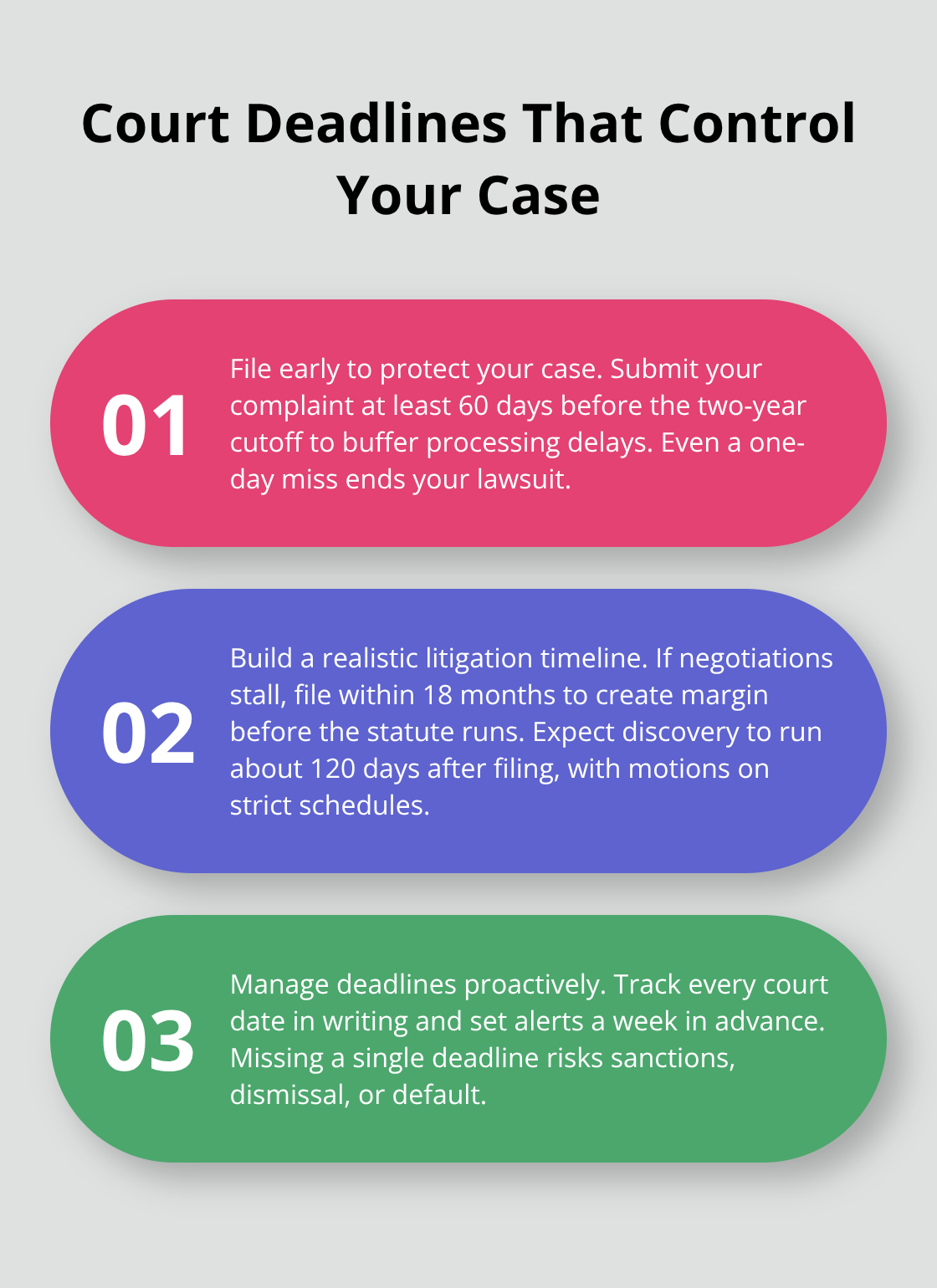
Many claimants wait until month 23 to file, leaving no margin for unexpected court closures or filing errors. If negotiations stall, file within 18 months of your accident, giving yourself breathing room before the statute of limitations expires. Once you file in court, new deadlines emerge: discovery deadlines typically run 120 days from filing, and motion deadlines follow strict court-imposed schedules (these vary by judge and case complexity).
Missing a single court deadline can result in sanctions, case dismissal, or default judgment against you. Courts show no mercy for missed deadlines, regardless of the reason. Track every court-imposed deadline in writing and set calendar reminders at least one week before each date arrives.
Final Thoughts
Car accident claim deadlines in Sacramento County aren’t suggestions-they’re legal requirements that determine whether you receive compensation or lose your case entirely. Missing a single deadline eliminates your right to recover damages, regardless of how serious your injuries are or how clear the other driver’s fault may be. The two-year statute of limitations, 30-day insurance notification requirement, and court filing deadlines all operate independently, creating multiple opportunities to miss critical dates if you don’t track them carefully.
Protecting your rights starts immediately after the accident. Write down the accident date and calculate your two-year deadline on paper, then set phone reminders for 18 months, 20 months, and 21 months after the accident (this redundancy prevents the statute of limitations from sneaking up on you). Notify your insurance company within 30 days through written notice, not just a phone call, and file your third-party claim within two weeks to maximize your negotiating position with the other driver’s insurance company.
The complexity of car accident claim deadlines makes professional guidance invaluable. We at O’Brien & Zehnder Law Firm help clients navigate these timelines while managing their recovery and medical treatment, and our team handles court filings if negotiations stall. Contact O’Brien & Zehnder Law Firm for a consultation about your specific situation and car accident claim deadlines.