

Sacramento County comparative fault rules decide what happens when more than one person may share the blame for an accident. After a crash, a fall, or any other injury, insurance adjusters and defense lawyers often argue that the injured person was partly responsible. Many people assume that even a small share of blame ends their claim. In California, that is not how the law works. The state uses a comparative fault system, and understanding it can change how you view your options.
At O’Brien & Zehnder Law Firm, we help injured people in Sacramento County pursue the answers and results they deserve so you can move forward with confidence. This guide explains what comparative fault means in California, how a jury is asked to think about it, how responsibility is divided among several defendants, and what injured people can do to protect their position.
What Comparative Fault Means in Sacramento County Injury Cases
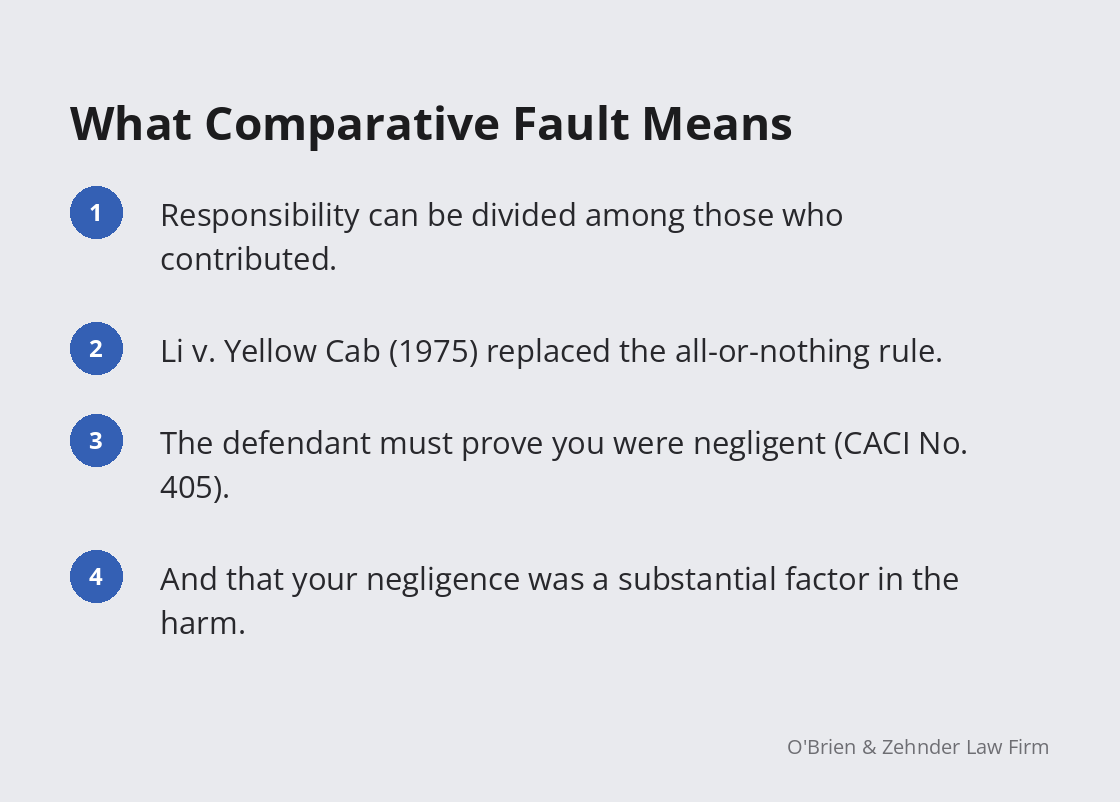
Comparative fault is the idea that responsibility for an injury can be divided among the people who contributed to it. Rather than treating a case as all or nothing, California courts and juries are asked to consider each person’s share.
The Shift Away From All-or-Nothing
In Li v. Yellow Cab Co., decided in 1975, the California Supreme Court concluded that the doctrine of comparative negligence is preferable to the all-or-nothing doctrine of contributory negligence from the point of view of logic, practical experience, and fundamental justice. That decision is the foundation of the system used today. The old all-or-nothing approach could leave an injured person with nothing for even a small mistake. Comparative fault replaced that rule with a more proportionate approach.
How the Jury Instruction Describes It
California’s civil jury instructions explain the idea in plain language. Under CACI No. 405, the defendant claims that the injured person’s own negligence contributed to the harm. The instruction says that, to succeed on this claim, the defendant must prove both that the injured person was negligent and that the injured person’s negligence was a substantial factor in causing the harm. If the defendant proves both, the injured person’s damages are reduced by the jury’s determination of the percentage of the injured person’s responsibility, and the judge calculates the actual reduction.
Who Has to Prove What
The wording of the instruction matters. The burden of showing that the injured person shared the blame falls on the defendant who raises the claim. A defendant who simply says the injured person should have been more careful has not met that burden. The defendant must prove negligence and a substantial factor in causing the harm. This is one reason that evidence gathered early, such as photographs, witness names, and records, can be important in a Sacramento County case.
How This Plays Out in Real Life
Consider how often accusations of shared blame arise. A driver is hit while changing lanes, and the other side says the lane change was careless. A shopper slips in a store, and the store says the shopper should have watched their step. A cyclist is struck at an intersection, and the driver says the cyclist was hard to see. In each case, the accusation is a claim that must be supported by evidence, not a conclusion. The jury instruction asks whether negligence was proven and whether it was a substantial factor in the harm. Sometimes the answer is yes for a small share, sometimes for none at all, and the facts of the particular incident drive the result.
How Responsibility Is Divided Among Several Defendants
Many injury cases involve more than one party who may be responsible. A crash may involve two drivers and a business whose vehicle was poorly maintained. A fall may involve a property owner and a contractor. California has a special statute that addresses how responsibility is allocated among defendants for certain kinds of losses.
Several Liability for Non-Economic Damages
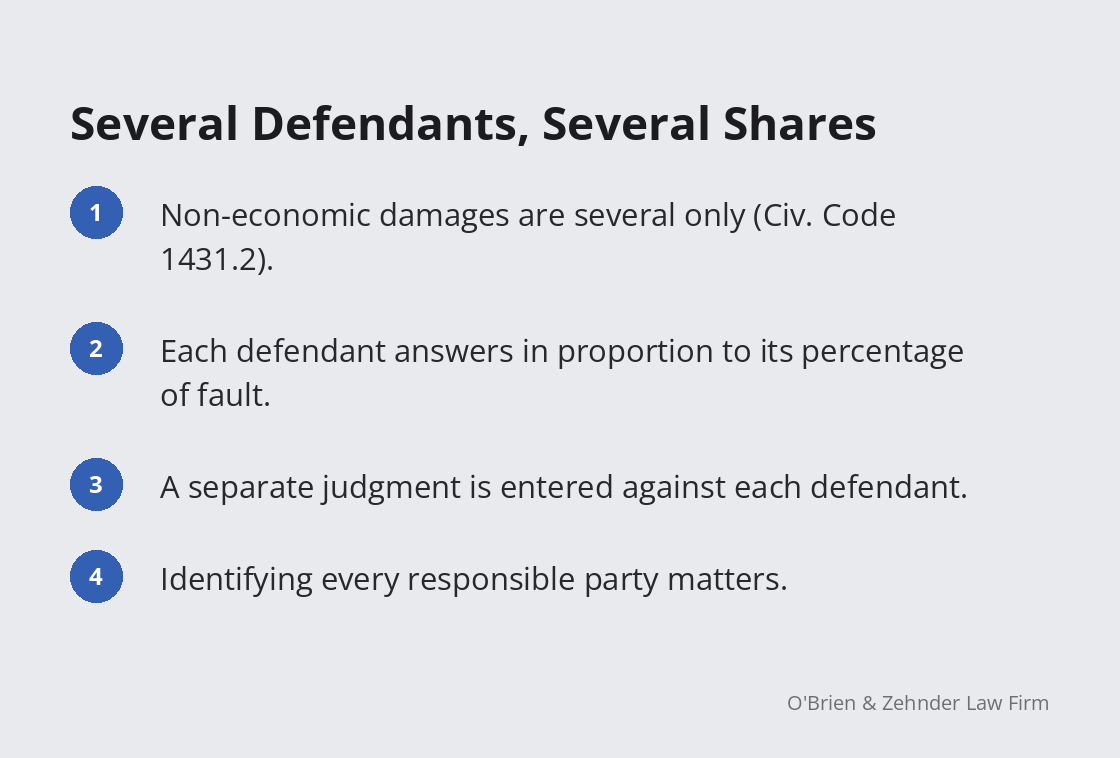
Civil Code section 1431.2(a) provides that, in any action for personal injury, property damage, or wrongful death based upon principles of comparative fault, the liability of each defendant for non-economic damages is several only and not joint. Each defendant is liable only for the amount of non-economic damages allocated to that defendant in direct proportion to that defendant’s percentage of fault, and a separate judgment is rendered against that defendant for that amount. This statute came from Proposition 51, the Fair Responsibility Act of 1986.
What Counts as Economic and Non-Economic Damages
Section 1431.2(b) defines the terms. Economic damages are objectively verifiable monetary losses, including medical expenses, loss of earnings, burial expenses, loss of use of property, repair or replacement of property, substitute domestic services, and loss of employment and of business or employment opportunities. Non-economic damages are subjective, non-monetary losses, including pain, suffering, inconvenience, mental suffering, emotional distress, loss of society and companionship, loss of consortium, injury to reputation, and humiliation. The statute’s rule about several liability applies to the second category, which is why the allocation of fault among defendants can have such a large effect on non-economic losses.
Why Identifying Every Responsible Party Matters
Because each defendant answers for non-economic damages only in proportion to its own share of fault, a case can change if a responsible party is overlooked. Investigating early to identify everyone who may have contributed, whether a driver, an employer, a property owner, or a business, can help an injured person understand the full picture. Not every case will involve more than one responsible party, but it is worth asking the question at the beginning rather than the end.
Protecting Your Position When Someone Says You Share the Blame
Accusations of shared fault are common, and they are often made early, in a phone call with an adjuster or in a letter. Responding thoughtfully can protect your claim.
Be Careful With Statements
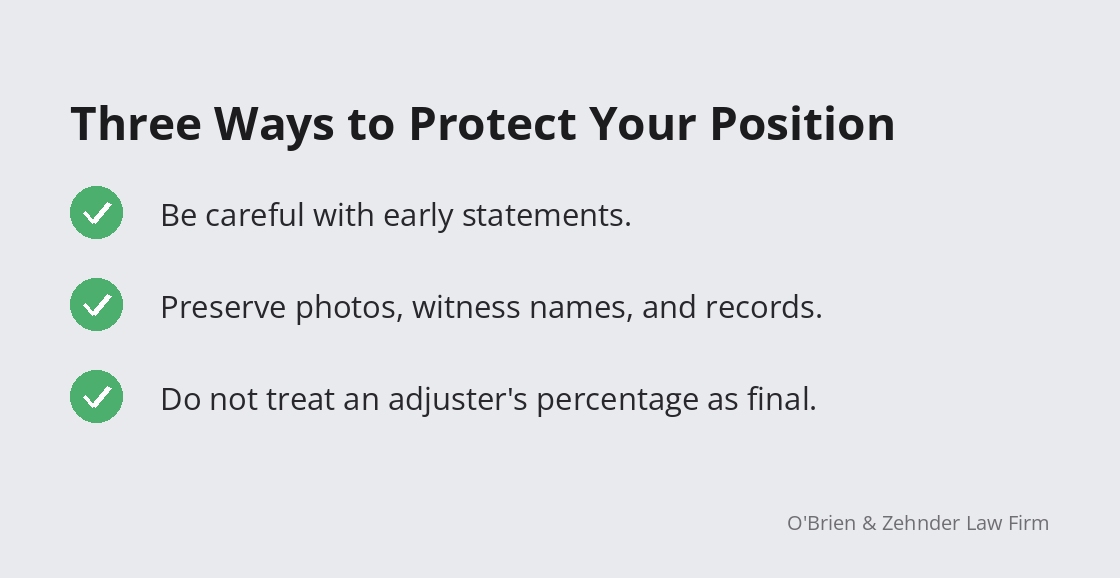
Avoid guessing about how the accident happened, apologizing out of politeness, or describing the event in a way that goes beyond what you know. Statements made soon after an injury, when you may be in pain or confused, can be used later to argue that you were careless. It is reasonable to say that you are still gathering information and that you would like to review the facts before providing a detailed account.
Preserve Evidence That Speaks for Itself
Photographs of the scene, the vehicles, and your injuries, the names and contact details of witnesses, medical records, and any available video can show what actually happened. Since the defendant has the burden of proving that you were negligent and that your negligence was a substantial factor in the harm, solid evidence on your side can make that burden harder to meet.
Do Not Assume a Percentage Is Final
An adjuster may suggest a percentage of blame as if it were a settled fact. Under the jury instruction, the percentage is the jury’s determination if the defendant proves the claim. A suggestion made during a call is only a position. Ask what evidence supports it, and consider getting advice before you accept it.
Remember That Deadlines Still Apply
Shared fault is a question about responsibility, not about timing. Time limits for bringing a claim run separately and apply no matter how fault is divided. If you were hurt, do not wait for a debate about blame to be resolved before learning about the deadlines that apply to your situation.
Final Thoughts
California’s comparative fault system means that sharing some blame for an accident does not automatically end an injury claim. The defendant who raises the issue must prove it, a jury decides each person’s percentage of responsibility, and Civil Code section 1431.2 divides responsibility for non-economic damages among defendants in proportion to their fault.
If someone is saying you share the blame for your injury, contact O’Brien & Zehnder Law Firm to speak with our team. We will review what happened and help you move forward with confidence.