
Sacramento County 18-wheeler accident claims are different from ordinary car crash cases in almost every way that matters. A fully loaded tractor-trailer traveling on Interstate 5, Interstate 80, Highway 99, or Highway 50 carries far more weight and momentum than a passenger car, and the injuries that follow a collision are often severe. These cases also involve federal safety rules, trucking company records, and multiple parties who may share responsibility, which means the evidence you need is often in someone else’s hands.
At O’Brien & Zehnder Law Firm, we help people across Sacramento County who have been hurt in truck, car, and motorcycle collisions so you can move forward with confidence. This guide explains how federal trucking rules actually work, who can be held responsible after a big truck crash, how the evidence is preserved and used, and the mistakes that most often weaken an injured person’s claim.
How Federal Trucking Rules Actually Shape an 18-Wheeler Claim
Most passenger car crashes turn on California’s traffic laws and the basic duty of care. Crashes involving tractor-trailers add another layer: the Federal Motor Carrier Safety Regulations, found in Title 49 of the Code of Federal Regulations, which govern how interstate trucking companies hire drivers, schedule their work, and keep records. When a carrier or driver ignores those rules, the violation can become powerful evidence of negligence.
California law also sets its own rules for heavy trucks on state roads. Together, these rules create a detailed picture of what a careful trucking company and a careful driver should have done before the crash ever happened.
Hours-of-Service Limits for Truck Drivers
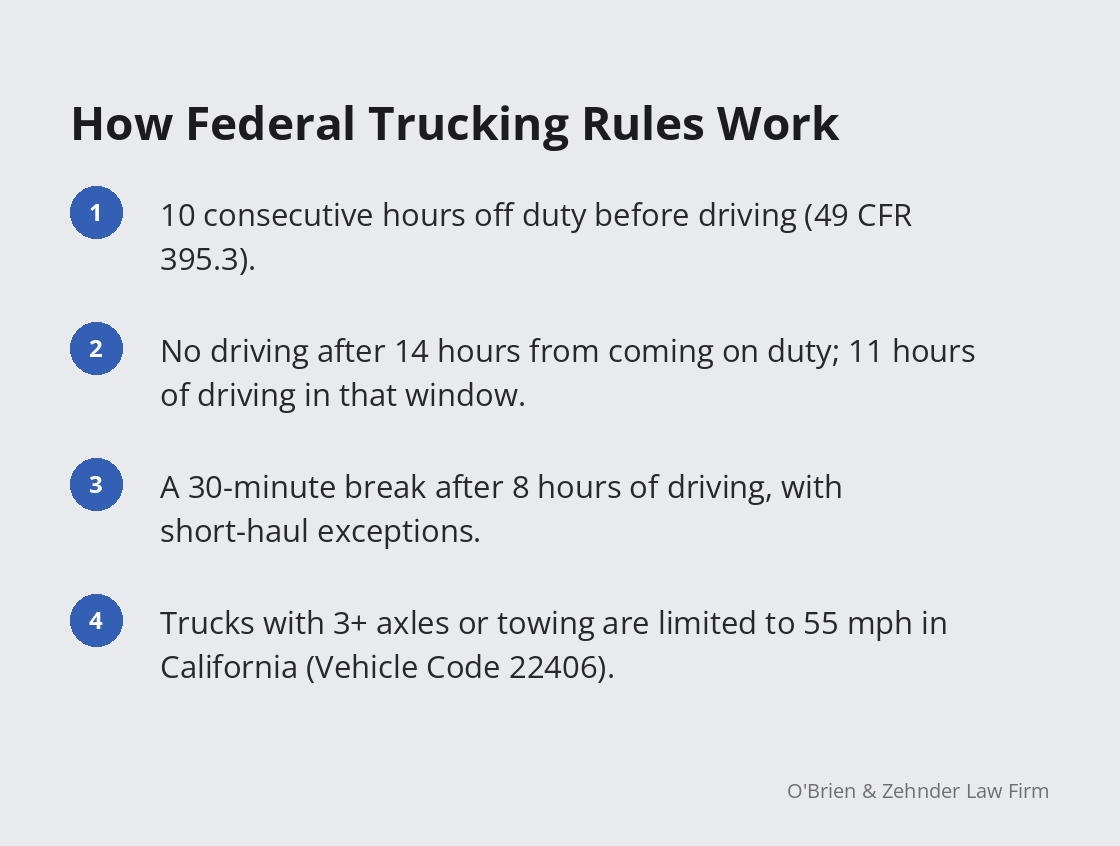
Driver fatigue is one of the most serious risks in long-haul trucking, and federal law addresses it directly. Under 49 CFR 395.3, a driver of a property-carrying commercial motor vehicle may not drive without first taking 10 consecutive hours off duty, may not drive after a period of 14 consecutive hours after coming on duty, and may drive a total of 11 hours within that window. The same section generally requires at least a 30-minute interruption in driving status once 8 hours of driving time have passed, with limited short-haul exceptions.
The rule also limits total on-duty time over a week. Drivers may not drive after 60 hours on duty in 7 consecutive days, or 70 hours in 8 consecutive days if the carrier operates every day of the week. When a driver’s logs show these limits were exceeded, it can help explain why the driver drifted out of a lane, reacted late, or failed to slow for traffic ahead.
The Fatigue and Illness Rule
Separate from the hour limits, 49 CFR 392.3 says no driver shall operate a commercial motor vehicle, and a motor carrier shall not require or permit a driver to operate one, while the driver’s ability or alertness is so impaired, or so likely to become impaired, through fatigue, illness, or any other cause, as to make it unsafe. This rule matters because it places responsibility on the company as well as the driver.
A carrier that pressures drivers to meet unrealistic delivery schedules, or that ignores signs that a driver is exhausted or unwell, may be breaking this rule even if the driver’s log appears to comply with the hour limits on paper.
California’s Truck Speed Limit
California Vehicle Code Section 22406 provides that no person may drive a motortruck or truck tractor having three or more axles, or any motortruck or truck tractor drawing another vehicle, on a highway at a speed in excess of 55 miles per hour.
Speed is one of the most important factors in a truck crash because a heavy vehicle needs much more distance to stop. Electronic data from the truck, along with witness accounts and video, can show whether the driver was traveling faster than the law allows or too fast for traffic and weather conditions.
Who Can Be Held Responsible After a Big Truck Crash
In a typical car accident, the claim is usually against one driver and that driver’s insurer. In an 18-wheeler accident, there are often several parties whose decisions contributed to the crash, and identifying each one early can make a real difference in the strength of your claim.
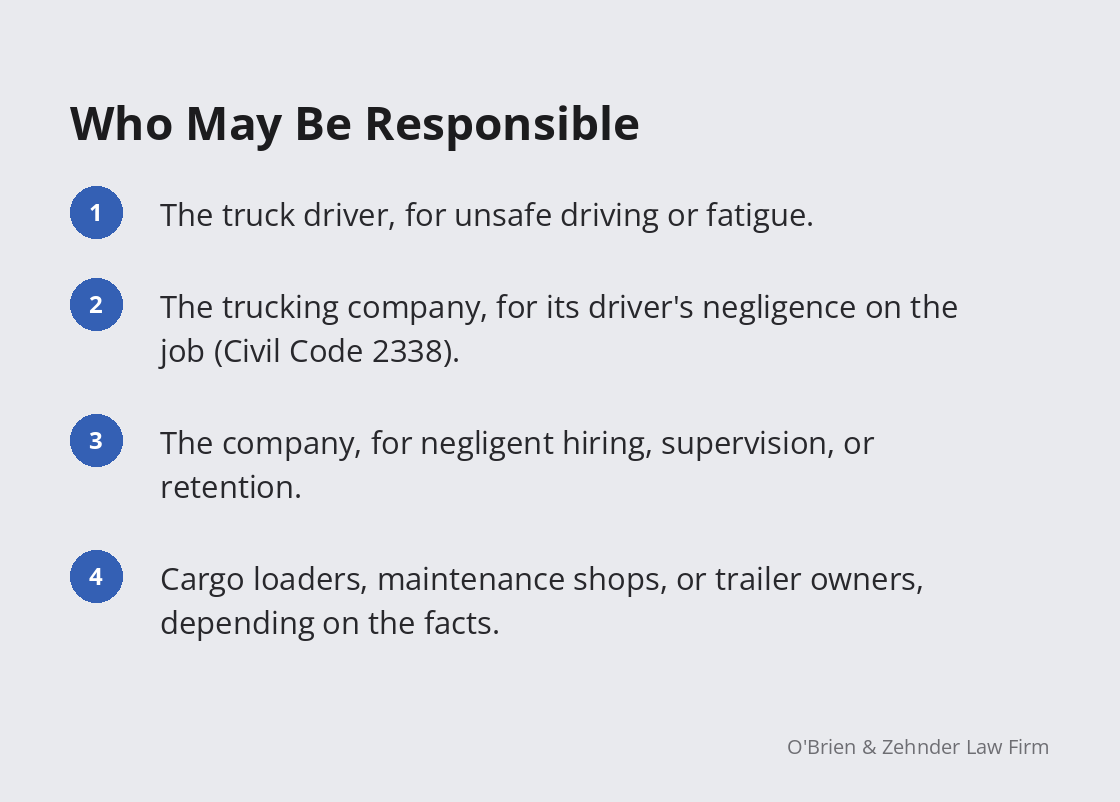
California Civil Code Section 1714 states that everyone is responsible for an injury caused to another by his or her want of ordinary care or skill. That basic principle applies to the driver, but it also reaches the companies that hire, train, dispatch, and maintain the truck.
The Truck Driver
The driver is responsible for operating the truck safely, obeying traffic laws, keeping a proper lookout, and staying within the hours-of-service limits. Common driver errors include following too closely, making unsafe lane changes into a smaller vehicle’s space, failing to check blind spots, speeding on downgrades or in construction zones, and driving while distracted or fatigued.
When a driver violates a safety statute or regulation, California law may presume negligence if the violation caused the type of harm the rule was designed to prevent. That presumption can be rebutted, but it often shifts the focus of the case to whether the driver had any valid excuse for breaking the rule.
The Trucking Company and Its Hiring Decisions
Under California Civil Code Section 2338, a principal is responsible to third persons for the negligence of its agent in the transaction of the business of the agency. In practical terms, a trucking company is often responsible for the careless acts of a driver who was working for it at the time of the crash, although whether the driver was an employee or an independent contractor can affect how that responsibility is analyzed.
A carrier can also be directly responsible for its own decisions. California’s civil jury instructions recognize claims that an employer negligently hired, supervised, or retained an employee it knew or should have known was unfit and created a particular risk to others. A company that keeps a driver with a history of unsafe driving on the road may face this kind of claim.
Other Parties Who May Share Responsibility
Depending on the facts, other parties may share responsibility. A company that loaded the trailer may be involved if cargo shifted or was improperly secured. Lease agreements, bills of lading, and maintenance logs often reveal who controlled the truck and the cargo. A maintenance shop may be involved if brakes, tires, or lights were not properly repaired. The owner of the trailer may be a different company than the one that employed the driver.
How Evidence Is Preserved and What Weakens a Truck Accident Claim
The most important evidence in an 18-wheeler accident claim is usually held by the trucking company, not by the injured person. Some of those records are kept only for limited periods, and the truck itself may be repaired and returned to service quickly.
Insurance companies representing carriers often move quickly after a serious crash, so understanding the most common mistakes can help you avoid giving them an advantage.
Electronic Logs and Driver Qualification Files
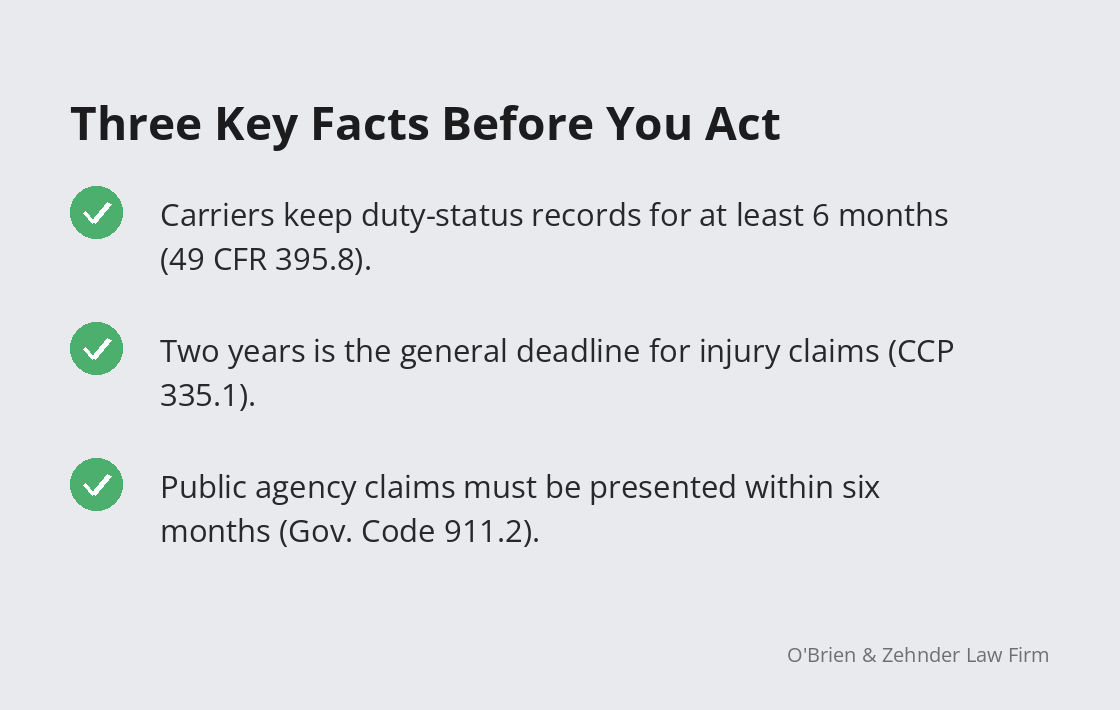
Under 49 CFR 395.8, a motor carrier must require each driver to record duty status for each 24-hour period, and most carriers must install and require drivers to use an electronic logging device. The carrier must retain records of duty status and supporting documents for not less than six months from the date of receipt, which means waiting too long can put this evidence at risk.
Federal rules also require each motor carrier to maintain a driver qualification file for every driver it employs under 49 CFR 391.51. That file includes items such as the driver’s employment application, motor vehicle records from licensing authorities, the road test certificate or its equivalent, and the medical examiner’s certificate. These documents can show whether the company properly screened the driver before putting him or her behind the wheel.
Mistakes That Hurt Injured People
One of the most common mistakes is giving a detailed recorded statement to the trucking company’s insurer before you understand your injuries or the facts of the crash. Another is posting about the accident or your recovery on social media, where comments and photos can be taken out of context. Delaying medical care is also harmful, because gaps in treatment are often used to argue that injuries were minor or caused by something else.
Shared fault is another area where people are caught off guard. Under California’s comparative fault rule, as described in the state’s civil jury instructions, a defendant who proves the injured person was also negligent can reduce the damages by that person’s percentage of responsibility. Carriers frequently argue that a car driver was in a blind spot or braked suddenly, so careful evidence about lane position and timing matters.
Deadlines You Cannot Afford to Miss
California Code of Civil Procedure Section 335.1 sets a two-year deadline for most lawsuits for injury or death caused by the wrongful act or neglect of another. That may sound like plenty of time, but investigating a truck crash, identifying every responsible party, and gathering records takes months.
If a public agency vehicle or a dangerous road condition contributed to the crash, a much shorter timeline can apply. Government Code Section 911.2 generally requires a claim for death or personal injury against a public entity to be presented not later than six months after the cause of action accrues. Missing that deadline can seriously limit your ability to recover.
Final Thoughts
Sacramento County 18-wheeler accident claims involve federal safety rules, company records, and several parties who may share responsibility for the crash. Understanding how hours-of-service limits, the fatigue rule, California’s truck speed limit, and employer responsibility fit together can help you see why these cases need prompt and thorough investigation.
The steps you take early, including getting medical care, avoiding recorded statements, and moving quickly to preserve logs and driver files, can make a real difference in the outcome. You can learn more about how we handle truck accident cases for injured people and their families.
If you or someone you love was hurt in a crash with a tractor-trailer, contact O’Brien & Zehnder Law Firm to speak with our team in Sacramento County. We’ll review what happened, explain your options, and help you move forward with confidence.