

Sacramento County construction accident claims often involve more than one path to recovery, and that is what makes them different from most other injury cases. A fall from a scaffold on a downtown high-rise, a trench collapse on a new subdivision, or contact with an energized line on a remodel can leave a worker facing surgery, months away from the job, and a stack of forms from an employer and an insurance carrier. Most injured workers know they can file a workers’ compensation claim. Fewer realize that California law may also allow a separate lawsuit against other companies whose carelessness contributed to the injury. Understanding how those two systems fit together gives you real control over what happens next.
At O’Brien & Zehnder Law Firm, we help injured people across Sacramento County understand their options after serious accidents so you can move forward with confidence. This guide explains how construction accident claims actually work in California, how third-party claims are built on busy job sites with many contractors, and the mistakes that most often weaken an injured worker’s case.
How Sacramento County Construction Accident Claims Actually Work
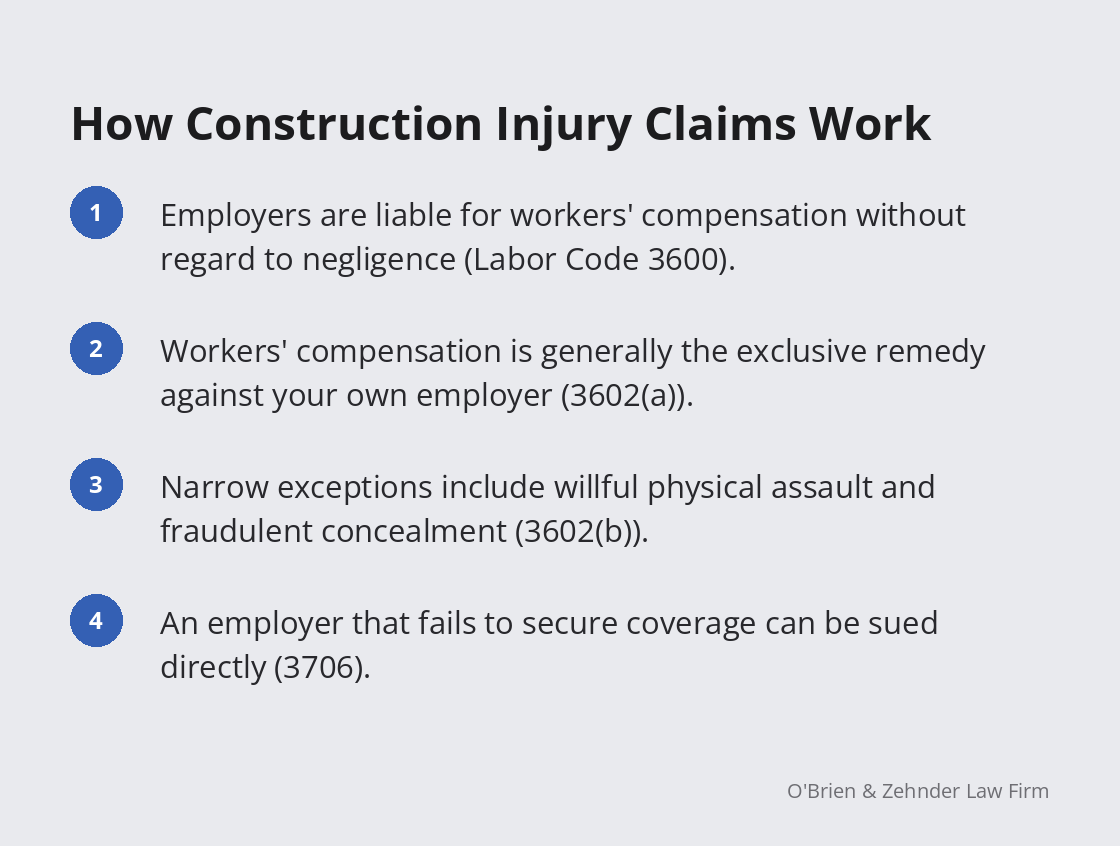
Construction injuries usually begin in the workers’ compensation system. California Labor Code section 3600 makes an employer liable for compensation, without regard to negligence, for any injury sustained by its employees arising out of and in the course of the employment, as long as the statute’s conditions of compensation are met. That no-fault structure means an injured worker generally does not have to prove that the employer did anything wrong to receive benefits. It also comes with an important tradeoff that shapes every construction case.
The Exclusive Remedy Rule
Labor Code section 3602(a) provides that where the conditions of compensation concur, the right to recover compensation is, except as specifically provided by law, the sole and exclusive remedy of the employee or his or her dependents against the employer. In plain terms, an injured worker usually cannot sue his or her own employer in civil court for a job injury. The workers’ compensation claim is the main avenue against the employer, and it provides the benefits set by the workers’ compensation laws rather than a civil claim for damages.
When an Employer Can Still Be Sued
The exclusive remedy rule has limited exceptions. Section 3602(b) allows an action at law against the employer where the injury or death is proximately caused by a willful physical assault by the employer, where the injury is aggravated by the employer’s fraudulent concealment of the existence of the injury and its connection with the employment, and where the injury is caused by a defective product manufactured by the employer and transferred to an independent third person, and the product is later provided for the employee’s use by a third person. Separately, Labor Code section 3700 requires every employer except the state to secure the payment of compensation, and section 3706 provides that if an employer fails to do so, an injured employee may bring an action at law against that employer for damages. Uninsured subcontractors are not unheard of on smaller projects, so this question deserves an early answer.
Why Construction Sites Are Different
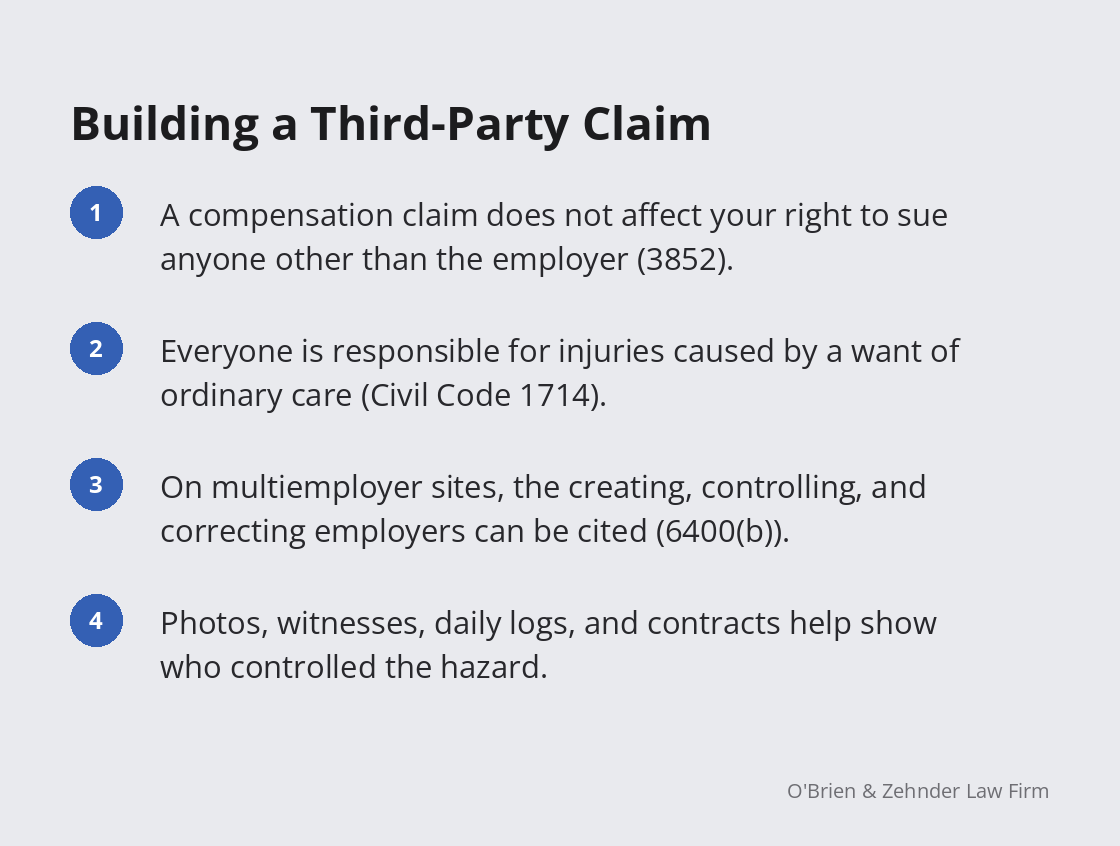
Most workplaces have one employer. A construction site may have a property owner, a general contractor, a dozen subcontractors, equipment rental companies, delivery drivers, and manufacturers whose products are in use every day. Labor Code section 6400(a) requires every employer to furnish employment and a place of employment that is safe and healthful for the employees therein. On multiemployer worksites, section 6400(b) allows citations from the state’s Division of Occupational Safety and Health, known as Cal/OSHA, to be issued not only to the employer whose workers were exposed to a hazard, but also to the employer who created the hazard, the employer responsible for safety conditions on the site, and the employer responsible for correcting it. That layered responsibility is often where a third-party claim begins.
Building a Third-Party Construction Injury Claim
Labor Code section 3852 provides that the claim of an employee for compensation does not affect the employee’s claim or right of action for all damages proximately resulting from the injury against any person other than the employer. That single sentence is the foundation of most construction injury lawsuits. Workers’ compensation handles the claim against your employer, and a separate civil claim may proceed against other parties whose negligence caused or contributed to the accident.
Identifying Who Else May Be Responsible
California’s general negligence rule appears in Civil Code section 1714(a), which provides that everyone is responsible for an injury occasioned to another by his or her want of ordinary care or skill in the management of his or her property or person. On a construction project, that can point to a general contractor that ignored fall hazards, a subcontractor whose crew left an unguarded opening, a property owner who knew about a dangerous condition, a driver who backed a truck into a work zone, or a company that designed or built defective scaffolding, lifts, or power tools. Each potential defendant has its own insurer and its own story about what happened, so careful investigation matters.
Evidence That Makes the Difference
Construction cases are won or lost on evidence that can disappear quickly. Site conditions change as work continues, damaged equipment is repaired or removed, and crews move on to other projects. Photographs of the area, the names of coworkers and other trades who saw the incident, daily logs, safety meeting records, contracts that assign safety responsibility, and any Cal/OSHA inspection file can all help show which company controlled the hazard. Medical records that connect your injuries to the incident are just as important. Requesting that relevant companies preserve evidence early can prevent arguments later about what the site looked like on the day of the accident.
How the Two Claims Interact
Workers’ compensation and a third-party lawsuit run on separate tracks, but they affect each other. Section 3852 also allows an employer that pays, or becomes obligated to pay, compensation to make a claim or bring an action against the third person. That means your employer or its insurer may have an interest in any recovery from a negligent contractor or manufacturer. Coordinating both claims from the start helps protect your recovery and avoids surprises when the cases resolve.
Deadlines and Mistakes That Weaken Construction Injury Cases
Even strong construction cases can be damaged by early missteps. Injured workers are often under pressure to return to work quickly, to downplay the injury, or to accept whatever explanation a supervisor offers. Knowing the notice rules and filing deadlines that apply to each claim is the first step toward protecting your rights.
Waiting to Report the Injury
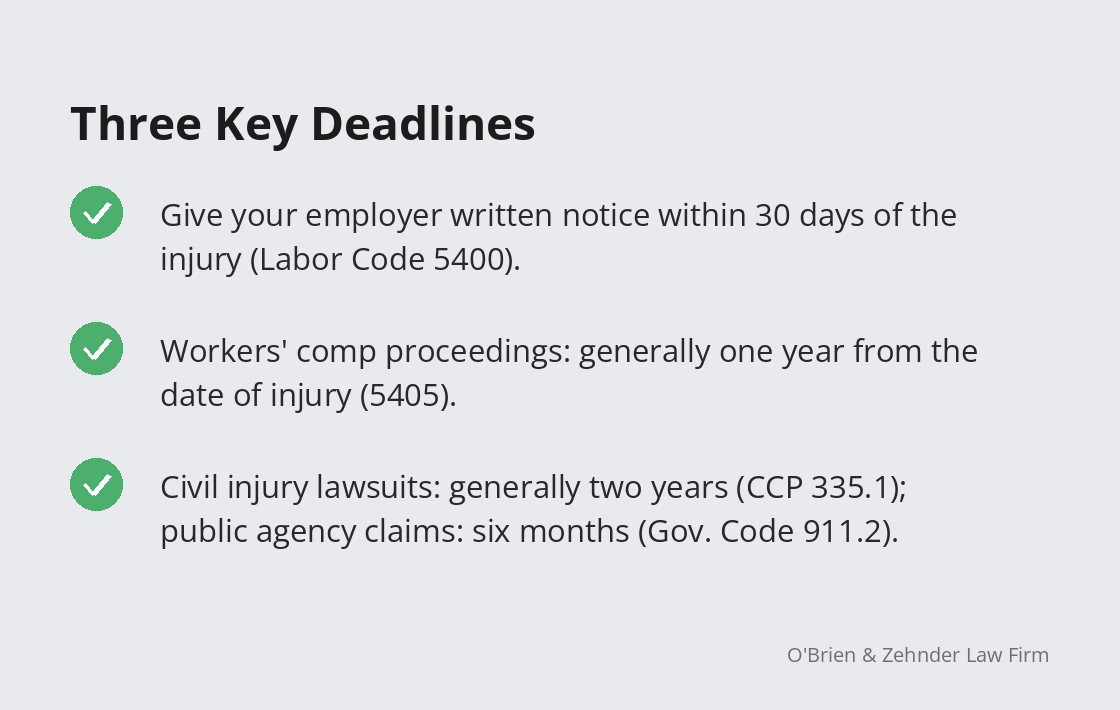
Labor Code section 5400 provides that, except as provided in other sections, no claim to recover compensation shall be maintained unless within thirty days after the occurrence of the injury, written notice is served upon the employer. Once an employer has notice or knowledge of an injury that causes lost time beyond the work shift or medical treatment beyond first aid, section 5401(a) requires the employer to provide a claim form and a notice of potential eligibility for benefits within one working day. Reporting promptly and in writing creates a clear record and starts the benefits process.
Missing the Filing Deadlines
Different claims carry different deadlines. Under Labor Code section 5405, the period to commence workers’ compensation proceedings for certain benefits is generally one year from the date of injury, with other starting points tied to when benefits were last provided, and section 5401(d) explains that filing the claim form with the employer tolls that period until the claim is denied or becomes presumptively compensable. For a civil lawsuit against a negligent third party, Code of Civil Procedure section 335.1 sets a general two-year period for an action for injury to, or for the death of, an individual caused by the wrongful act or neglect of another. If a public agency is involved, such as a city or county that owns the project or controls the roadway, Government Code section 911.2 generally requires a claim for injury to be presented not later than six months after the cause of action accrues.
Giving Statements Without Understanding Your Options
After a serious accident, adjusters for contractors, equipment companies, and insurers may ask for recorded statements. A casual remark about being in a hurry or skipping a step can be used later to shift blame. Under California’s comparative fault approach, reflected in CACI No. 405, a plaintiff’s damages are reduced by the percentage of the plaintiff’s own responsibility rather than automatically barred, but avoidable statements still create problems. It is wise to understand both claims before discussing fault with anyone outside your medical providers.
Assuming Workers’ Compensation Is the Only Option
The most damaging misunderstanding is believing that a workers’ compensation claim is the end of the road. When another contractor, property owner, driver, or manufacturer contributed to the accident, a third-party claim may seek all damages proximately resulting from the injury, as section 3852 describes, rather than only workers’ compensation benefits. Looking into every responsible party early gives you the best chance of a complete recovery.
Final Thoughts
Sacramento County construction accident claims often follow two tracks at once: a workers’ compensation claim against the employer and, when another company’s carelessness played a role, a separate civil claim against that third party. California’s exclusive remedy rule, its narrow exceptions, the multiemployer safety rules in Labor Code section 6400, and the notice and filing deadlines all shape what you can recover and when.
Reporting the injury in writing, preserving evidence from the job site, and identifying every company that controlled the hazard are the steps that protect your claim. Acting promptly keeps your options open while the facts are still fresh.
If you or someone you love was hurt on a construction site, contact O’Brien & Zehnder Law Firm to speak with our team in Sacramento County. We’ll review what happened, explain your options, and help you move forward with confidence.