
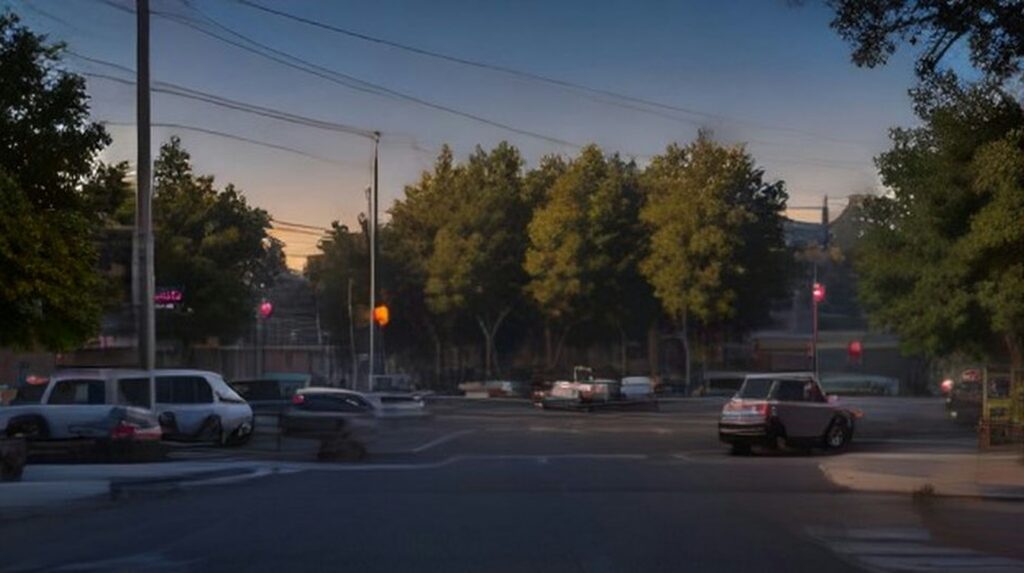
A Sacramento County T-bone accident happens when the front of one vehicle strikes the side of another, usually in the middle of an intersection or at the mouth of a driveway or parking lot. Because the side of a car offers far less protection than the front or rear, occupants on the impact side can be hurt badly even at moderate speeds. These crashes almost always raise the same question: who had the right-of-way? California’s Vehicle Code answers that question in detail, and those rules often decide who is responsible and how a claim moves forward. Understanding them early gives you real control over your claim.
At O’Brien & Zehnder Law Firm, we help people injured in intersection and side-impact collisions throughout Sacramento County hold careless drivers accountable so you can move forward with confidence. This guide explains how right-of-way actually works in a T-bone crash, how fault is decided, and the mistakes that can weaken an otherwise strong claim.
How Right-of-Way Actually Works in a Sacramento County T-Bone Accident
Most broadside collisions happen because one driver entered a space that belonged to someone else at that moment. California does not leave that question to guesswork. Chapter 4 of Division 11 of the Vehicle Code, beginning with Section 21800, sets out who must yield at intersections, at stop signs, during left turns, and when entering a road from private property. Traffic signal rules in Sections 21451 and 21453 add another layer. When a driver ignores one of these duties and a side-impact crash follows, the violated rule frequently becomes the centerpiece of the injury claim.
Traffic Signals and Red-Light Crashes
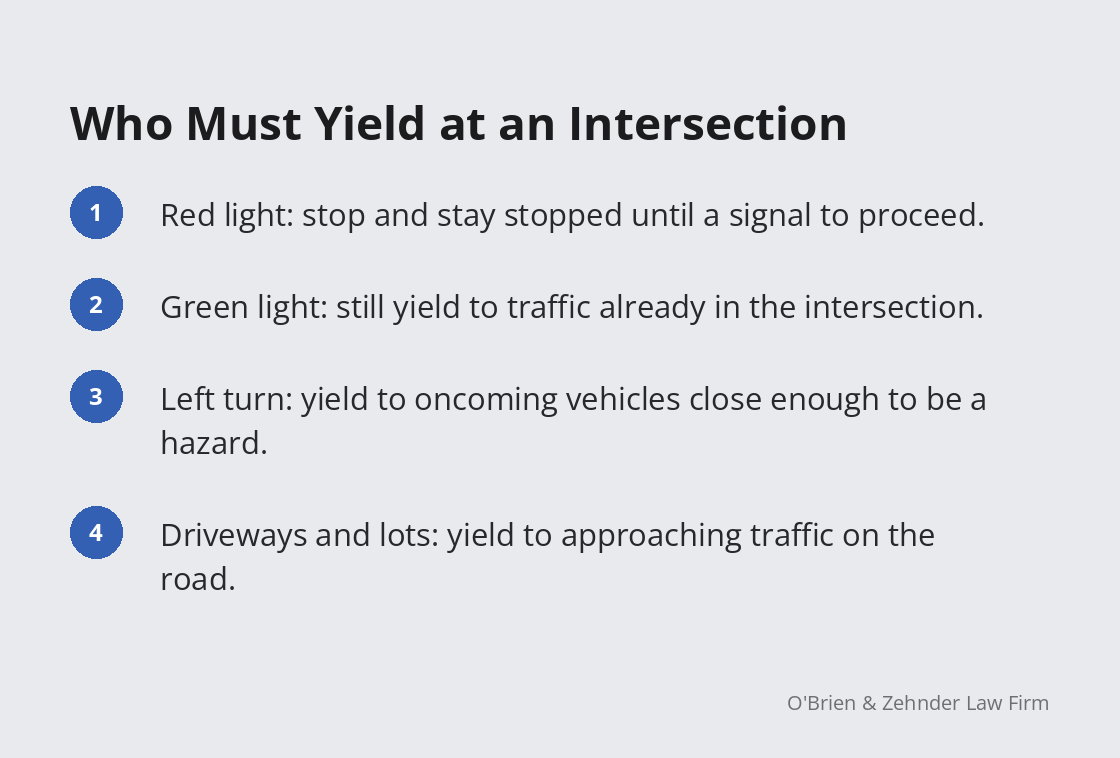
Signalized intersections produce many of the most serious T-bone collisions. Under Vehicle Code Section 21453(a), a driver facing a steady circular red signal must stop at the limit line or before the crosswalk or intersection and remain stopped until an indication to proceed is shown. A green light does not give unlimited permission either. Section 21451(a) provides that a driver facing a circular green signal, including one who is turning, must yield the right-of-way to other traffic and to pedestrians lawfully within the intersection or an adjacent crosswalk. That means a driver who rushes into an intersection the moment the light changes may still share responsibility if a vehicle was already lawfully crossing.
Left Turns Across Oncoming Traffic
Left turns are a classic source of side-impact crashes. Vehicle Code Section 21801(a) requires a driver intending to turn left or make a U-turn to yield the right-of-way to all vehicles approaching from the opposite direction which are close enough to constitute a hazard at any time during the turning movement, and to keep yielding until the turn can be made with reasonable safety. If the turning driver misjudges the gap or fails to see an oncoming car or motorcycle, the oncoming vehicle often strikes the turning car broadside. Section 21801(b) provides that once a driver has properly yielded and signaled, approaching drivers must then yield to the turning vehicle, so the timing of each car’s movement matters a great deal.
Stop Signs, Uncontrolled Intersections, and Driveways
At a two-way stop, Vehicle Code Section 21802(a) requires the driver facing the stop sign to stop and then yield to vehicles that have approached from another highway or are approaching so closely as to constitute an immediate hazard. At an intersection with no signals or signs, Section 21800(a) requires a driver approaching the intersection to yield to any vehicle that has already entered it from a different highway, and Section 21800(b) provides that when two vehicles enter at the same time, the driver on the left yields to the vehicle on the immediate right. Under Section 21800(d), a driver approaching an intersection whose signals are not working must stop and may proceed with caution when it is safe. Section 21804(a) adds that a driver entering a road from a driveway, parking lot, or alley must yield to approaching traffic close enough to constitute an immediate hazard, a common cause of side impacts near shopping centers.
How Fault Is Decided After a Sacramento County Side-Impact Collision
Once the applicable right-of-way rule is identified, the next question is how that rule translates into legal responsibility. California personal injury claims are built on negligence, and evidence that a driver broke a traffic law can be powerful. At the same time, California allows fault to be shared, and insurers routinely argue that the injured driver also could have avoided the crash. Understanding both sides of that analysis helps you anticipate how your claim will be evaluated.
When a Traffic Violation Creates a Presumption of Negligence
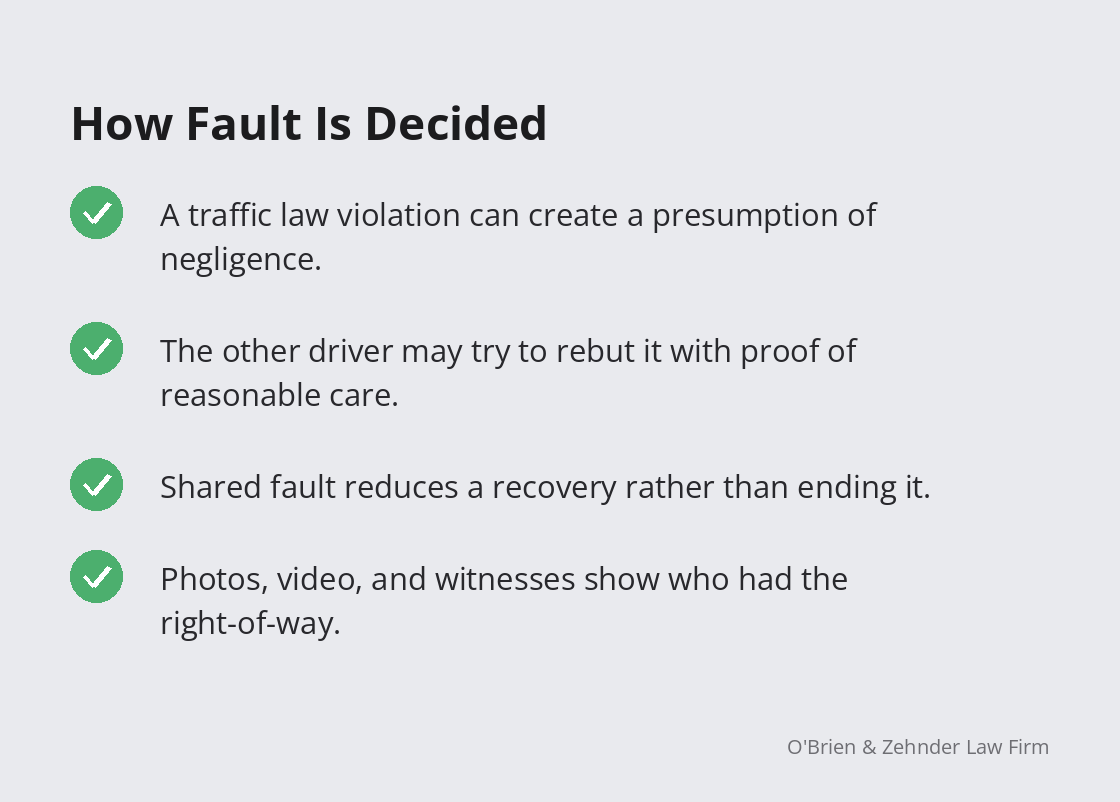
California Evidence Code Section 669 provides that a failure to exercise due care is presumed when a person violated a statute, the violation proximately caused the injury, the injury resulted from an occurrence of the kind the statute was designed to prevent, and the injured person was one of the class of persons the statute was meant to protect. Right-of-way and signal laws exist to prevent exactly the kind of crossing collisions that cause T-bone crashes, so proof that the other driver ran a red light or failed to yield on a left turn can shift the analysis significantly. The presumption can be rebutted, however, if the violating driver shows that he or she did what a person of ordinary prudence would reasonably do under similar circumstances while trying to comply with the law.
Shared Fault Between Drivers
Many intersection crashes involve some carelessness on both sides. One driver may have run a yellow light while the other was distracted or traveling too fast. California follows a comparative fault approach, reflected in CACI No. 405, under which a defendant who proves that the injured person was negligent and that this negligence was a substantial factor in causing the harm can reduce the injured person’s damages by that person’s percentage of responsibility. A share of fault reduces a recovery rather than eliminating it, which is why it is important not to assume you have no claim simply because the other side says you were partly to blame.
Evidence That Shows What Really Happened
Because T-bone crashes happen in seconds, the evidence often comes from sources other than the drivers’ own memories. Photos of where the vehicles came to rest and where each car was damaged can show the angle of impact. Traffic camera footage, dashcam video, and nearby business surveillance can confirm who had the light, although that footage may be overwritten quickly. Statements from independent witnesses, the investigating officer’s report, and vehicle event data can also help establish speed and timing. Gathering this information early protects details that are difficult to recover later.
What Weakens T-Bone Accident Claims in Sacramento County
Even a clear right-of-way violation can lead to a disappointing result if important steps are missed after the crash. Deadlines, reporting duties, and statements made too quickly are the problems that most often undercut otherwise strong side-impact claims. Knowing these pitfalls in advance lets you protect your position while you focus on recovery.
Missing Filing and Reporting Deadlines
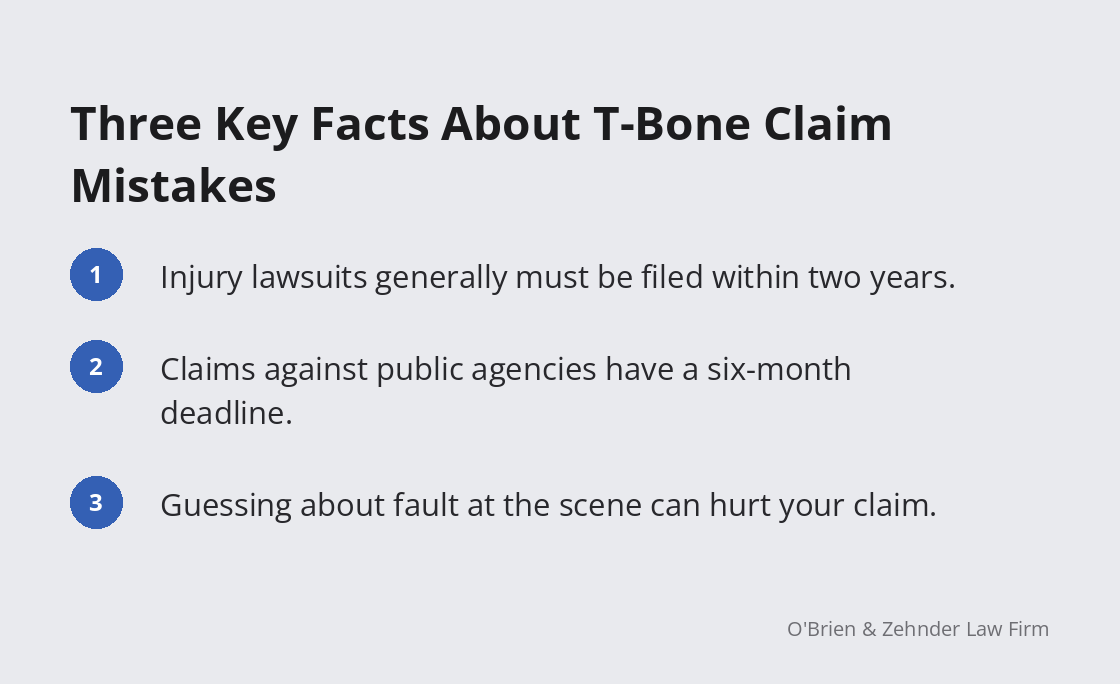
California generally gives injured people two years to file a lawsuit. Code of Civil Procedure Section 335.1 sets a two-year period for an action for injury to, or for the death of, an individual caused by the wrongful act or neglect of another. When a city, county, or other public agency may share responsibility, such as for a malfunctioning signal or a dangerous intersection design, the timeline is much shorter: Government Code Section 911.2 requires a claim for personal injury to be presented no later than six months after the cause of action accrues. Our guide to Sacramento County government claims explains that process. Separately, Vehicle Code Section 16000 requires a driver involved in a crash that results in bodily injury or death to report it to the DMV within 10 days.
Admitting Fault or Guessing at the Scene
People involved in a sudden crash often apologize or speculate about what happened before they know the facts. A driver who says “I never saw you” may simply be in shock, and a driver who says “I thought I had the green” may not have seen the signal change. Statements like these are frequently repeated to insurers later. It is better to exchange information, cooperate with officers, describe only what you know, and avoid guessing about speed, timing, or signal color until the evidence is reviewed.
Delaying Medical Care
Side-impact crashes can cause injuries to the neck, back, head, shoulders, and hips that are not fully apparent right away. Waiting to see a doctor can harm your health, and it also gives an insurer room to argue that your symptoms came from something other than the crash. Prompt evaluation, consistent follow-up care, and keeping records of every appointment create a clear connection between the collision and your injuries.
Final Thoughts
A Sacramento County T-bone accident claim usually turns on the right-of-way rules in the Vehicle Code, from red-light and green-light duties under Sections 21453 and 21451 to the left-turn, stop sign, and driveway rules in Sections 21801, 21802, and 21804. A traffic violation can create a presumption of negligence under Evidence Code Section 669, while shared fault reduces rather than ends a recovery. You can learn more on our page about car accident claims.
Focus on your recovery first, but keep your medical records, photos, and notes about the crash in one place. Those details often make the difference in showing who really had the right-of-way.
If you were hurt in a side-impact collision in Sacramento County, contact O’Brien & Zehnder Law Firm to speak with our team. We will review your situation, explain your rights under California law, and help you take the next step with confidence.