
A Sacramento County pedestrian accident can turn an ordinary walk to work, school, or a light rail stop into a life-changing event in a matter of seconds. People on foot have no protection against the weight and speed of a car, so even a low-speed collision in a parking lot or crosswalk can cause serious injuries. California law gives pedestrians important rights and places clear duties on drivers, and those rules often decide who is responsible after a crash. Understanding them gives you real control over your claim from the very beginning.
At O’Brien & Zehnder Law Firm, we help people injured as pedestrians throughout Sacramento County hold careless drivers accountable so you can move forward with confidence. This guide explains how pedestrian right-of-way actually works in California, what happens when someone crosses outside a crosswalk, and how a strong pedestrian accident claim is built.
How Pedestrian Right-of-Way Actually Works in California
Most pedestrian claims begin with a simple question: who had the right-of-way? California’s Vehicle Code answers that question with a set of rules that apply in Sacramento, Rancho Cordova, Citrus Heights, Folsom, and every other community in the county. When a driver breaks one of these rules and hits someone on foot, the violation can become key evidence of fault.
Marked and Unmarked Crosswalks
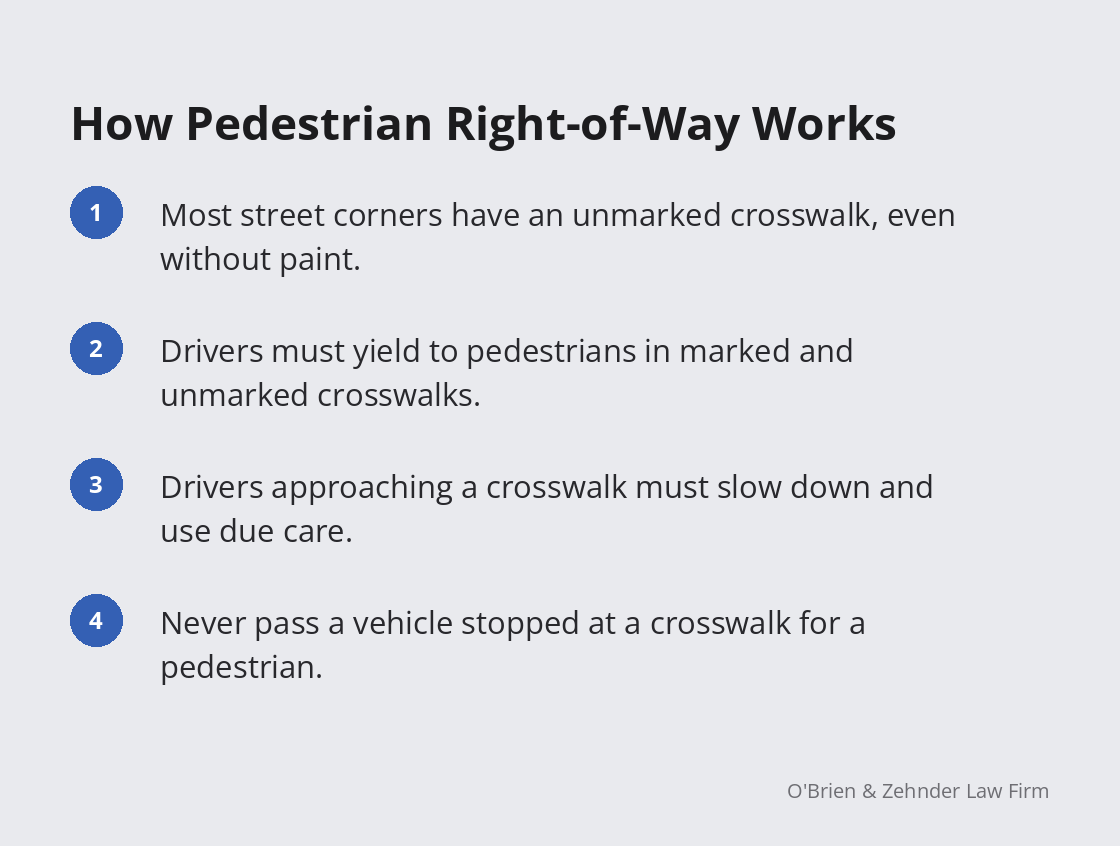
Many people are surprised to learn that a crosswalk does not need painted lines. Vehicle Code Section 275 defines a crosswalk as either the portion of a roadway included within the prolongation or connection of the boundary lines of sidewalks at intersections where the intersecting roadways meet at approximately right angles, or any portion of a roadway distinctly indicated for pedestrian crossing by lines or other markings on the surface. In other words, most ordinary street corners have an unmarked crosswalk even without paint, unless local authorities have placed signs indicating no crossing.
The Driver’s Duty to Yield and Slow Down
Vehicle Code Section 21950 provides that the driver of a vehicle shall yield the right-of-way to a pedestrian crossing the roadway within any marked crosswalk or within any unmarked crosswalk at an intersection, except as otherwise provided in that chapter. The same section requires a driver approaching a pedestrian within a crosswalk to exercise all due care and to reduce speed or take any other action necessary to safeguard the pedestrian. A driver who rolls through a right turn on red while looking only for cars, or who speeds up to beat someone stepping off the curb, may be violating this law.
Passing a Car Stopped at a Crosswalk
Some of the most dangerous pedestrian crashes happen on multilane roads such as Stockton Boulevard, Florin Road, or Fair Oaks Boulevard, when one driver stops for a pedestrian and another driver in the next lane keeps going. Vehicle Code Section 21951 addresses this directly. It provides that whenever a vehicle has stopped at a marked crosswalk or at an unmarked crosswalk at an intersection to permit a pedestrian to cross, the driver of any other vehicle approaching from the rear shall not overtake and pass the stopped vehicle.
When a Pedestrian Crosses Outside a Crosswalk
Insurance companies often focus on whether the injured person was in a crosswalk. Crossing outside a crosswalk can affect a claim, but it does not automatically end it. California law places duties on both pedestrians and drivers, and the details of each situation matter.
The Pedestrian’s Duty of Care
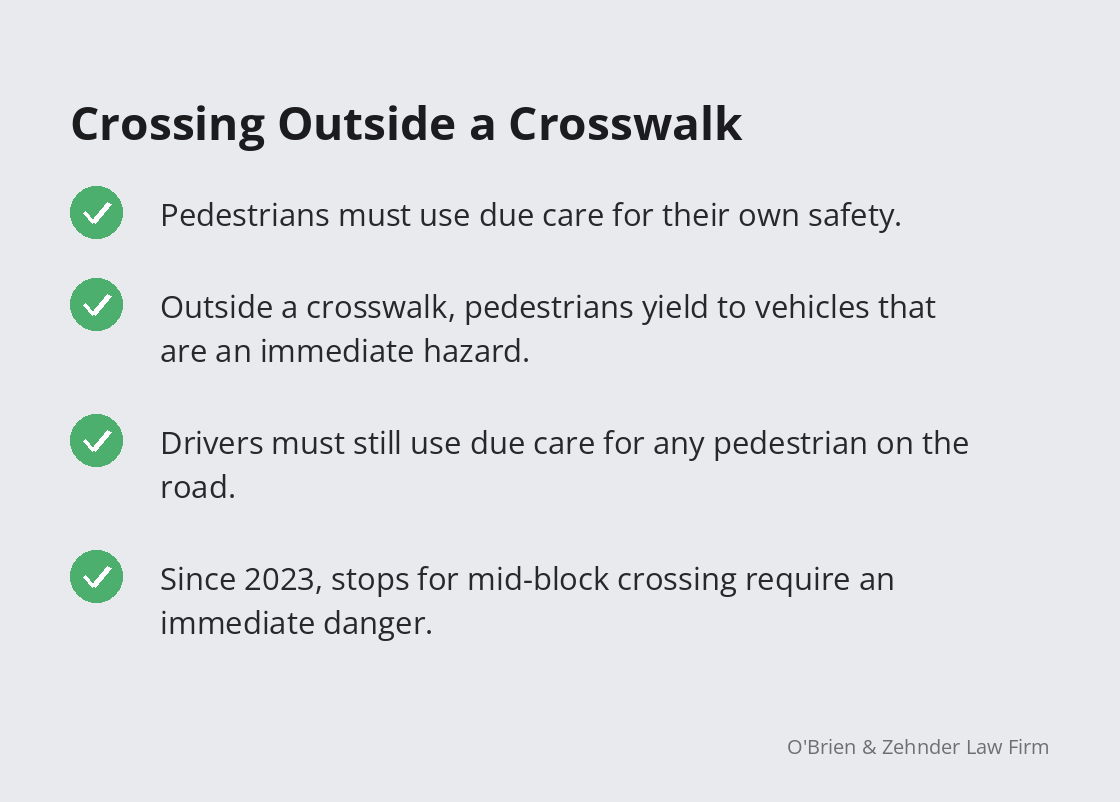
Pedestrians have responsibilities too. Vehicle Code Section 21950 provides that it does not relieve a pedestrian from the duty of using due care for their safety, and that no pedestrian may suddenly leave a curb or other place of safety and walk or run into the path of a vehicle that is so close as to constitute an immediate hazard. Vehicle Code Section 21954 provides that a pedestrian on a roadway outside a marked or unmarked crosswalk shall yield the right-of-way to vehicles so near as to constitute an immediate hazard.
Drivers Must Still Use Due Care
Even when a pedestrian is outside a crosswalk, drivers are not free to ignore them. Section 21954 states that its provisions shall not relieve the driver of a vehicle from the duty to exercise due care for the safety of any pedestrian upon a roadway. A driver who was speeding, distracted by a phone, or not watching the road may still be responsible for hitting someone who was crossing mid-block. Under Civil Code Section 1714, everyone is responsible for an injury caused to another by a lack of ordinary care in the management of their property or person.
The 2023 Update to Crossing Rules
California updated its pedestrian laws through Assembly Bill 2147, effective January 1, 2023. Vehicle Code Section 21955 still provides that between adjacent intersections controlled by traffic signals or police officers, pedestrians shall not cross the roadway except in a crosswalk. However, the updated law provides that a peace officer shall not stop a pedestrian for that violation unless a reasonably careful person would realize there is an immediate danger of a collision with a moving vehicle. The law also states that this change does not relieve a driver of the duty of exercising due care for the safety of any pedestrian within the roadway.
Building a Sacramento County Pedestrian Accident Claim
Once you understand the rules, the next step is proving what happened. Strong pedestrian claims are built on evidence gathered quickly, a clear understanding of how fault is shared, and careful attention to deadlines.
Evidence That Shows What Happened
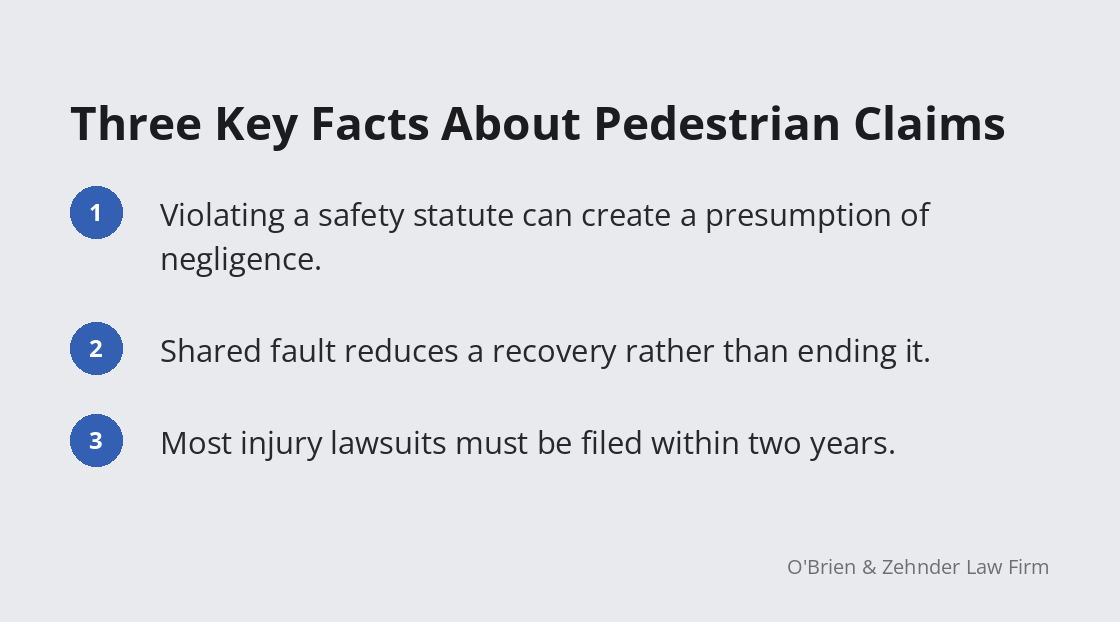
Helpful evidence includes photos of the crosswalk, signals, and lighting, the location of the vehicle after the crash, and any visible injuries. Witness names and contact information, video from nearby homes, businesses, buses, or traffic cameras, and the official collision report can all help show where you were and what the driver was doing. Under Evidence Code Section 669, a failure to exercise due care is presumed when a person violates a safety statute, the violation causes the kind of injury the statute was designed to prevent, and the injured person is among those it was meant to protect. Evidence that a driver failed to yield under Section 21950 can be a powerful part of your claim.
When the Driver Leaves the Scene
Some drivers panic and leave after hitting a person on foot, but the law is clear. Vehicle Code Section 20001 requires the driver of a vehicle involved in an accident resulting in injury to a person, other than the driver, or in the death of a person to immediately stop the vehicle at the scene and fulfill the duties set out in the related sections of the code. If a driver flees, report the crash to law enforcement right away and write down anything you remember about the vehicle, the direction it went, and anyone who saw it.
How Shared Fault Is Handled
If the insurance company argues that you were partly to blame, California’s comparative fault rule applies. Under the Judicial Council’s civil jury instruction CACI No. 405, if a defendant proves that the injured person was negligent and that the negligence was a substantial factor in causing the harm, the injured person’s damages are reduced by the percentage of that person’s responsibility. A share of fault reduces a recovery rather than eliminating it.
Deadlines That Protect Your Claim
Under Code of Civil Procedure Section 335.1, an action for injury to an individual caused by the wrongful act or neglect of another generally must be filed within two years. If a city or county vehicle was involved, or a dangerous public crosswalk or sidewalk contributed to the crash, Government Code Section 911.2 requires a written claim to be presented to the public entity not later than six months after the claim accrues. Acting early protects your options.
Final Thoughts
A Sacramento County pedestrian accident claim often turns on the rules of the road. California requires drivers to yield to pedestrians in marked and unmarked crosswalks, to slow down and use due care, and never to pass a car stopped for someone crossing. Pedestrians must also use care, but crossing outside a crosswalk does not excuse a careless driver, and a share of fault reduces rather than ends a recovery. You can learn more on our page about pedestrian accident claims.
Focus on your recovery first, but keep your medical records, photos, and notes about the crash in one place. Those details often make the difference in showing what really happened.
If you were hit by a car while walking in Sacramento County, contact O’Brien & Zehnder Law Firm to speak with our team. We will review your situation, explain your rights under California law, and help you take the next step with confidence.