

Sacramento County spinal cord injury claims involve some of the most life-changing harms a person can suffer after a crash, fall, or other accident caused by someone else’s carelessness. A spinal cord injury can affect how you move, what you can feel, and how your body functions, and those effects may last for months, years, or a lifetime. Building a strong claim means documenting not only what happened on the day of the accident, but also how the injury will shape your health, work, and daily life going forward. Understanding how these claims work helps you protect your rights while you focus on recovery.
At O’Brien & Zehnder Law Firm, we help injured people and their families throughout Sacramento County pursue full accountability after serious injuries, so you can move forward with confidence. This guide walks you through what makes spinal cord injury claims different, how these cases are built and proven under California law, and the mistakes that can weaken a claim when so much is at stake.
What Makes Spinal Cord Injury Claims Different
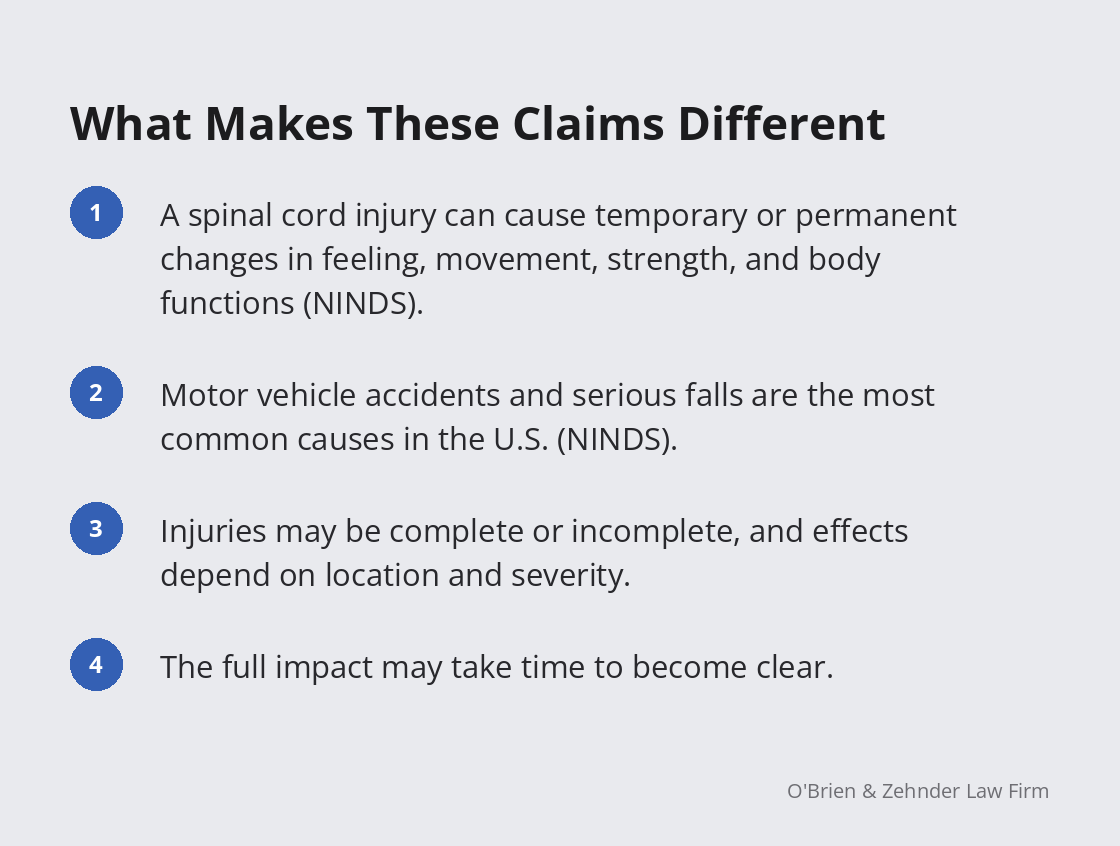
A spinal cord injury is not like most other injuries in a personal injury case. The National Institute of Neurological Disorders and Stroke explains that a spinal cord injury is damage to the bundle of nerves and nerve fibers that sends and receives signals from the brain, and that this damage can cause temporary or permanent changes in feeling, movement, strength, and body functions below the point of injury. Because the effects depend on where the injury occurs and how much damage there is, two people injured in similar accidents can face very different futures. A claim has to capture that individual picture.
Common Causes in Sacramento County
According to the National Institute of Neurological Disorders and Stroke, motor vehicle accidents and serious falls are the most common causes of spinal cord injury in the United States. In Sacramento County, that can mean a collision on a busy freeway or a rural road, a rear-end crash at a stoplight, a pedestrian or bicycle collision, or a fall on a poorly maintained property. When another driver, property owner, or business failed to act with reasonable care, the injured person may have a claim against the party responsible.
Complete and Incomplete Injuries
Medical providers often describe spinal cord injuries as complete or incomplete. NINDS explains that with an incomplete injury, the spinal cord can still send some messages to or from the brain, so the person keeps some feeling, function, and muscle control below the injury site, while a complete injury means there is no nerve communication below the injury site. NINDS also notes that injuries higher on the spinal cord affect more of the body than injuries lower down. These distinctions matter in a claim because they shape treatment, rehabilitation, and the long-term care a person may need.
Why the Full Picture Takes Time
The full impact of a spinal cord injury is not always clear right away. NINDS notes that paralysis can happen immediately or develop over time from bleeding and swelling in the spinal cord, and that rehabilitation programs combine physical therapies with skill-building activities and counseling. Because recovery can unfold over a long period, resolving a claim too quickly can leave future needs out of the picture. Careful tracking of medical care, therapy, and changes in daily function helps make sure the claim reflects the injury as it truly is.
How Spinal Cord Injury Claims Are Built and Proven
Most spinal cord injury claims in Sacramento County are negligence claims. The injured person must show that another party acted carelessly and that this conduct was a substantial factor in causing the injury. Proving that connection, and showing the full extent of the harm, requires evidence gathered early and organized carefully.
Establishing Fault
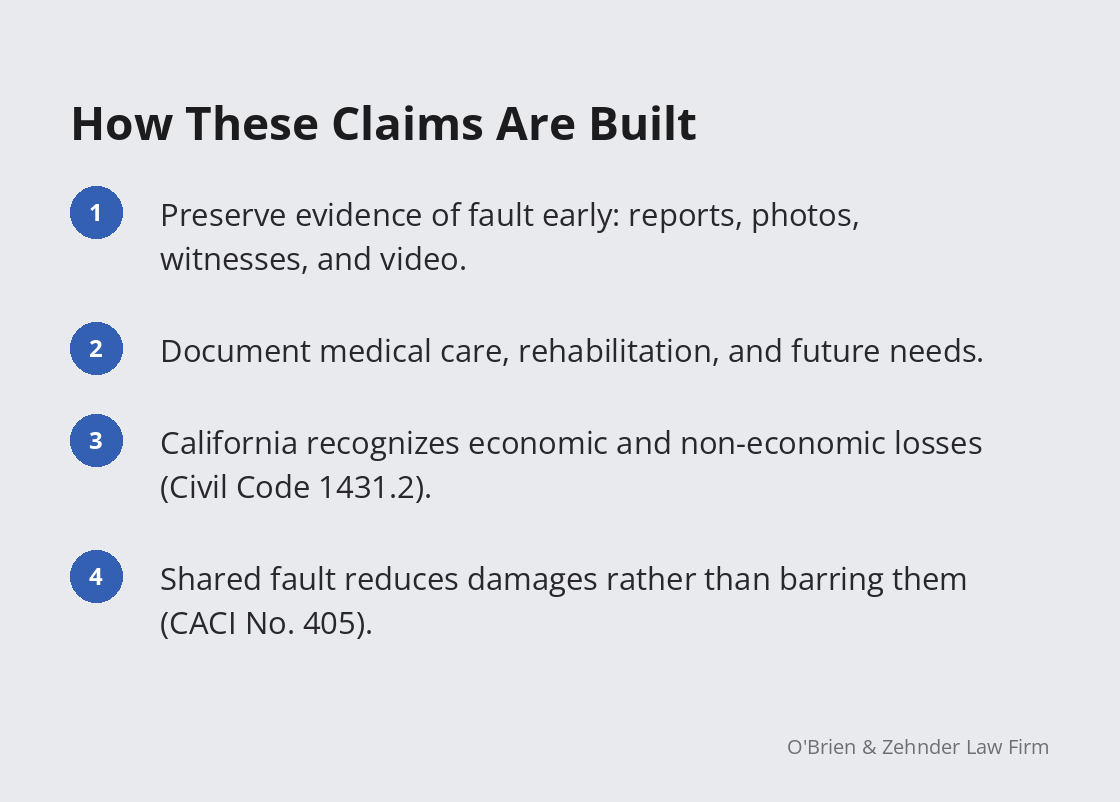
Evidence of fault depends on how the injury happened. In a vehicle collision, it can include the police report, photographs of the scene and vehicles, witness statements, and video from nearby cameras. In a fall on someone else’s property, it can include photographs of the hazard, incident reports, and records showing how long the dangerous condition existed. Preserving this evidence quickly is important, because scenes are repaired, vehicles are moved, and video recordings can be overwritten. Identifying every party who may share responsibility also matters. A crash may involve more than one driver, a vehicle owner, or a business whose employee was on the job, and a fall may involve both a property owner and a company hired to maintain the property. Looking at the whole chain of events early helps make sure no responsible party is overlooked.
Documenting Medical Care and Future Needs
Medical records are the backbone of a spinal cord injury claim. Emergency treatment notes, imaging results, surgical records, rehabilitation reports, and statements from treating providers all help show the nature of the injury and how it affects the person’s life. Because spinal cord injuries can require ongoing therapy, adaptive equipment, home modifications, and personal care, opinions from treating doctors and other qualified professionals about future needs often play a central role. Keeping a personal journal of symptoms, limitations, and missed activities can add an important human perspective to the medical records.
The Types of Losses a Claim Can Address
California law recognizes different categories of harm. Civil Code Section 1431.2 describes economic damages as objectively verifiable monetary losses, including medical expenses and loss of earnings, along with loss of employment and loss of business or employment opportunities. The same section describes non-economic damages as subjective, non-monetary losses, including pain, suffering, inconvenience, mental suffering, emotional distress, and loss of consortium. A spinal cord injury claim often involves both categories, because the injury can affect a person’s ability to work as well as their independence, relationships, and quality of life.
How Shared Fault Is Handled
Insurance companies sometimes argue that the injured person was partly to blame. California follows a comparative fault approach. Under the Judicial Council’s civil jury instruction CACI No. 405, if the defense proves the injured person was negligent and that this negligence was a substantial factor in causing the harm, the person’s damages are reduced by their percentage of responsibility rather than eliminated. In cases with more than one at-fault party, Civil Code Section 1431.2 provides that each defendant’s liability for non-economic damages is several only and is allocated in direct proportion to that defendant’s percentage of fault.
Mistakes That Can Weaken a Spinal Cord Injury Claim
Because the stakes are so high, small missteps early in a spinal cord injury case can have a lasting effect. The most common problems involve deadlines, incomplete documentation, and communications with insurance companies.
Missing Filing Deadlines
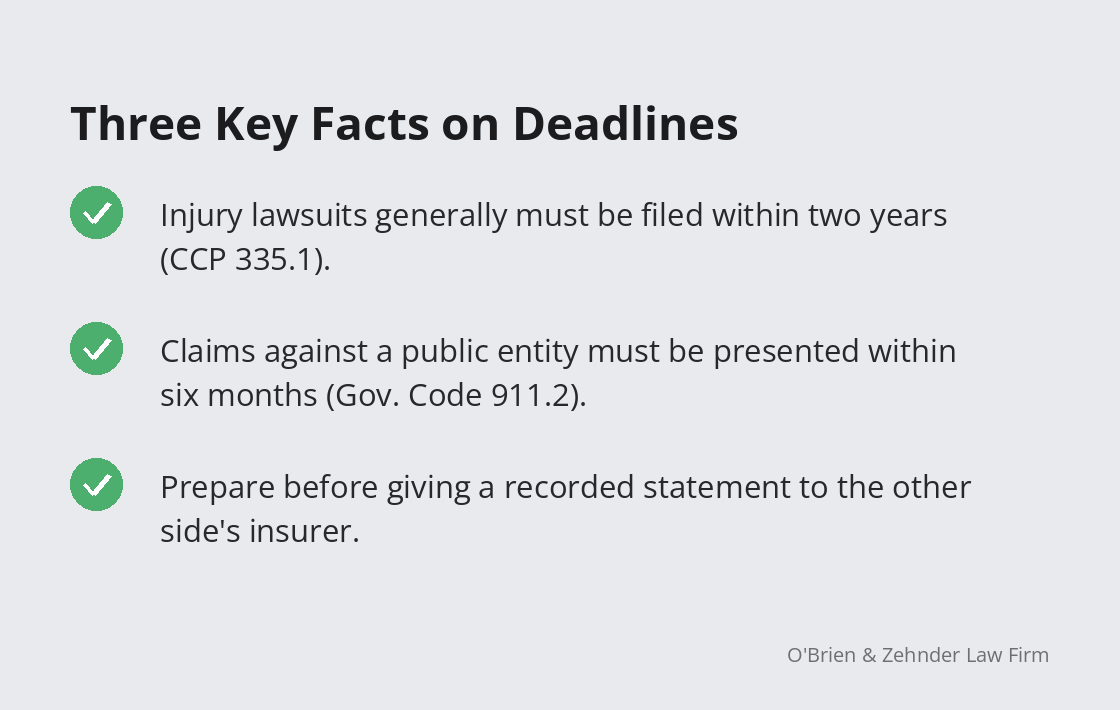
California sets firm deadlines for injury claims. Code of Civil Procedure Section 335.1 provides a two-year period to file an action for injury to an individual caused by the wrongful act or neglect of another. When a public entity may be responsible, such as a city, county, or transit agency, the timeline is much shorter at the start. Government Code Section 911.2 requires a claim for injury to a person to be presented not later than six months after the cause of action accrues. For a person under the age of majority or lacking the legal capacity to make decisions, Code of Civil Procedure Section 352 can pause the general deadline, but that rule does not apply to claims that must be presented to a public entity under the Government Claims Act.
Underestimating Long-Term Needs
A spinal cord injury can change over time, and the care a person needs today may look very different a few years from now. Accepting an early offer before the long-term picture is clear can leave important needs unaddressed. Waiting for a clearer medical picture, and gathering opinions about future care and work capacity, helps make sure the claim reflects the full effect of the injury. It also helps to think beyond medical treatment. A spinal cord injury may affect the kind of work a person can do, the need for help with household tasks, transportation, and the layout of a home. Each of these practical changes belongs in the record so the claim tells the complete story of how life has changed.
Giving Statements Without Preparation
Insurance adjusters may contact an injured person soon after an accident and ask for a recorded statement. Comments made while you are in pain, on medication, or still learning about your diagnosis can be taken out of context later. It is usually wise to understand your rights and the facts of your case before giving a detailed statement to the other side’s insurer, and to keep your own records of every conversation.
Final Thoughts
Sacramento County spinal cord injury claims require careful attention to medical evidence, long-term needs, and California’s deadlines. A spinal cord injury can affect movement, sensation, and body functions in ways that change over time, and a strong claim documents both the cause of the injury and its full effect on your life. California’s comparative fault rules, the two-year general deadline, and the much shorter six-month claim period for public entities all shape how these cases move forward.
You and your family deserve time to focus on treatment and recovery. Having a team handle the evidence, the insurance companies, and the deadlines can relieve some of that burden while protecting your ability to pursue full accountability.
If you or a loved one suffered a spinal cord injury in an accident caused by someone else, contact O’Brien & Zehnder Law Firm to speak with our team in Sacramento County. We will review what happened, explain your options, and help you take the next step with confidence.