

A heavy truck accident can change your life in seconds. The sheer size and weight of commercial vehicles mean injuries are often severe and recovery costs mount quickly.
We at O’Brien & Zehnder Law Firm help Sacramento heavy truck accident victims understand their rights and fight for fair compensation. This guide walks you through liability, damages, and the legal process ahead.
Why Truck Weight and Regulations Matter for Your Claim
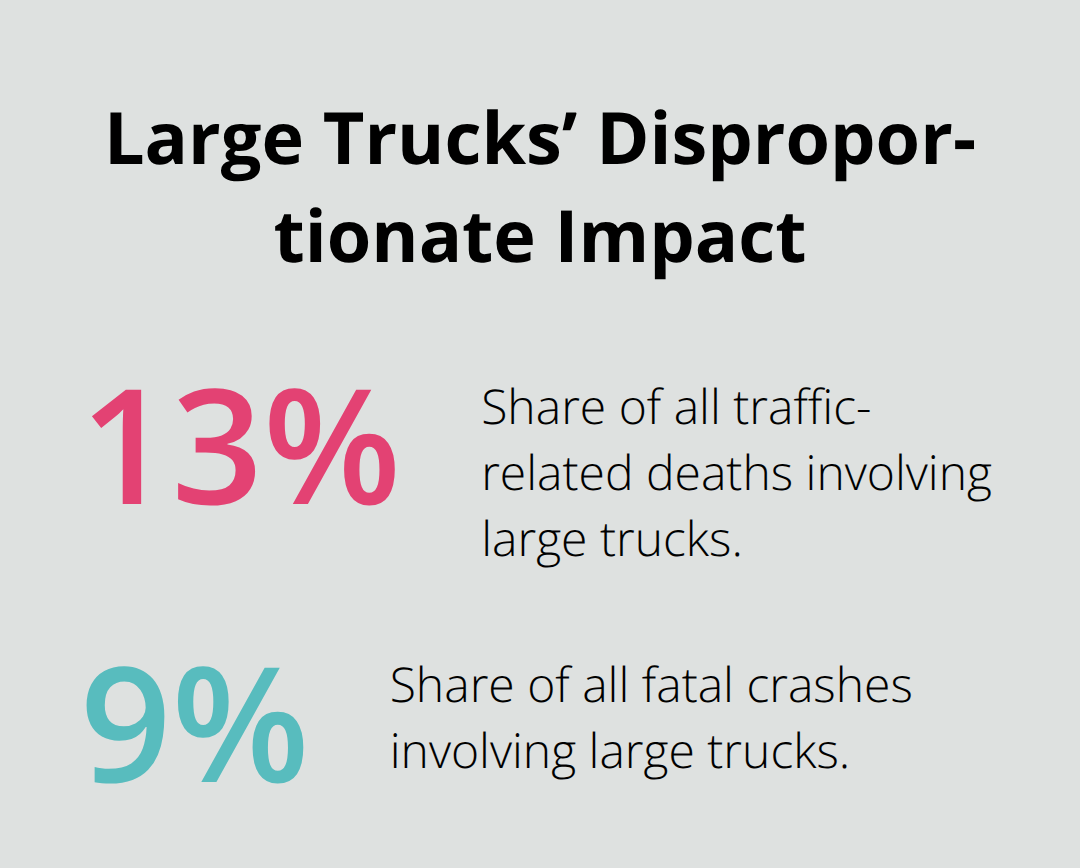
A fully loaded tractor-trailer weighs up to 80,000 pounds and stretches 75 feet long. When that mass collides with a passenger vehicle, the physics are brutal. The National Highway Traffic Safety Administration reported nearly 5,500 fatalities and over 150,000 injuries from crashes involving large trucks in 2025. What makes this worse is the disproportionate severity: large trucks account for roughly 13% to 13.5% of all traffic-related deaths despite representing only about 9% of fatal crashes. This gap exists because truck operators face minimal impact forces compared to occupants of smaller vehicles, who absorb the full energy of the collision.
A person in a sedan hit broadside by a semi has almost no protection.
Federal Rules Create Accountability Points
The Federal Motor Carrier Safety Administration enforces strict regulations that directly affect liability in truck accidents. Drivers can legally operate up to 11 hours per day, yet many log 70 or more hours within an eight-day window. Over-the-road drivers average 125,000 miles annually and spend up to 300 days on the road. These grueling schedules contribute to driver fatigue, which accounts for roughly 30% of truck accidents annually. When a crash occurs, your attorney must examine electronic logging devices and driver logs to prove hours-of-service violations. A driver operating beyond legal limits strengthens your case considerably. Violations demonstrate negligence at the company level, not just the individual driver.
Federal regulations also mandate vehicle maintenance standards and cargo-loading procedures. If records show a trucking company ignored these requirements, that negligence becomes admissible evidence of liability. Sacramento operates on major corridors like I-5 and Highway 99, where high traffic volumes increase collision likelihood. The Highway 50 and 80 interchange creates congestion hotspots that amplify crash risk, especially during peak evening commute hours when fatigued drivers navigate heavy traffic.
Multiple Parties Share Responsibility
Your instinct might be to hold the truck driver accountable, but that approach leaves money on the table. The driver, the trucking company, the cargo-loading company, the vehicle manufacturer, and the maintenance provider can all bear liability. A driver classified as an independent contractor may carry their own insurance with lower coverage limits, while the trucking company claims they bear no responsibility. That misclassification attempt fails under California law if the company exercised control over the driver’s work. Employment agreements, dispatch records, and compensation structures reveal these liability-shifting tactics. Defective truck parts also create manufacturer liability. Brake failure, tire blowouts, and design flaws (independent of driver conduct) can cause crashes. A thorough investigation identifies which defendant bears responsibility and reaches all available insurance policies and assets.
What Injuries and Damages Follow a Heavy Truck Collision
Truck crashes inflict injuries that ordinary car accidents rarely produce. Traumatic brain injuries, spinal cord damage, crushed bones, internal organ trauma, severe burns, and amputations dominate heavy truck injury patterns. These are not theoretical concerns-they define the medical reality for Sacramento victims. A person trapped in a crushed sedan after impact with an 80,000-pound rig faces permanent disability, not a quick recovery. The 2025 NHTSA data showing over 150,000 injuries from large truck crashes reflects the scale of this problem across America, and Sacramento’s rising commercial vehicle traffic means local collision rates continue climbing. Economic recovery becomes impossible without understanding exactly what compensation categories apply to your situation and how to calculate lifetime costs accurately.
Spinal Cord Injuries and Lifetime Medical Expenses
A spinal cord injury from truck impact costs between 1.3 million and 4.7 million dollars over a lifetime, according to research from the Model Systems Knowledge Translation Center. That figure includes immediate hospitalization, emergency surgery, rehabilitation, and ongoing care-but the real financial burden appears years later through assistive devices, home modifications, around-the-clock nursing, and persistent medical treatment. A person paralyzed at age 35 faces 50 years of expenses that compound with inflation and advancing care needs. Lost wages multiply this damage when the victim can no longer work. An accountant earning 75,000 dollars annually who suffers permanent disability loses not just current income but future raises, promotions, and retirement contributions.
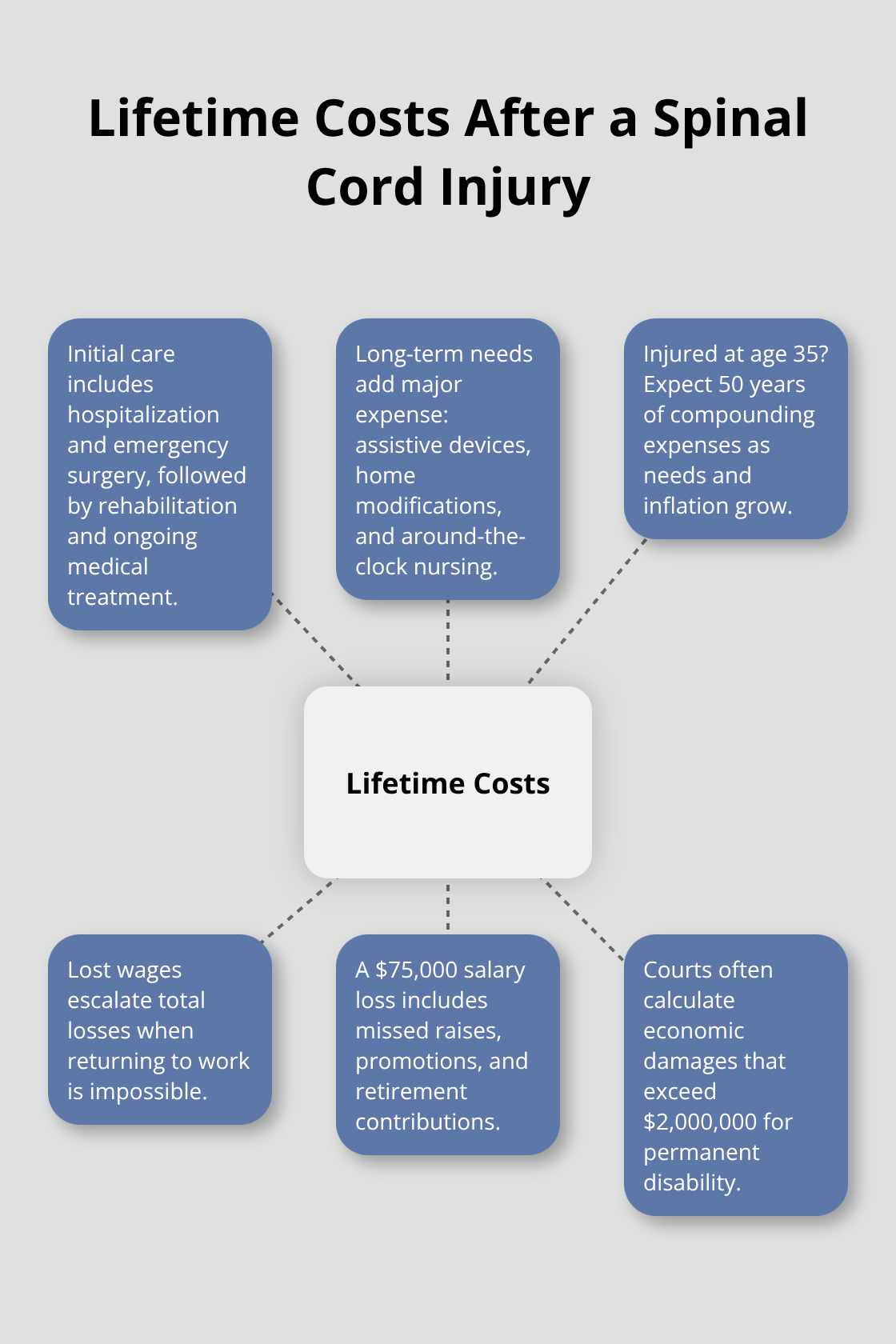
Courts in California calculate these losses from the injury date through normal retirement age, often producing economic damages exceeding 2 million dollars alone.
Pain, Suffering, and Loss of Life Quality
Non-economic damages-pain, suffering, loss of consortium, reduced quality of life-frequently match or exceed economic figures in catastrophic cases. Sacramento juries have awarded verdicts reflecting this reality; a 34.9 million dollar verdict for paralysis and a 24.3 million dollar verdict for a child run over by commercial vehicle demonstrate how courts value permanent disability when evidence proves liability clearly. These awards recognize that a paralyzed person cannot walk, work, or enjoy activities they once loved. The psychological toll of permanent injury-depression, anxiety, post-traumatic stress-compounds physical suffering and justifies substantial non-economic awards.
Building Your Damage Documentation Strategy
Insurance companies deny or minimize claims by challenging medical necessity and causation. They hire their own doctors to dispute treatment recommendations and argue pre-existing conditions caused injuries rather than the crash. Countering this requires detailed medical records showing the injury occurred at impact, not before. Photographs from the hospital documenting visible trauma, imaging studies proving fresh fractures or organ damage, and surgeon notes explaining why specific procedures were necessary all matter. Life-care planners project future medical needs based on your specific injury and calculate lifetime care costs with precision. A detailed life-care plan showing 3.2 million dollars in future medical costs carries far more weight than a general statement that you will need ongoing treatment. The difference between accepting an insurer’s initial offer and presenting documented evidence often reaches hundreds of thousands of dollars.
Expert Medical Review Strengthens Your Position
Medical experts review your records and prepare reports linking each treatment to the collision. This documentation transforms vague damage claims into concrete numbers that insurers cannot easily dispute. Experts in life-care planning, vocational rehabilitation, and medical specialties specific to your injury all contribute to a comprehensive damage picture. When you work with a personal injury firm experienced in truck accident claims, that team coordinates with these specialists to build an airtight case. The coordination between legal strategy and expert testimony determines whether you recover full compensation or settle for far less than your injuries warrant.
Your documented damages now form the foundation for negotiating with insurance companies and, if necessary, presenting your case to a jury. Understanding what you can recover sets realistic expectations and prevents you from accepting inadequate settlement offers.
Fighting Back Against Insurance Company Tactics
Trucking companies and their insurers deploy sophisticated strategies to minimize what you recover, and understanding these tactics prevents you from accepting lowball offers. The insurance adjuster assigned to your claim works for the trucking company, not for you, regardless of how friendly they sound during initial conversations. Their job is to pay as little as possible, which means they will challenge your medical treatment, question whether injuries came from the crash, and dispute your lost wage calculations. A major trucking carrier handles dozens of claims monthly and has refined processes to pressure victims into quick settlements before evidence fully develops. They know most people cannot afford extended medical treatment or lost income while waiting for resolution, so they exploit financial desperation. The Federal Motor Carrier Safety Administration data shows large trucks cause disproportionate injury severity, yet insurers routinely argue that your specific injuries resulted from pre-existing conditions rather than impact forces. This is where immediate evidence collection becomes your strongest defense against these denial tactics.
Preserve Evidence Before It Disappears
The first 48 hours after a crash determine whether critical evidence survives. Electronic Logging Devices record the truck driver’s hours, speed, and braking patterns up to the moment of impact, but trucking companies can legally delete this data after a short retention period. Request preservation of all ELD data, Event Data Recorder information from the truck, and driver logs immediately through your attorney, not through the insurance company. Photographs of vehicle damage, road conditions, skid marks, and traffic signals must be captured before cleanup crews arrive. Witness statements collected while memories are fresh carry far more weight than statements gathered weeks later when details fade.
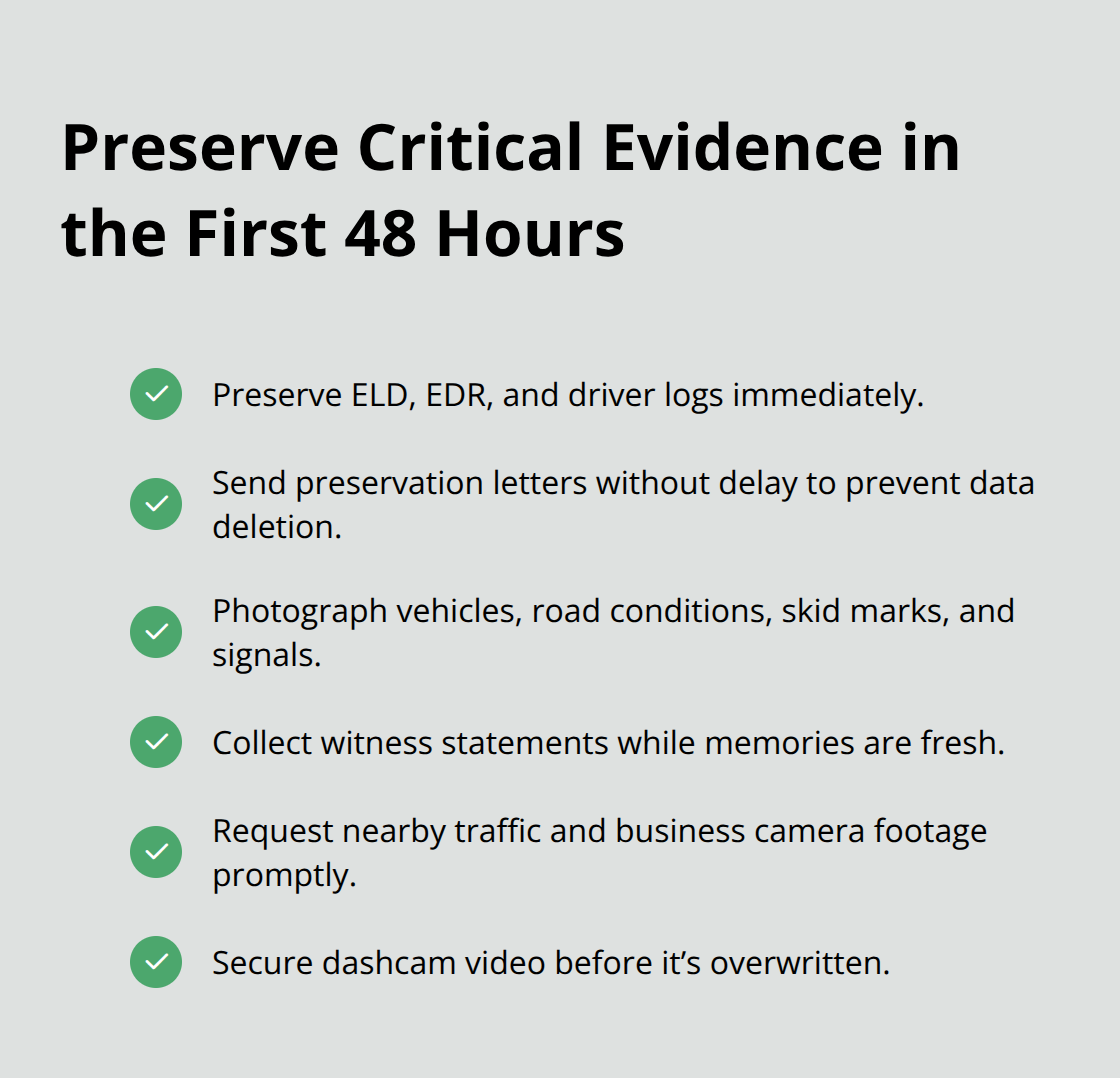
Traffic camera footage from nearby intersections or businesses often captures the crash sequence, but this footage may be recorded over within days if you do not request it be preserved. An experienced attorney recognizes settlement tactics and understands which evidence sources exist in your specific location, moving quickly to secure them before they vanish. The difference between having dashboard camera footage and losing it can mean the difference between proving the truck driver ran a red light and having no proof of liability.
Build Your Medical Timeline With Precision
Insurance companies attack the connection between your crash and subsequent medical treatment by arguing you waited too long to seek care or that your treatment was unnecessary. Seek medical attention immediately after the crash, even if injuries seem minor. Traumatic brain injuries often appear hours or days after impact, and spinal cord damage may not produce symptoms until swelling develops. Document every visit, test result, and treatment recommendation in medical records that clearly show the crash caused your condition. When you delay seeking care, insurers argue the injury predates the accident or resulted from unrelated causes. Hospital records from emergency treatment carry the most weight because they document injuries at the moment when crash trauma was most obvious. Subsequent imaging studies, surgical procedures, and specialist evaluations all build the medical timeline showing progressive injury management directly connected to the collision. Life-care planners then project future treatment costs based on this documented medical foundation, transforming vague injury claims into specific dollar figures that courts and juries accept as credible.
Expert Coordination Shifts Power in Your Favor
Crash reconstruction engineers, medical specialists, vocational rehabilitation experts, and life-care planners review insurance company arguments and expose their flaws with independent evidence. A crash reconstruction engineer analyzes vehicle damage, road conditions, and physics to prove fault and establish that impact forces caused your injuries. Medical experts review your treatment and explain why specific procedures were necessary and appropriate. Vocational rehabilitation specialists calculate lost earning capacity when injuries prevent you from returning to your previous occupation. These experts do not work for the insurance company, and their independent reports create leverage during settlement negotiations. Insurers know that taking your case to trial against credible expert testimony is expensive and risky, so documented expert support often accelerates settlement at fair value. We investigate what actually happened, not what the insurance company claims, ensuring comprehensive coordination between legal strategy and expert testimony determines whether you recover full compensation or accept inadequate offers based on incomplete information.
Final Thoughts
A heavy truck accident creates immediate medical crises and long-term financial uncertainty that most people have never faced before. Accepting an early settlement offer without expert analysis of your damages almost always costs you hundreds of thousands of dollars, since insurance companies count on victims settling quickly out of desperation or confusion about what their injuries are actually worth. A spinal cord injury victim who accepts $500,000 without understanding lifetime care costs of $2 to $4 million has made a permanent financial mistake that no amount of regret can undo.
Sacramento’s heavy traffic corridors and congestion hotspots create unique collision patterns that a local Sacramento heavy truck attorney understands deeply. I-5, Highway 99, and the Highway 50/80 interchange generate predictable crash scenarios, and an attorney familiar with these locations knows which evidence sources exist and how local juries evaluate truck accident cases. Federal regulations governing hours of service, vehicle maintenance, and cargo loading create accountability points that out-of-state attorneys may miss, while California’s two-year statute of limitations means you must act quickly.
We at O’Brien & Zehnder Law Firm help Sacramento heavy truck accident victims understand their rights and pursue full compensation through comprehensive case development and expert coordination. Contact us today for a free consultation to discuss what happened and what you can recover without any obligation.