
Semi truck accidents cause far more severe injuries and financial losses than typical car collisions. If you’ve been hit by a commercial truck in Sacramento County, you need to understand how these claims work differently.
We at O’Brien & Zehnder Law Firm have handled hundreds of semi truck cases. This guide walks you through what happens after an accident, how to build a strong claim, and why having a semi truck attorney in Sacramento matters for your recovery.
How Semi Truck Crashes Hit Harder Than Car Accidents
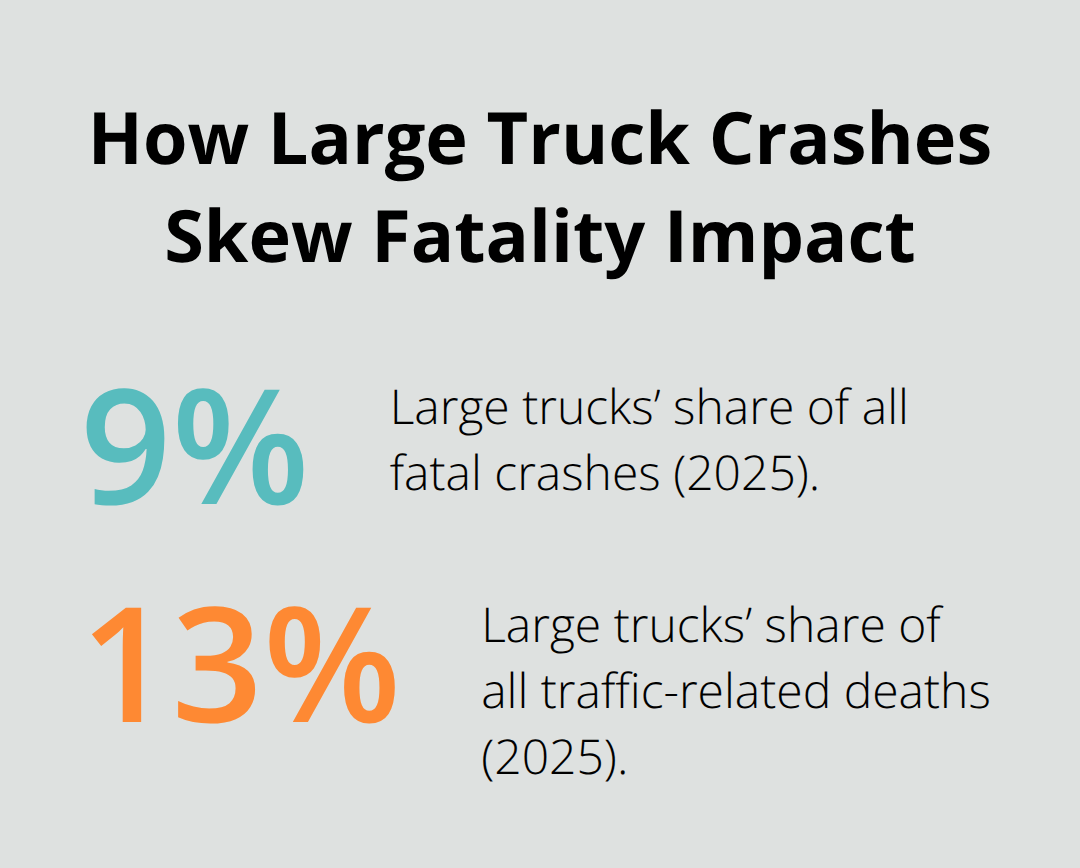
Semi trucks weighing up to 80,000 pounds create injury patterns that car crashes simply cannot match. When a fully loaded tractor-trailer strikes a passenger vehicle, the physics overwhelm standard safety systems. According to the National Highway Traffic Safety Administration, large trucks accounted for roughly 9% of fatal crashes in 2025 but represented 13% to 13.5% of all traffic-related deaths, showing the disproportionate severity these collisions produce. Victims routinely suffer traumatic brain injuries, spinal cord damage, amputations, crush injuries, and internal organ failure. Sacramento sees this firsthand on I-5, I-80, Highway 50, and Highway 99, where heavy commercial traffic moves through congested corridors in Natomas, Elk Grove, and West Sacramento.
The medical costs alone exceed typical car accidents by hundreds of thousands of dollars, with many victims requiring lifetime care, home modifications, and round-the-clock assistance.
Multiple Parties Share Liability in Truck Claims
Your truck accident likely involves multiple liable parties, not just a driver. The trucking company, freight broker, cargo loader, truck manufacturer, maintenance contractor, and even parts suppliers can share responsibility. This complexity means insurance coverage extends far beyond a standard auto policy.
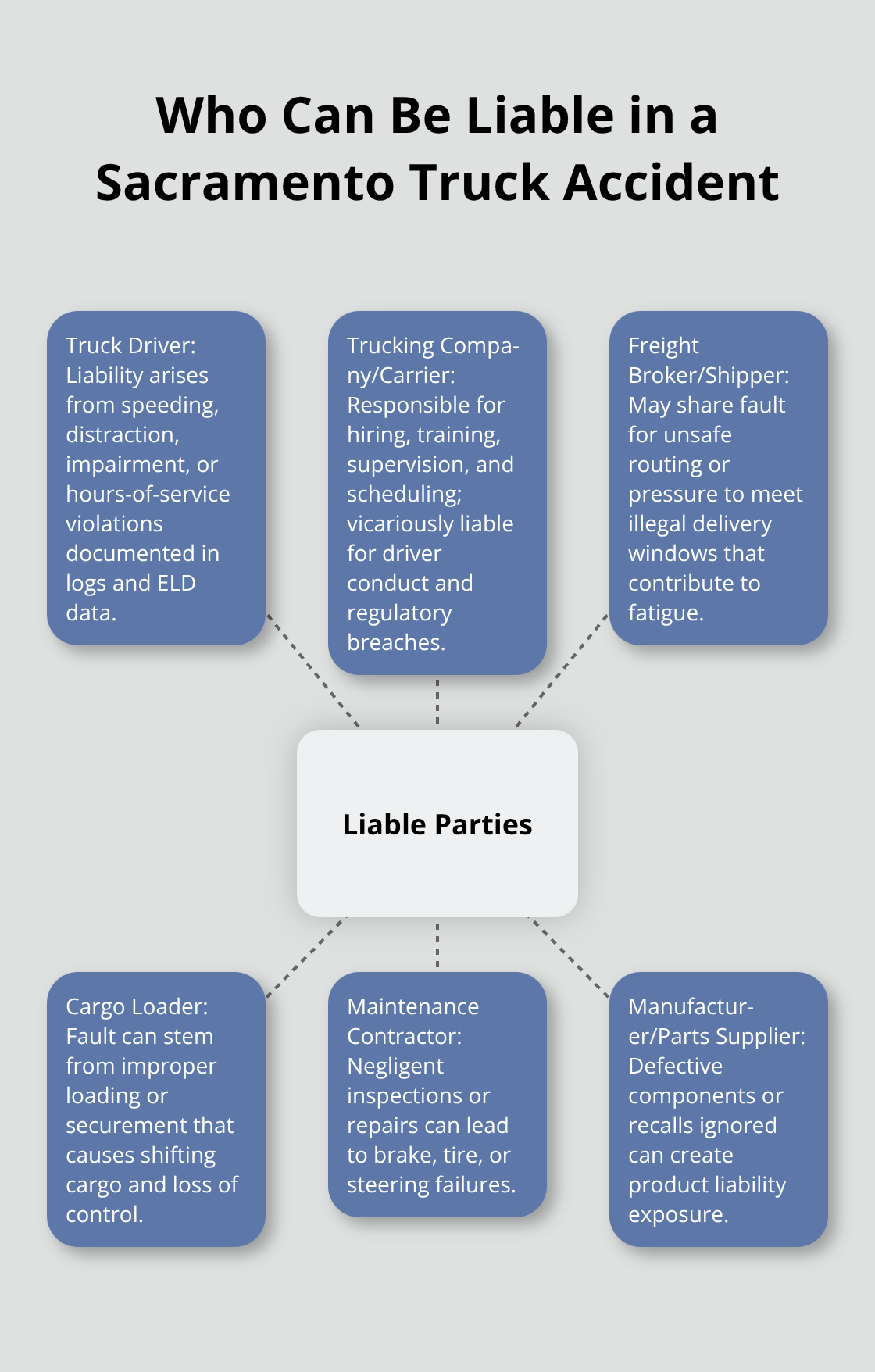
Trucking companies typically carry multi-million-dollar policies (starting around one million dollars), which fundamentally changes settlement leverage compared to car accidents. Federal Motor Carrier Safety Administration regulations govern everything from hours-of-service compliance to cargo securement and vehicle inspections. A driver who violates the 11-hour driving limit after 10 hours off-duty, or who fails to take a mandatory 30-minute break after 8 hours of driving, creates direct liability for the carrier itself. Electronic Logging Devices automatically record duty status and must be cross-checked against fuel receipts, GPS data, dispatch records, and bills of lading to expose violations that standard police reports miss.
How Federal Regulations Create Liability
Federal trucking rules establish clear standards that carriers must follow. When drivers exceed these limits, the company bears responsibility for the crash. The Federal Motor Carrier Safety Administration confirms that fatigue contributes to roughly 30% of truck crashes, yet most victims never learn about hours-of-service violations without an attorney’s investigation. Route timing, dispatch communications, and driver logs often reveal illegal scheduling patterns that caused the collision. A driver’s logbook might appear compliant on its surface but contain edited entries or missing documents that hide dangerous hours. These violations transform what looks like a simple accident into a case of corporate negligence.
Preserving Evidence Before It Disappears
Evidence in truck crashes vanishes quickly. ELD data, dashcam footage, GPS telematics, driver qualification files, maintenance records, and post-crash drug tests must be preserved immediately through a preservation letter sent to the trucking company and insurers. Fatigue remains the hardest element to prove from a police report alone, yet dispatch records and driver logs often reveal the truth. Accident reconstruction experts, economists calculating lifetime care costs, and medical specialists documenting catastrophic injuries become necessary to quantify damages properly. Sacramento’s major logistics corridors mean many crashes involve repeat violators whose case results show patterns of negligence. The sooner you act, the sooner critical evidence stays protected.
What to Do Immediately After a Semi Truck Crash
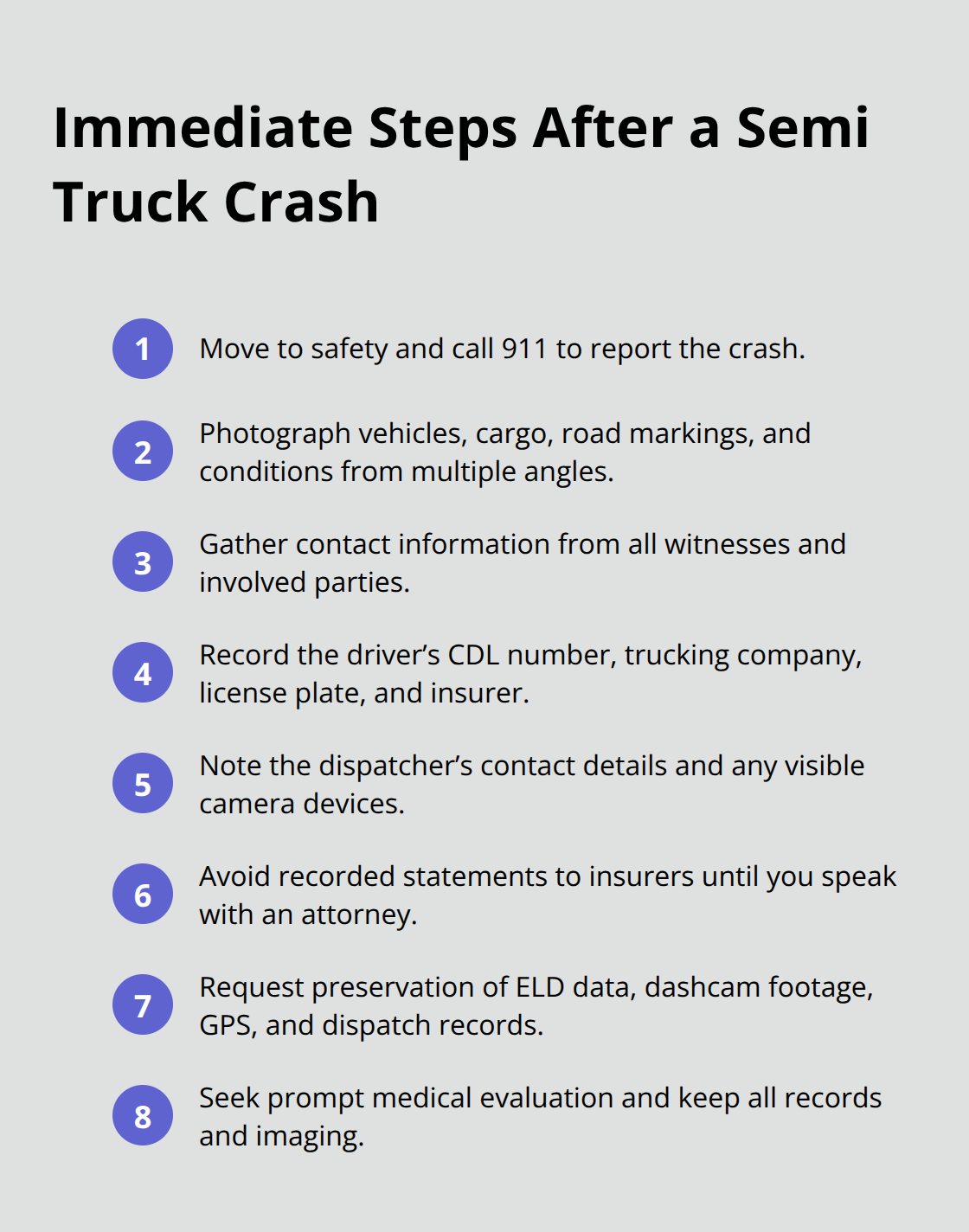
The first hours after a semi truck collision determine whether you preserve critical evidence or lose it forever. Move to a safe location if possible, then call 911 to report the crash. Police documentation creates an official record, though officer reports rarely capture the full scope of a truck accident’s complexity. Photograph everything at the scene: the truck’s position, cargo condition, road markings, weather, lighting, traffic signals, and all vehicle damage from multiple angles. Collect names, phone numbers, and addresses from every witness, including other drivers, pedestrians, and nearby workers. Request the truck driver’s commercial driver’s license number, the trucking company name, the truck’s license plate, the carrier’s insurance information, and the dispatcher’s contact details. These details form the foundation of your claim, but they pale compared to the electronic evidence you must preserve immediately.
Secure Evidence Before It Vanishes
Contact a semi truck attorney before speaking with any insurance representative. Insurance adjusters routinely pressure accident victims into recorded statements that later undermine their claims. A preservation letter sent to the trucking company and its insurers within 24 hours of the crash locks down Electronic Logging Device data, dashcam footage, GPS telematics, driver qualification files, maintenance records, and dispatch communications. Trucking companies legally must retain this evidence, yet many deliberately destroy it or claim records no longer exist. Your attorney can enforce preservation requirements and subpoena data if the carrier fails to comply.
Obtain Medical Documentation Immediately
Seek immediate medical evaluation even if you feel fine, since many serious injuries like internal bleeding or traumatic brain injury develop hours or days after impact. Obtain copies of all medical records, imaging studies, and treatment notes, as these documents quantify your damages and establish the accident’s severity. Medical providers often document injury patterns that strengthen your claim significantly.
Avoid Early Settlement Traps
Do not sign any settlement offers, medical lien agreements, or releases without attorney review. Insurance companies move quickly to close cases before victims understand the true cost of their injuries. The difference between accepting a quick insurance payout and pursuing a full claim often exceeds hundreds of thousands of dollars in catastrophic truck cases. Your attorney guides you through each decision point and protects your rights against aggressive settlement pressure.
What Happens Next in Your Investigation
Once you’ve taken these immediate steps, the real investigation begins. Your attorney coordinates with accident reconstruction experts, medical specialists, and investigators to build a comprehensive case against all liable parties.
What Happens During Your Truck Accident Claim
Your case enters a discovery phase immediately after filing, where your attorney requests Electronic Logging Device records, maintenance logs, driver qualification files, dispatch communications, and safety inspection reports from the trucking company. The carrier will resist producing damaging evidence, so your attorney must issue formal document requests and subpoenas to force compliance. Sacramento truck crashes typically reveal violations within 30 to 60 days of investigation, especially when ELD data contradicts the driver’s logbook or dispatch records show illegal scheduling patterns.
How Experts Build Your Case
Accident reconstruction experts analyze vehicle damage, road conditions, and physics to establish how the collision occurred and who bears fault. Medical experts review your injuries and project lifetime care costs, which often reach six figures in catastrophic cases involving spinal cord damage or traumatic brain injury. Economic experts calculate lost wages and reduced earning capacity, particularly important for younger victims with decades of lost income ahead. This investigation phase typically lasts four to eight months, though complex cases involving multiple liable parties extend longer. Insurance companies know this timeline and pressure victims to settle early before evidence fully emerges, which is why accepting quick offers before your investigation completes guarantees you’ll leave substantial money on the table.
Why You Should Avoid Early Settlement Offers
Insurance adjusters will contact you within days claiming they want to help, but their actual goal is minimizing the payout. They’ll request recorded statements, medical authorizations, and early settlement figures before your attorney has time to investigate properly. Do not engage with these requests directly. Your attorney handles all communications with insurance representatives and prevents adjusters from exploiting information gaps that exist early in the claim.
Negotiating From a Position of Strength
Once your investigation reveals the full scope of damages and identifies all liable parties, settlement negotiations begin from a position of strength. Trucking companies carrying multi-million-dollar policies understand that catastrophic injury cases can reach seven figures, so they negotiate seriously when your evidence shows clear violations and substantial damages. Settlement offers typically range from 60% to 90% of estimated case value in truck accidents, depending on liability clarity and injury severity.
When Settlement Fails and Trial Becomes Necessary
If negotiations stall or the insurer refuses fair compensation, your attorney prepares for trial, which involves presenting evidence to a jury in Sacramento County Superior Court. Jury verdicts in truck cases often exceed settlement offers because jurors understand the devastating consequences of corporate negligence and the lifetime costs victims endure. The decision to settle or proceed to trial depends entirely on whether the offer adequately covers your medical expenses, lost wages, pain and suffering, and future care needs calculated by your experts (medical specialists, economists, and accident reconstructionists).
Final Thoughts
Semi truck accidents demand immediate action and experienced legal guidance because the injuries are catastrophic, the liable parties are numerous, and federal regulations create additional accountability that car crashes never involve. Your recovery depends on preserving evidence before it disappears, identifying all liable parties through thorough investigation, and quantifying damages accurately through medical and economic experts. Insurance companies count on victims settling quickly without understanding the true cost of lifetime care, lost wages, and permanent disability.
The investigation phase reveals violations that police reports never capture-Electronic Logging Device data, dispatch records, and maintenance logs expose hours-of-service violations, negligent scheduling, and corporate safety failures that transform liability from the driver alone to the entire trucking company. This shift in accountability dramatically increases settlement leverage and jury sympathy when cases proceed to trial. A semi truck attorney Sacramento protects you from early settlement traps and ensures your claim reflects the actual harm you’ve suffered.
Contact O’Brien & Zehnder Law Firm before speaking with any insurance representative, as the firm provides free consultations to Sacramento County claimants and guides you through every phase of your claim without upfront fees. Time matters in truck accidents, so act now to protect your rights and secure the compensation you deserve.