

Sacramento County child injury claims follow many of the same rules as any other injury case, but California law adds important protections when the injured person is a child. A crash on the way to school, a fall at a poorly maintained property, or a dog attack in a neighbor’s yard can leave a family dealing with medical appointments, missed school, and worry about the future. Knowing how the law treats a child’s claim helps you protect your child’s rights while you focus on recovery.
At O’Brien & Zehnder Law Firm, we help Sacramento County families understand these rules so you can move forward with confidence. This guide explains who counts as a minor under California law, how a child’s claim is brought and resolved, how deadlines work for children, and the mistakes that most often create problems for families.
What Sacramento County Child Injury Claims Actually Involve
A child injury claim is a request to hold a careless person or business responsible for harm to a minor. The basic questions are familiar: who was at fault, what injuries resulted, and how those injuries affect the child’s life. What changes is who speaks for the child and how the court supervises the process.
Who Counts as a Minor in California
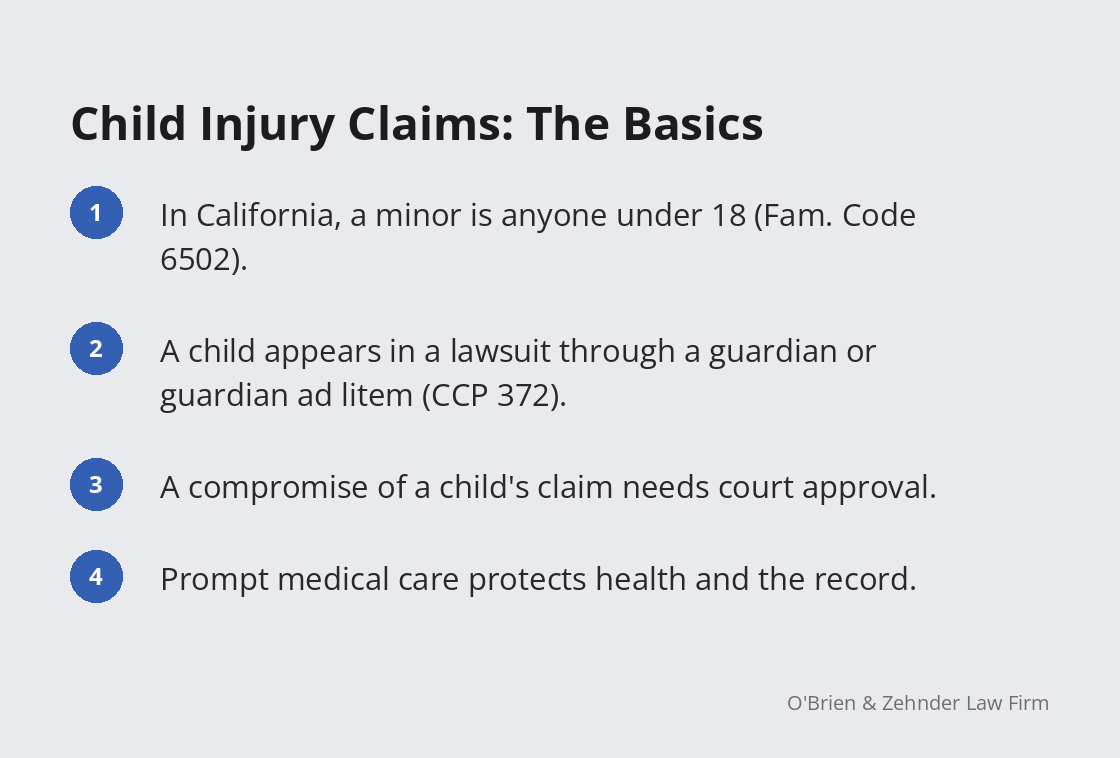
California Family Code section 6502 provides that references to a minor, made on or after March 4, 1972, refer to individuals younger than 18 years of age. That means a high school junior hurt in a car crash and a toddler hurt in a fall are both minors for purposes of their injury claims. The special rules discussed in this guide apply throughout childhood, not only to very young children.
Common Ways Children Are Hurt
Children are injured in many of the same situations as adults, and in some that are unique to childhood. Car crashes remain a frequent source of serious injuries, whether the child is a passenger, a pedestrian in a crosswalk, or riding a bicycle home from a friend’s house. Children are also hurt at swimming pools, playgrounds, stores, apartment complexes, daycare settings, and in dog attacks. Each of these situations can involve different responsible parties, from drivers and property owners to businesses and organizations that supervise children.
Why Children’s Injuries Can Be Hard to Recognize
Young children may not be able to describe what hurts, and older children sometimes downplay symptoms because they do not want to miss activities or worry their parents. Some injuries, such as head injuries, can also show signs gradually rather than all at once. A prompt medical evaluation after any significant incident, followed by careful attention to changes in sleep, mood, school performance, and behavior, protects both your child’s health and the record of what happened. Keeping notes about these changes can be just as important as keeping medical paperwork.
How a Child Injury Claim Moves Forward in California
Because a child cannot manage a legal claim alone, California law sets up a structure for who acts on the child’s behalf and when a court must be involved. These rules exist to make sure decisions are made in the child’s best interest rather than for anyone else’s convenience.
The Guardian Ad Litem
Code of Civil Procedure section 372(a)(1) states that when a minor is a party to a lawsuit, the minor must appear either by a guardian or conservator of the estate or by a guardian ad litem appointed by the court. Before the appointment, section 372(d) requires a proposed guardian ad litem to disclose to the court and the parties any known actual or potential conflicts of interest and any familial or affiliate relationship with any of the parties. Once appointed by the court, the guardian ad litem acts for the child in the case.
Court Approval Before a Child’s Claim Is Resolved
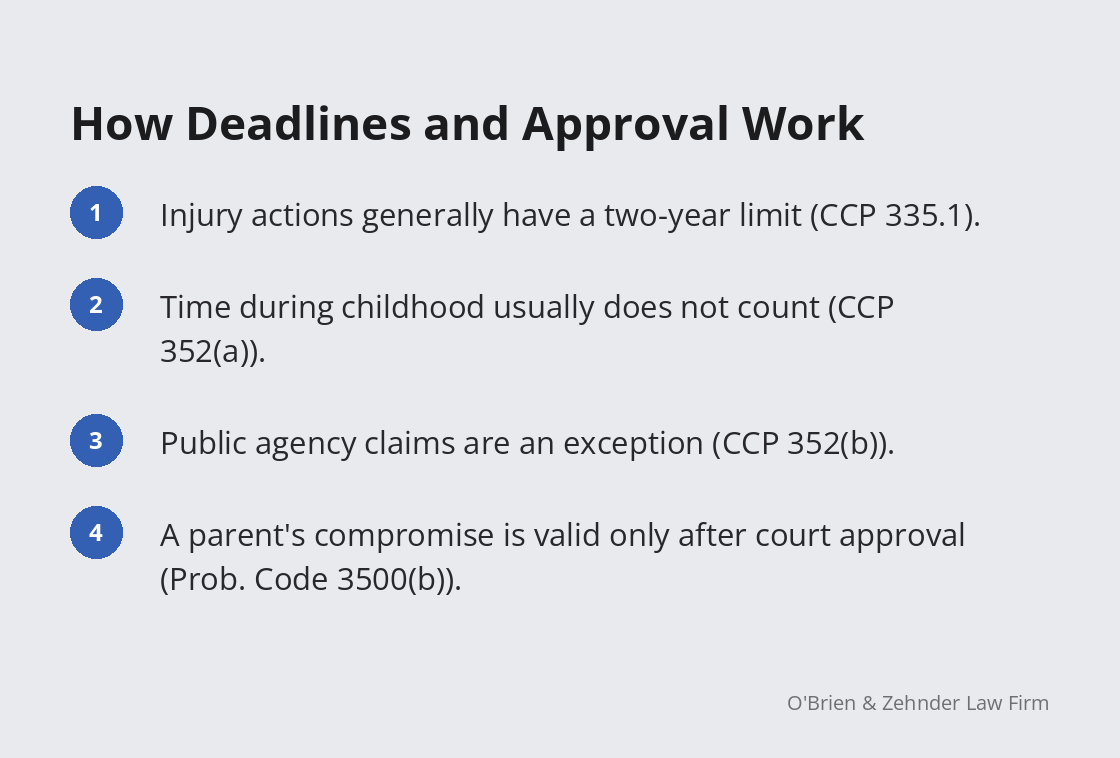
One of the most important protections for children is court oversight of any resolution. Under section 372(a)(3), a guardian ad litem has the power to compromise the child’s claim only with the approval of the court where the case is pending. When no lawsuit has been filed, Probate Code section 3500 gives a parent the right to compromise a minor’s disputed claim, but subsection (b) states that the compromise is valid only after it has been approved, upon the filing of a petition, by the superior court of the county where the minor resides or any county where suit on the claim properly could be brought. Section 3500(c) also requires that anything to be paid or delivered for the child’s benefit be handled under the Probate Code’s protective rules. For a family living in Sacramento County, that typically means the Sacramento County Superior Court reviews the proposal before it becomes final.
How Deadlines Work for Children
Code of Civil Procedure section 335.1 sets a two-year time limit for an action for injury to an individual caused by the wrongful act or neglect of another. For children, section 352(a) adds an important rule: if the person entitled to bring the action was under the age of majority when the claim accrued, the time of that disability is not part of the time limited for starting the action. In practical terms, the clock on many of a child’s injury claims does not run during childhood. That rule has limits, though, and it does not mean waiting is wise. Evidence fades, witnesses move, and medical records become harder to gather as time passes.
Claims Against Public Agencies Are Different
Section 352(b) states that the childhood tolling rule does not apply to an action against a public entity or public employee on a claim for which a government claim must be presented under the Government Code. If a child is hurt because of a dangerous public road, a city or county vehicle, a public school setting, or another government-related cause, much shorter claim presentation rules can apply. Families should treat any injury involving a public agency as time sensitive from the start.
Mistakes That Can Hurt a Child’s Claim
Parents are understandably focused on their child’s health after an injury. That focus is the right priority, but a few common missteps can make the legal side of the situation much harder than it needs to be.
Assuming There Is Always Plenty of Time
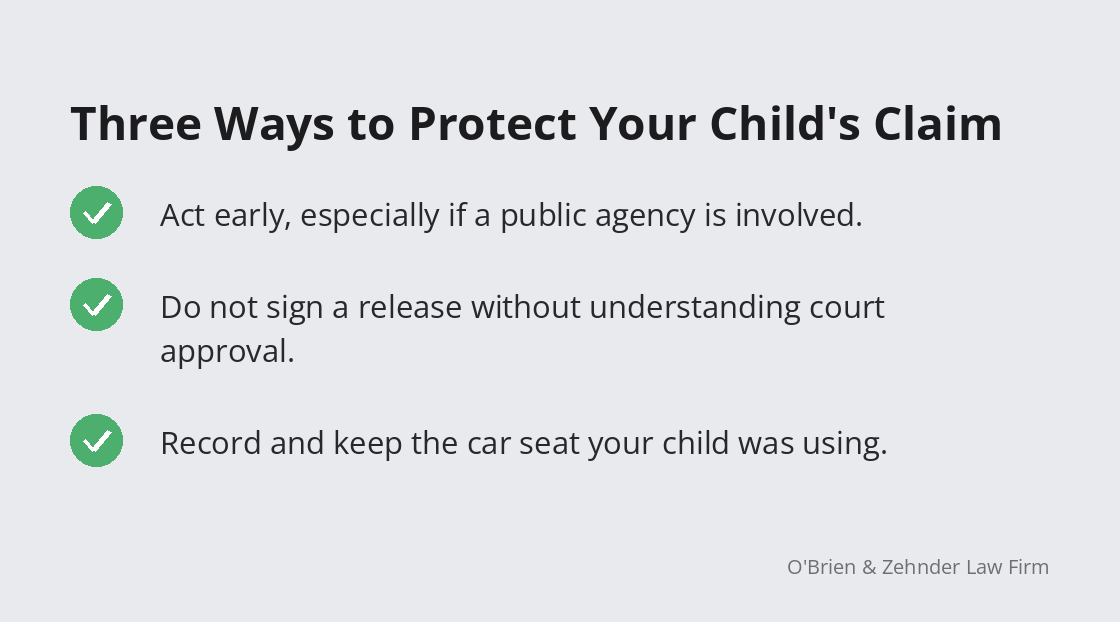
The childhood tolling rule leads some families to believe they can wait years before doing anything. As explained above, that rule does not apply to claims against public entities that require a government claim, and the evidence needed to prove any claim is strongest soon after the incident. Photographs of the scene, names of witnesses, surveillance video, and vehicle information can disappear quickly. Acting early protects your child’s options even if the claim itself is not resolved for some time.
Signing a Release Without Court Approval
An insurance company may present a parent with a release or proposal soon after an injury. Under Probate Code section 3500(b), a parent’s compromise of a minor’s disputed claim is valid only after court approval on a petition. Families should be cautious about signing documents that claim to resolve a child’s case, and should understand that the court’s role is to review whether a proposed resolution truly serves the child. It is also important to understand the full extent of a child’s injuries before any resolution is considered, because some effects become clear only as the child grows.
Overlooking Car Seat and Safety Details
For crashes involving young passengers, details about how the child was secured often come up. Vehicle Code section 27360(a) requires a parent, legal guardian, or driver transporting a child under eight years of age to properly secure the child in a rear seat in an appropriate child passenger restraint system that meets federal safety standards, except as provided in Section 27363. Section 27360(b) requires a child under two years of age to be secured in a rear-facing system unless the child weighs 40 or more pounds or is 40 or more inches tall. Writing down which seat your child was using, keeping the seat after a crash, and saving its manual can help answer questions later and support your child’s claim.
Final Thoughts
Sacramento County child injury claims are shaped by protections designed for minors. A child appears in court through a guardian or guardian ad litem under Code of Civil Procedure section 372, a compromise of a child’s claim needs court approval, and section 352 generally stops the clock on many injury claims during childhood, except for claims against public entities that require a government claim.
Those protections work best when families act thoughtfully. Get your child the medical care they need, keep careful records of their recovery, preserve evidence, and be cautious about signing anything that claims to resolve the case. With the right information, you can protect both your child’s health and your child’s future.
If your child was hurt because of someone else’s carelessness, contact O’Brien & Zehnder Law Firm to speak with our team. We will review what happened and help your family move forward with confidence.