

Sacramento County bus accident claims follow different rules than an ordinary car crash, and knowing those rules early can protect your right to recover. Whether you were a passenger on a city transit bus, a rider on a private charter or tour coach, a driver whose car was struck by a bus, or a pedestrian or cyclist hit near a bus stop, the identity of the bus operator often decides which deadlines apply and what steps must come first. Many people do not learn about those differences until it is too late.
At O’Brien & Zehnder Law Firm, we help injured people and their families across Sacramento County understand their rights after serious bus accidents. This guide explains how bus accident claims actually work in California, how a claim moves forward when a public transit agency is involved, and the mistakes that most often weaken an otherwise strong case, so you can move forward with confidence.
How Sacramento County Bus Accident Claims Actually Work
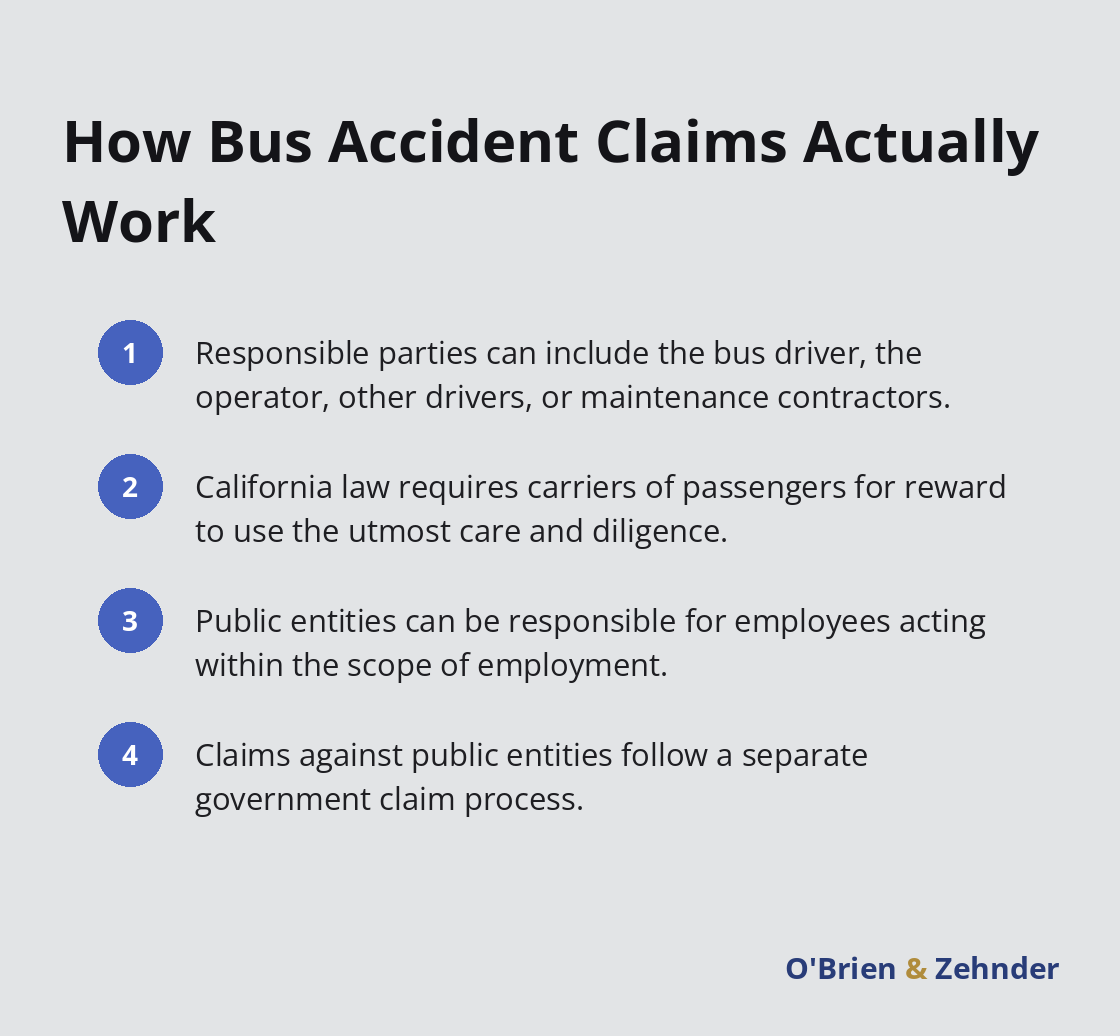
A bus accident claim starts with the same basic question as any injury case: whose carelessness caused the crash? The answer might be the bus driver, the company or agency that operates the bus, the driver of another vehicle, a maintenance contractor, or a combination of several parties. What sets bus cases apart is the legal duty owed to passengers and the special procedures that apply when the bus belongs to a government entity.
Buses carry many people at once, and passengers may be standing, boarding, or moving toward an exit when a sudden stop or collision occurs. That makes careful investigation especially important. Video from onboard cameras, maintenance logs, driver schedules, and dispatch records can all help explain what happened, and those records are controlled by the operator rather than by the injured person.
The Heightened Duty Owed to Passengers
California law holds carriers of passengers to a high standard. Civil Code section 2100 states that a carrier of persons for reward must use the utmost care and diligence for their safe carriage, must provide everything necessary for that purpose, and must exercise to that end a reasonable degree of skill. That duty is stricter than the ordinary care expected of most drivers on the road. For a paying passenger hurt by an abrupt stop, a crash, or an unsafe boarding situation, this standard can play a central role in the claim.
Public Transit Versus Private Bus Operators
Not every bus is operated by the same kind of organization. City and regional transit systems, school districts, and some shuttle services are run by public entities, while tour coaches, charter buses, airport shuttles, and many intercity lines are run by private companies. The difference matters a great deal. Claims against a private bus company generally follow the standard rules for personal injury cases, while claims against a public entity must first go through a separate government claim process with much shorter deadlines.
When the Driver Works for a Public Entity
If a public employee was driving the bus, the agency can be responsible for that driver’s conduct. Government Code section 815.2 provides that a public entity is liable for injury proximately caused by an act or omission of an employee within the scope of employment if the act or omission would otherwise have given rise to a cause of action against that employee. The same section also states that, except as otherwise provided by statute, the entity is not liable where the employee is immune from liability, which is one reason these cases require careful legal analysis.
How a Bus Accident Claim Moves Forward in California
The path a claim follows depends heavily on who operated the bus. When a public entity is involved, California’s Government Claims Act controls the early steps and sets deadlines that are far shorter than most people expect. Understanding the sequence helps you avoid losing a valid claim on a technicality.
Presenting a Government Claim on Time
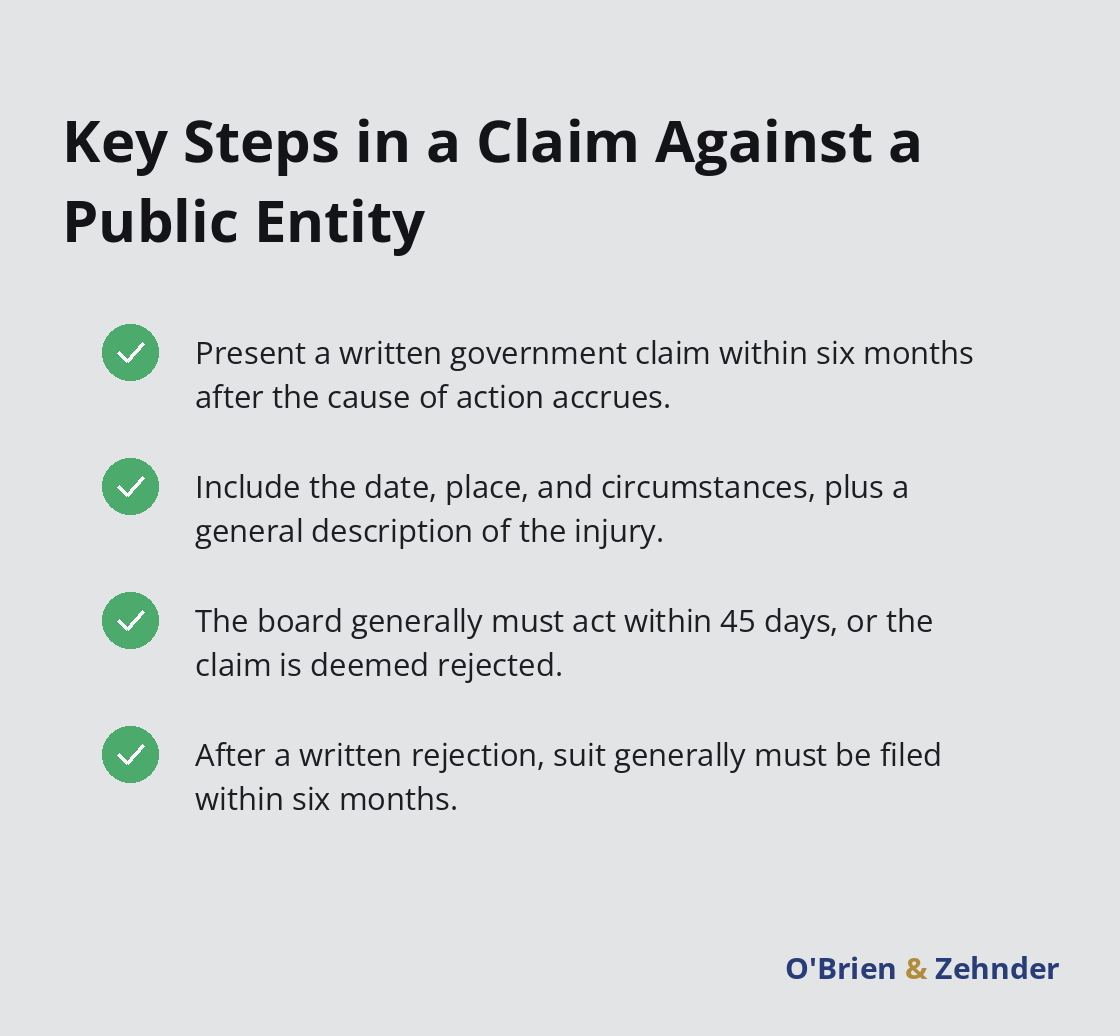
Under Government Code section 911.2, a claim relating to a cause of action for death or for injury to a person must be presented to the public entity not later than six months after the cause of action accrues. Government Code section 910 lists what the claim must show, including the claimant’s name and mailing address, the date, place, and other circumstances of the incident, a general description of the injury, and the name of the public employee who caused it, if known. Getting these details right the first time helps prevent disputes later about whether the claim was proper.
Waiting for the Agency to Respond
Government Code section 945.4 generally bars a lawsuit against a public entity on a claim that must be presented until a written claim has been presented and acted upon, or deemed rejected. Under section 912.4, the entity’s board must act on the claim within forty-five days after it is presented, unless the claimant and the board agree in writing to extend that period. If the board fails or refuses to act within the required time, the claim is deemed rejected on the last day of that period.
The waiting period is not wasted time. While the agency reviews the claim, you can continue medical treatment, gather records, and keep track of how your injuries affect your work and daily routine. Keeping copies of everything you send to the agency, along with proof of the date it was delivered or mailed, helps avoid later arguments about whether the claim was presented on time and whether the rejection deadlines have started to run.
Filing Suit After a Rejection
Once a claim is rejected, another deadline begins. Government Code section 945.6 provides that if the entity gives written notice of rejection, a lawsuit generally must be filed not later than six months after that notice is personally delivered or deposited in the mail. If no written notice is given, the suit generally must be filed within two years from the accrual of the cause of action. For bus accidents involving a private operator, Code of Civil Procedure section 335.1 generally allows two years to file an action for injury to an individual caused by the wrongful act or neglect of another.
Mistakes That Weaken a Bus Accident Claim
Bus accident cases often involve organizations with their own investigators and claims staff who begin building their side of the story right away. Small missteps in the weeks after a crash can make it much harder to show what happened and who should be responsible. Avoiding these common mistakes keeps more options open.
Assuming the Usual Two-Year Deadline Applies
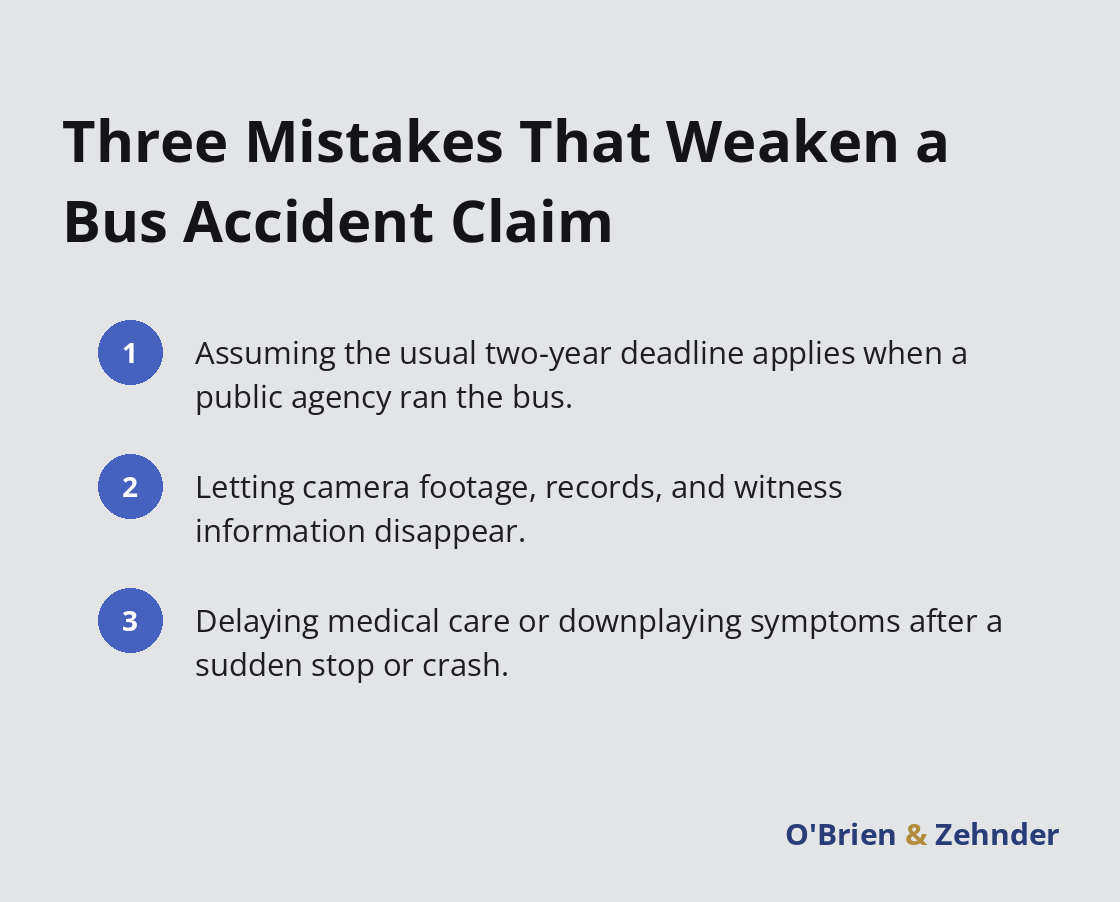
Many people have heard that California gives injured people two years to bring a case and assume that rule covers every crash. When a public entity operates the bus, the six-month claim deadline under Government Code section 911.2 comes first. Section 911.4 does allow a written application for leave to present a late claim, but that application must be made within a reasonable time not to exceed one year after the cause of action accrues and must explain the reason for the delay. Relying on that exception is risky, so identifying the bus operator quickly is one of the most important early steps.
Letting Key Evidence Disappear
Onboard and exterior camera footage, electronic data from the bus, maintenance and inspection records, and driver logs may not be kept forever. Witnesses who were riding the bus may be difficult to locate weeks later. Writing down the bus route and number, the time and location of the crash, and the names and contact details of other passengers or witnesses can make a real difference. Photos of the scene, your injuries, and any vehicle damage are also valuable, as is a copy of any police or incident report.
Delaying Medical Care or Downplaying Symptoms
Passengers thrown forward during a sudden stop or collision may not feel the full effect of their injuries until hours or days later. Neck, back, shoulder, and head injuries are common, and some do not show obvious signs at first. Getting prompt medical attention protects your health and creates a clear record that connects your injuries to the crash. Following through with recommended treatment and keeping copies of your records helps show the true impact of the accident on your daily life. If a child was hurt, our guide on when a child is injured on a school bus covers additional concerns for families.
Final Thoughts
Sacramento County bus accident claims can be more complex than other traffic injury cases because of the heightened duty owed to passengers, the number of parties who may be involved, and the strict government claim rules that apply when a public entity operates the bus. Knowing who ran the bus, acting before short deadlines pass, and preserving evidence early all put you in a stronger position.
You do not have to sort through these rules on your own while you are focused on healing. Asking questions early can help you understand which deadlines apply to your situation and what steps should come next.
If you or someone you love was hurt in a bus accident, contact O’Brien & Zehnder Law Firm to speak with our team serving Sacramento County. We’ll review what happened, explain your options in plain terms, and help you take the next step with confidence.