

Sacramento County traumatic brain injury claims often begin with an injury that does not look serious at first. A driver walks away from a rear-end collision, a cyclist gets up after a fall, or a passenger feels only a headache after a crash on Interstate 5. Days later, the problems start to show up: trouble concentrating, poor sleep, irritability, or memory lapses that make work and family life harder. Because brain injuries can be invisible to others, they are some of the most misunderstood injuries in personal injury cases.
At O’Brien & Zehnder Law Firm, we help injured people and their families across Sacramento County understand their rights after accidents that cause brain injuries. This guide explains how these claims actually work, how a strong claim is built step by step, and the mistakes that most often weaken a brain injury case, so you can move forward with confidence.
How Traumatic Brain Injury Claims Actually Work in Sacramento County
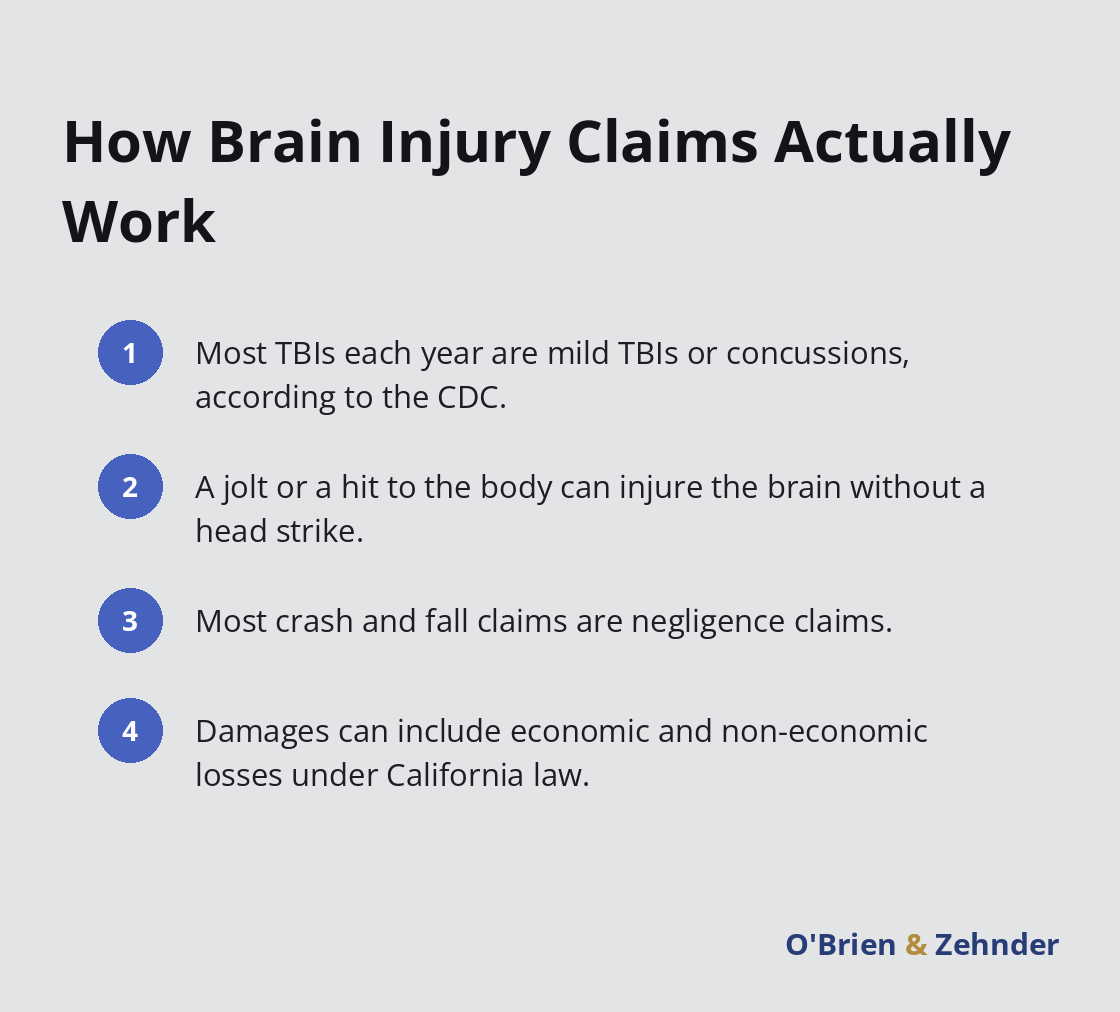
A traumatic brain injury, often called a TBI, is not limited to severe head trauma. According to the Centers for Disease Control and Prevention, most TBIs that occur each year are mild TBIs or concussions. A mild TBI can be caused by a bump, blow, or jolt to the head, or by a hit to the body that causes the head and brain to move quickly back and forth. That means a person can suffer a brain injury in a car crash without ever striking their head on anything.
From a legal standpoint, most brain injury claims arising from crashes and falls are negligence claims. The question is whether someone failed to use reasonable care and whether that failure caused the injury. California Civil Code section 3333 provides that for the breach of an obligation not arising from contract, the measure of damages is the amount that will compensate for all the detriment proximately caused by it, whether it could have been anticipated or not. For a brain injury, that detriment can extend well beyond the first visit to the emergency room.
Why Mild Brain Injuries Are Still Serious
The word mild can be misleading. The CDC explains that health care providers may describe these injuries as mild because they are usually not life-threatening, but the effects of a mild TBI or concussion can still be serious. A person with a history of repeated concussions may experience a longer recovery or more severe symptoms. Insurance adjusters sometimes treat a concussion diagnosis as a minor injury, which is why documenting the real effects on your daily life is so important.
Symptoms That May Appear Later
Brain injury symptoms do not always appear right away. The CDC notes that some mild TBI and concussion symptoms may appear immediately, while others may not appear for hours or days after the injury. Symptoms can affect how a person feels, thinks, acts, or sleeps, including headaches, dizziness, sensitivity to light or noise, trouble concentrating, memory problems, irritability, and changes in sleep. The CDC also points out that a person may not recognize or admit that they are having problems, and that family members may notice changes before the injured person does.
What Damages Can Include
California law recognizes two broad categories of losses in injury cases. Civil Code section 1431.2 describes economic damages as objectively verifiable monetary losses, such as losses tied to medical care and loss of earnings, and non-economic damages as subjective, non-monetary losses including pain, suffering, inconvenience, mental suffering, emotional distress, and loss of consortium. For many brain injury survivors, the non-economic side of the claim is significant, because the injury affects relationships, independence, and the ability to enjoy everyday activities.
Building a Strong Brain Injury Claim Step by Step
Brain injury cases depend heavily on evidence that connects the accident to the symptoms you are living with. Because there may be no visible wound, the claim is built through medical records, testing, observations from people who know you, and a clear timeline. The earlier you start gathering that evidence, the easier it is to show what changed.
Getting Prompt Medical Care
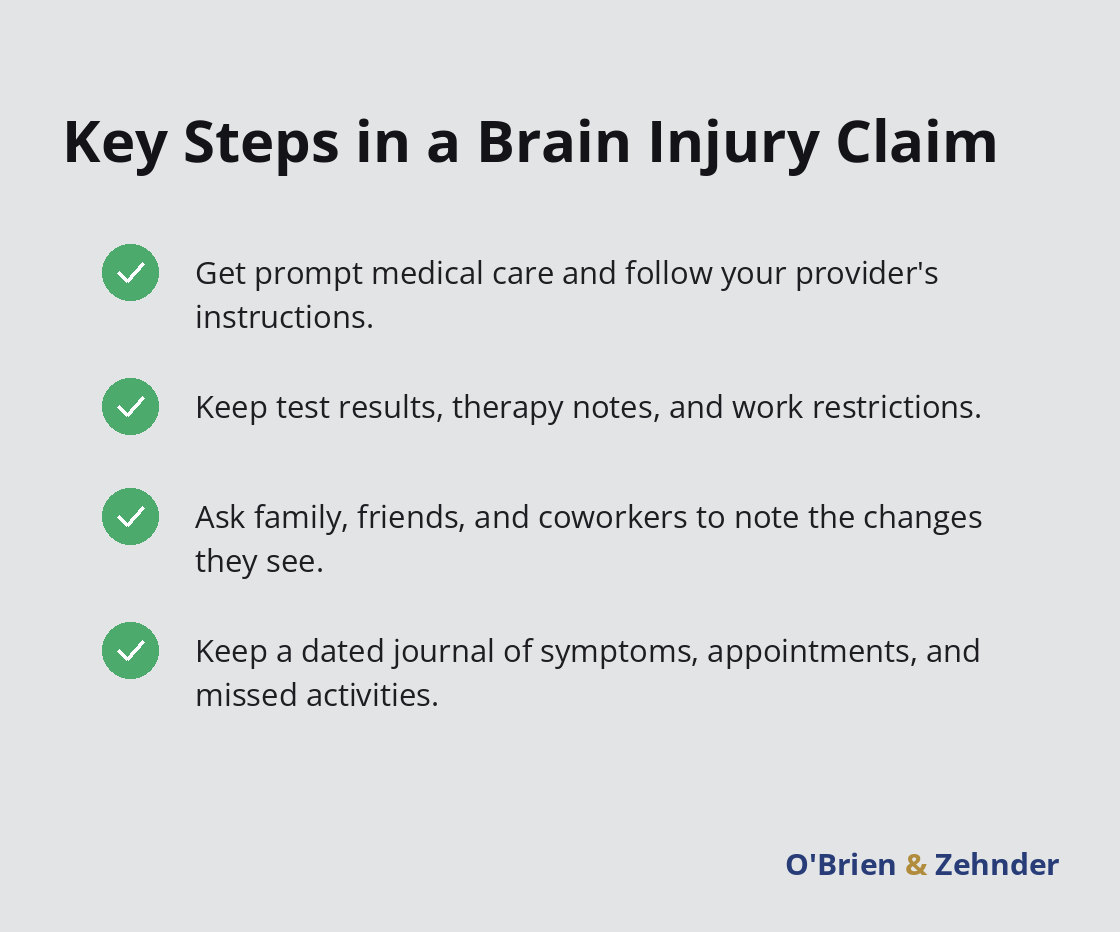
The CDC advises that people with a mild TBI or concussion need to be seen by a health care provider, and that getting care can help speed recovery. It also lists danger signs that call for emergency care right away, such as a headache that gets worse and does not go away, repeated vomiting, slurred speech, or unusual drowsiness. From a claim perspective, prompt care creates a medical record that ties your symptoms to the date of the accident, which makes it much harder for an insurer to argue that something else caused them.
Testing and Documentation
Brain injuries are not always visible on imaging. The CDC explains that a CT scan is not needed to spot a mild TBI or concussion, although it may be used for patients at risk for bleeding on the brain. Providers may instead use neuropsychological or neurocognitive tests that look at learning, memory, concentration, and problem solving. The CDC also notes that even if an injury does not show up on these tests, a person may still have a mild TBI or concussion. Keeping copies of evaluations, therapy notes, and work restrictions helps show the full picture.
Statements From Family, Friends, and Coworkers
Because brain injury symptoms affect behavior and personality, the people around you are often the best witnesses to what changed. A spouse may notice new irritability, a coworker may see that tasks take longer, and a friend may notice you avoid noisy places. Short written accounts, kept with dates, can be powerful evidence. A simple journal of your own symptoms, appointments, missed work, and activities you can no longer enjoy can also help your medical providers and support your claim.
Mistakes That Weaken a Brain Injury Claim
Many brain injury claims are weakened not by the facts of the accident, but by decisions made in the weeks and months afterward. Insurers look for gaps, inconsistencies, and delays. Avoiding a few common mistakes can protect both your health and your case.
Waiting to See if Symptoms Go Away
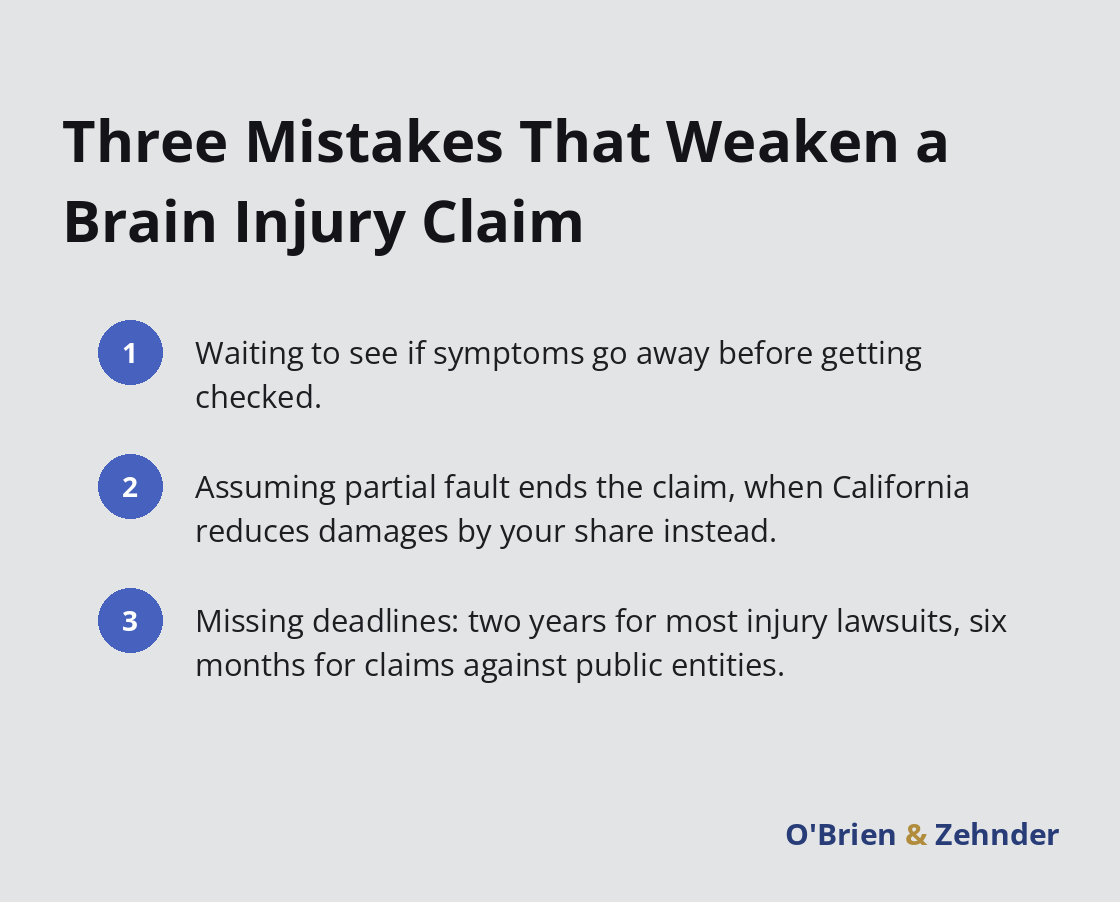
It is natural to hope that a headache or fogginess will pass. The CDC notes that symptoms generally improve over time and most people with a mild TBI or concussion feel better within a couple of weeks, but some people have symptoms that last longer. If you delay treatment and symptoms persist, an insurer may argue that the injury was minor or that something else caused it. Getting checked early protects your health and creates a clear record from the start.
Assuming Partial Fault Ends the Claim
Some people never pursue a claim because they think they were partly to blame, perhaps for not wearing a helmet or for a moment of distraction. California follows a comparative fault rule. Under the Judicial Council’s civil jury instruction on comparative fault, a plaintiff’s damages are reduced by the jury’s determination of the percentage of the plaintiff’s responsibility. In other words, sharing some fault generally reduces what you can recover rather than eliminating the claim entirely.
Missing Filing Deadlines
California sets firm time limits for injury claims. Under Code of Civil Procedure section 335.1, an action for injury to an individual caused by the wrongful act or neglect of another generally must be brought within two years. When a government entity is involved, such as a city vehicle or a dangerous public roadway, Government Code section 911.2 requires a claim relating to injury to a person to be presented within six months after the cause of action accrues. For injured children, Code of Civil Procedure section 352 provides that the time a person is under the age of majority generally is not counted toward the two-year period, but that rule does not apply to claims against public entities that require a government claim. Because brain injury symptoms can develop slowly, these deadlines can pass before families fully understand the injury.
Final Thoughts
Sacramento County traumatic brain injury claims require patience, careful documentation, and attention to deadlines. A mild TBI or concussion can still change how you work, sleep, and connect with the people you love. California law allows injured people to seek compensation for the full detriment caused by another person’s negligence, but building that claim depends on medical evidence, consistent records, and timely action.
You do not have to sort through medical records, insurance calls, and filing rules on your own. Learning more about how a Sacramento brain injury lawyer approaches these cases is a helpful first step, especially when symptoms are still developing.
If you or someone you love suffered a brain injury in an accident, contact O’Brien & Zehnder Law Firm to speak with our team serving Sacramento County. We’ll review what happened, explain your options in plain terms, and help you take the next step with confidence.