

If you’ve been injured in Sacramento County, understanding how California injury claims work is the first step toward getting fair compensation. We at O’Brien & Zehnder Law Firm know that navigating the legal process can feel overwhelming.
This guide walks you through everything you need to know about filing a claim, from gathering evidence to negotiating settlements and knowing when to pursue a lawsuit.
Understanding California Injury Claims
Which Injury Cases Qualify in California
California law covers a broad range of personal injury cases, and understanding which incidents qualify matters because the two-year statute of limitations clock starts ticking from the date of injury. Car accidents represent the largest category of injury claims, but California also recognizes claims from truck collisions, motorcycle crashes, pedestrian incidents, premises liability (injuries on someone else’s property), product liability (injuries from defective products), and dog bites. The key requirement is that someone else’s negligence or intentional action directly caused your harm. This means the defendant failed to act with reasonable care, or acted recklessly, and that failure resulted in your injury.
You cannot recover damages for injuries you caused yourself, and you cannot sue someone for an incident that occurred more than two years ago in most cases. The two-year deadline is absolute in California under California Code of Civil Procedure Section 335.1, with very limited exceptions for cases involving minors or defendants who leave the state. Missing this deadline bars you from recovering any compensation, regardless of the strength of your case. File a claim or consult an attorney well before the two-year mark expires.
How Negligence Establishes Fault
Fault in California injury claims rests on negligence, which requires four elements: the defendant owed you a duty of care, the defendant breached that duty, the breach caused your injury, and you suffered damages. A driver owes other road users a duty to obey traffic laws and drive safely; a property owner owes visitors a duty to maintain reasonably safe premises; a manufacturer owes consumers a duty to produce non-defective products. Proving negligence means showing the defendant’s actions fell below what a reasonable person would have done in that situation.
Comparative Negligence Works in Your Favor
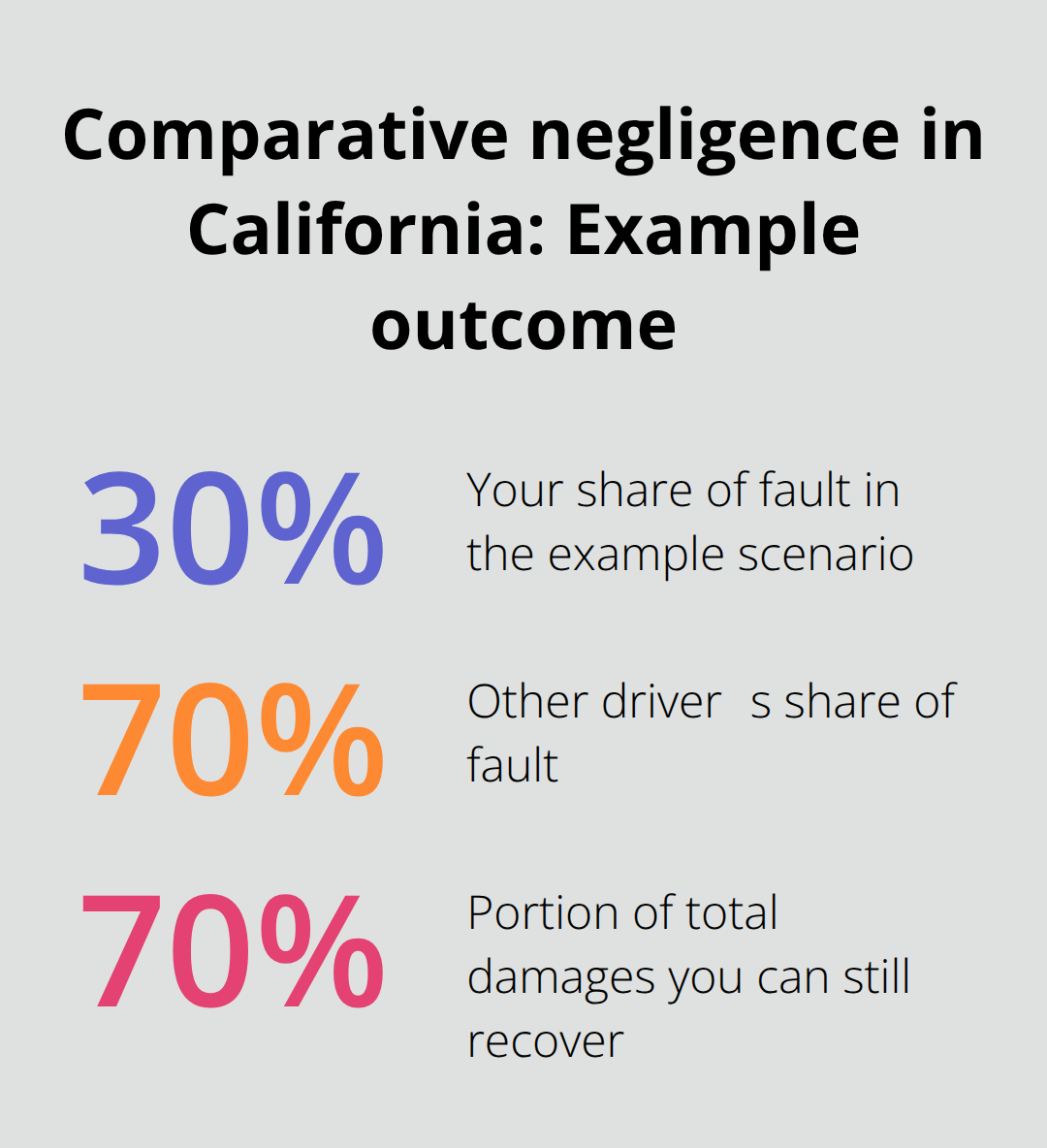
California applies comparative negligence rules, meaning even if you were partially at fault, you can still recover damages if you were less than 50 percent responsible for the injury. If you were 30 percent at fault for a car accident and the other driver was 70 percent at fault, you can recover 70 percent of your total damages. This rule makes many cases recoverable that might seem hopeless at first glance.
Document Everything From the Start
The evidence you gather immediately after an injury directly supports your negligence claim and strengthens your position in negotiations. Photograph the scene from multiple angles, collect witness names and contact information, and write down your account of events while details remain fresh. Medical records, police reports, and repair estimates all establish the connection between the defendant’s actions and your harm. The stronger your documentation, the more leverage you gain when discussing settlement amounts with insurance companies.
Moving Your Claim Forward After Injury
Report the Incident Quickly
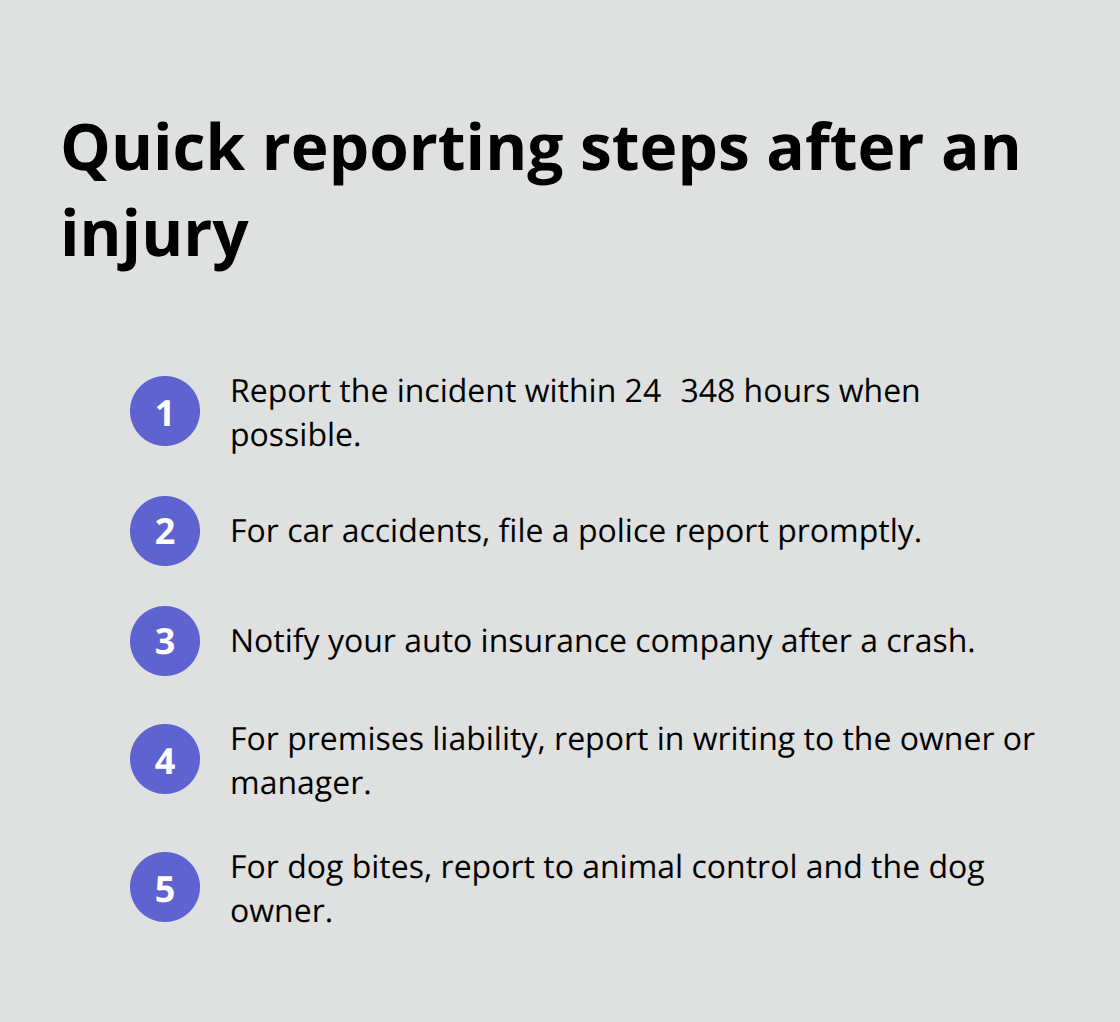
The period immediately after your injury determines whether you maximize your compensation or leave money on the table. Report the incident to the relevant parties within 24 to 48 hours whenever possible. For car accidents, file a police report and notify your insurance company; for premises liability, report the incident to the property owner or manager in writing; for dog bites, report to animal control and the dog owner. This creates an official record with timestamps that insurers and courts respect.
Gather Medical Documentation and Evidence
See a doctor even if your injuries seem minor-many serious conditions develop days or weeks after impact, and gaps in medical records weaken your claim significantly. Request copies of all medical records, imaging results, and treatment notes directly from providers and keep them organized chronologically. Photograph any visible injuries, damage to property, and the accident scene itself, then save these images with dates and descriptions. Collect contact information from witnesses and ask them to provide written statements about what they observed.
Document All Expenses and Lost Income
Keep a detailed log of all expenses related to your injury, including medical bills, medications, mileage to appointments, and time away from work with corresponding lost wages. This documentation becomes your foundation for negotiating with insurers and supports your claim for special damages (out-of-pocket costs) and medical damages (treatment expenses).
Understand How Insurers Calculate Settlement Offers
Insurance companies evaluate claims using damage multipliers that apply to your medical expenses. If your medical bills total $10,000, insurers typically start settlement discussions using a 1.5 to 5 multiplier, meaning they might initially offer between $15,000 and $50,000 depending on injury severity and treatment duration. The multiplier increases when injuries require surgery, extended physical therapy, or result in permanent effects. Present your initial settlement demand in writing to the insurance adjuster, backed by your complete medical records, wage documentation, and expense receipts. Most insurers respond within two to four weeks, and negotiations typically involve three to five rounds of offers before reaching agreement or deciding to file a lawsuit.
Know When to File a Lawsuit
If the insurer’s offers remain substantially below your documented damages, filing a lawsuit becomes necessary-California courts see cases through to trial when settlements fail, and juries awarded an average of $35,000 in California personal injury cases according to recent civil litigation data. File a formal demand letter before initiating a lawsuit, as this demonstrates good faith and sometimes prompts insurers to increase their final offers significantly. The statute of limitations gives you two years to file suit, but filing earlier strengthens your position because it signals you’re serious about court proceedings and creates pressure on insurers to settle before trial costs mount. Once you understand your settlement options and the value of your claim, the next step involves navigating the formal legal process if negotiations stall.
How California Courts Value Your Injury Claim
California Civil Code Section 3281 defines damages as monetary compensation for the detriment caused by someone else’s fault, with the goal of making you whole by restoring you to the position you occupied before the injury. Damages split into two categories: special damages (economic losses) and general damages (non-economic losses like pain and suffering). Special damages cover medical bills, lost wages, property damage, and out-of-pocket expenses you can document with receipts and records. General damages compensate for pain, anxiety, lost enjoyment of life, and emotional distress-intangible harms that have no fixed price tag.
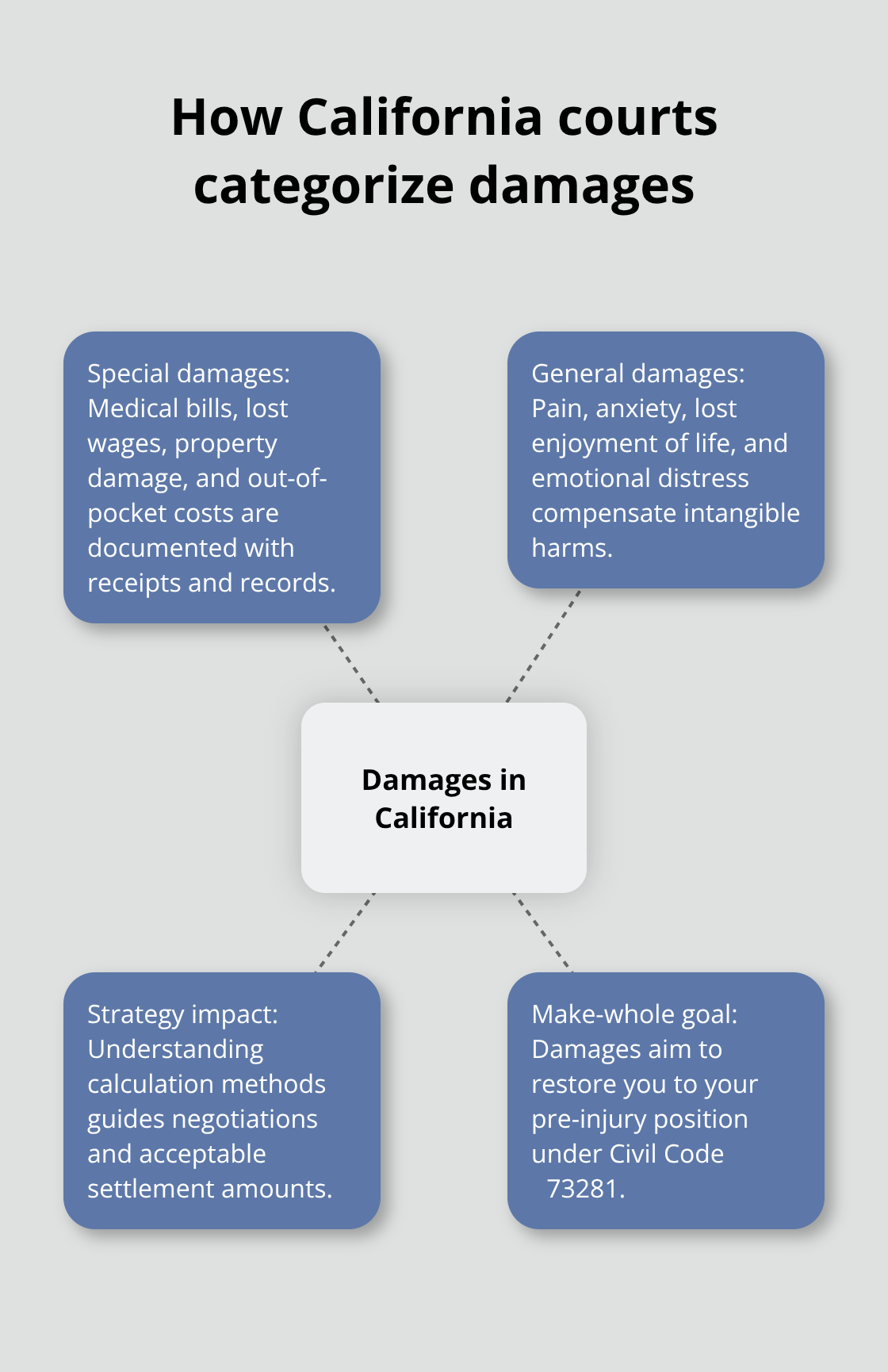
Understanding how insurers and courts calculate each category directly impacts your negotiation strategy and the settlement amount you should accept.
Medical Bills and Lost Wages Form Your Foundation
Medical special damages are calculated using the actual amounts paid or required to be paid for treatment, not the billed amounts that providers list before insurance negotiation. This distinction matters significantly because a hospital bill of $50,000 might be reduced to $20,000 after insurance processing, and under California case law from Howell v. Hamilton Meats and Provisions Inc., the actual payment amount controls your damages calculation. You must document every medical expense: ambulance fees, emergency room visits, imaging, surgery, medications, physical therapy, and follow-up appointments. Lost wages include not only your salary but also commissions, bonuses, and benefits lost during recovery, supported by pay stubs and employer verification. If your injury prevents you from pursuing a chosen career path, you can recover damages reflecting the anticipated earnings from that career, but you’ll need expert testimony to project future income and duration. Future medical expenses require proof that treatment is reasonably necessary and reasonably certain to occur, typically supported by medical expert testimony beyond your treating physician’s opinion.
Pain and Suffering Multipliers Start Your Negotiation
General damages (pain and suffering) lack a fixed formula, but insurers and courts typically apply a multiplier to your medical special damages as a starting framework. The multiplier ranges from 1.5 to 5 or higher depending on injury severity, treatment invasiveness, and lasting effects. A $10,000 medical bill at a 1.5 multiplier suggests $15,000 in pain and suffering; the same bill at a 5 multiplier suggests $50,000. More serious injuries with surgery, extended physical therapy, or permanent effects justify higher multipliers. The multiplier increases when treatment lasts months rather than weeks, when pain is severe and ongoing, and when the injury disrupts your daily activities permanently. You should present this calculation in your settlement demand to the insurance adjuster backed by your complete medical records-the more detailed your documentation of treatment necessity and duration, the stronger your argument for a higher multiplier. Juries ultimately decide damages if your case goes to trial, and they may award amounts significantly above or below the multiplier framework based on witness credibility, defendant behavior, and how effectively you present evidence of your suffering.
Final Thoughts
California injury claims follow a predictable path, but the details matter enormously when it comes to maximizing your recovery. You now understand that negligence requires four elements, comparative negligence allows recovery even if you’re partially at fault, and the two-year statute of limitations is absolute. You know how to gather evidence immediately after injury, how insurers calculate settlement offers using damage multipliers, and when filing a lawsuit becomes necessary.
Medical special damages are based on actual payments, not billed amounts, while general damages use multipliers ranging from 1.5 to 5 applied to your medical expenses. Documentation of every medical visit, lost wage, and out-of-pocket cost directly strengthens your negotiating position with insurance adjusters. Insurance companies negotiate aggressively, and accepting an initial offer often means leaving substantial compensation on the table.
An attorney reviews settlement proposals against your actual damages, identifies evidence gaps before they weaken your claim, and handles negotiations while you focus on recovery. We at O’Brien & Zehnder Law Firm help Sacramento County residents navigate the California injury claims overview from start to finish, whether your case involves car, truck, motorcycle, pedestrian, premises-liability, product-liability, or dog-bite incidents. Contact us for a consultation before accepting any settlement offer or missing any deadlines.