
Commercial truck accidents demand a different legal approach than standard car collisions. The stakes are higher, the regulations more complex, and the parties involved often multiply quickly.
We at O’Brien & Zehnder Law Firm understand what makes these cases unique in Sacramento County. This guide walks you through the critical factors that shape commercial truck claims in our region.
What Makes Truck Accident Cases Fundamentally Different
The Physics and Severity of Commercial Truck Collisions
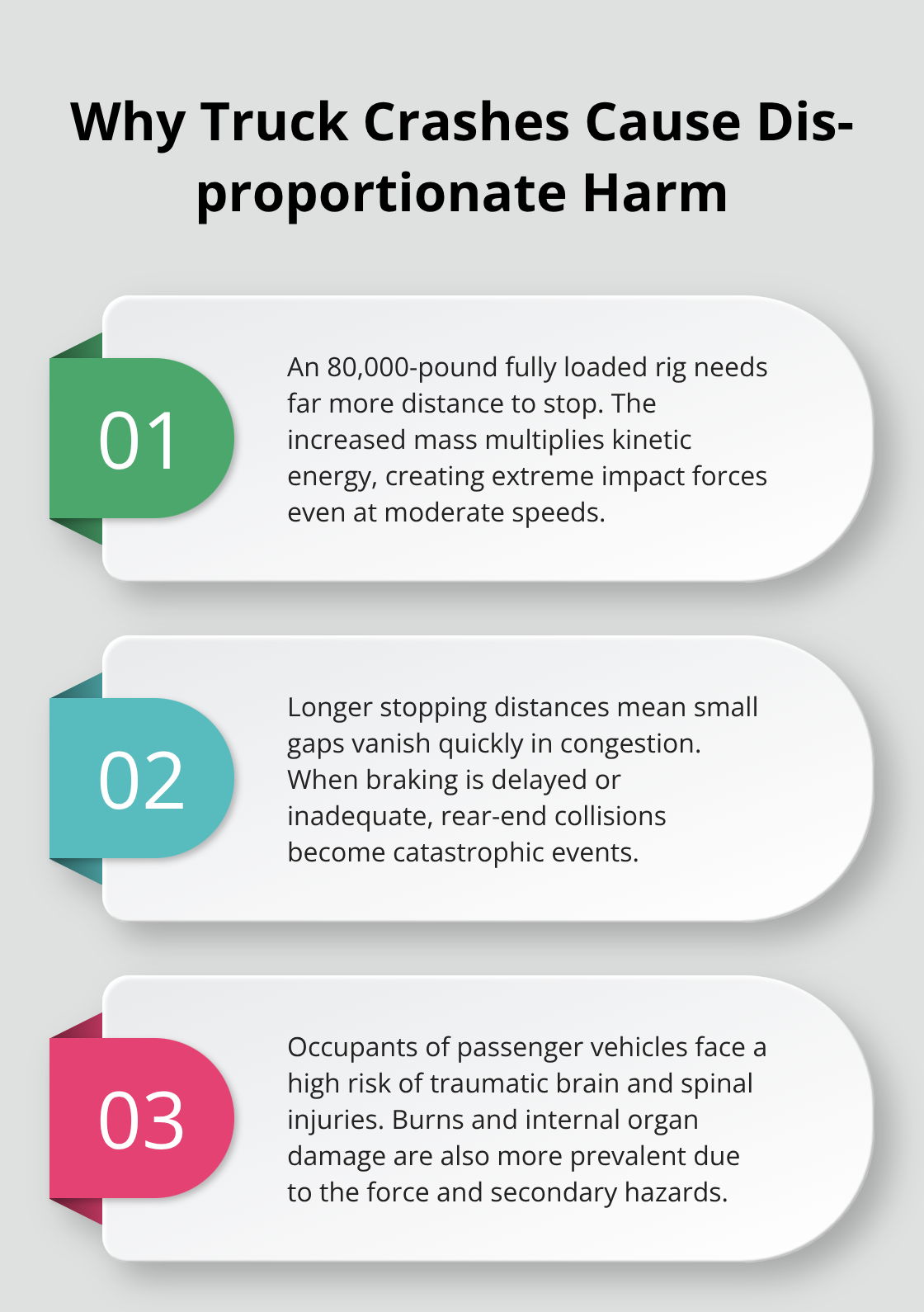
Commercial trucks weighing up to 80,000 pounds create injury patterns that bear no resemblance to standard car crashes. According to the National Highway Traffic Safety Administration, large trucks account for about 9% of fatal crashes but represent 13 to 13.5% of all traffic deaths. That disparity exists because a fully loaded big rig requires significantly longer stopping distances and generates catastrophic force on impact. When a passenger vehicle collides with a commercial truck, occupants suffer traumatic brain injuries, spinal cord damage, permanent paralysis, third-degree burns, and internal organ trauma at rates far exceeding typical motor vehicle accidents.
Federal Regulations That Apply Only to Commercial Trucking
The Federal Motor Carrier Safety Administration enforces a strict regulatory framework that does not apply to passenger vehicles, including hours-of-service rules that limit drivers to 11 hours of driving after 10 consecutive hours off duty and prohibit driving beyond the 14th hour after coming on duty. Violations of these rules provide direct evidence of negligence and often point to driver fatigue, one of the leading causes of commercial truck crashes alongside speeding, tire blowouts, and inadequate maintenance. Sacramento County sits at the intersection of major trucking corridors including I-5, I-80, Highway 50, and Highway 99, meaning residents face constant exposure to heavy commercial traffic in neighborhoods like Natomas, Elk Grove, West Sacramento, and Downtown Sacramento.
Multiple Defendants and Complex Insurance Coverage
Liability in truck accident cases extends far beyond the driver. A single crash can implicate the trucking company, cargo brokers, cargo loaders, maintenance contractors, and component manufacturers-each with their own insurance policies and defense strategies. Truck accidents involve complex federal laws and multiple liable parties, and insurers vigorously defend these claims and often attempt to settle prematurely for far less than full value.
Evidence Preservation and Financial Stakes
Investigating these cases demands immediate evidence preservation because Electronic Logging Device data, event data recorder information, maintenance records, and dispatch communications can disappear or alter within days. The financial toll of catastrophic truck injuries justifies eight-figure settlements and verdicts because victims face decades of medical care, assistive devices, home modifications, and lost earning capacity. Understanding which parties bear responsibility and what evidence proves negligence shapes how Sacramento County residents can recover full compensation for their losses.
What Evidence Wins Truck Accident Cases
Electronic Logging Device Data and Event Data Recorders
Electronic Logging Device data forms the backbone of modern truck accident investigations, and you must act fast to secure it. The FMCSA requires all commercial trucks to use ELDs that synchronize with the engine and record driving time, speed, location, and engine diagnostics in real time. This data reveals whether a driver exceeded the 11-hour driving limit, violated the 14-hour on-duty restriction, or skipped mandatory 30-minute breaks after eight hours of driving. Cross-referencing ELD records with fuel receipts, toll transactions, GPS data, bills of lading, and dispatch messages creates an objective timeline that proves fatigue or productivity pressure contributed to the crash.
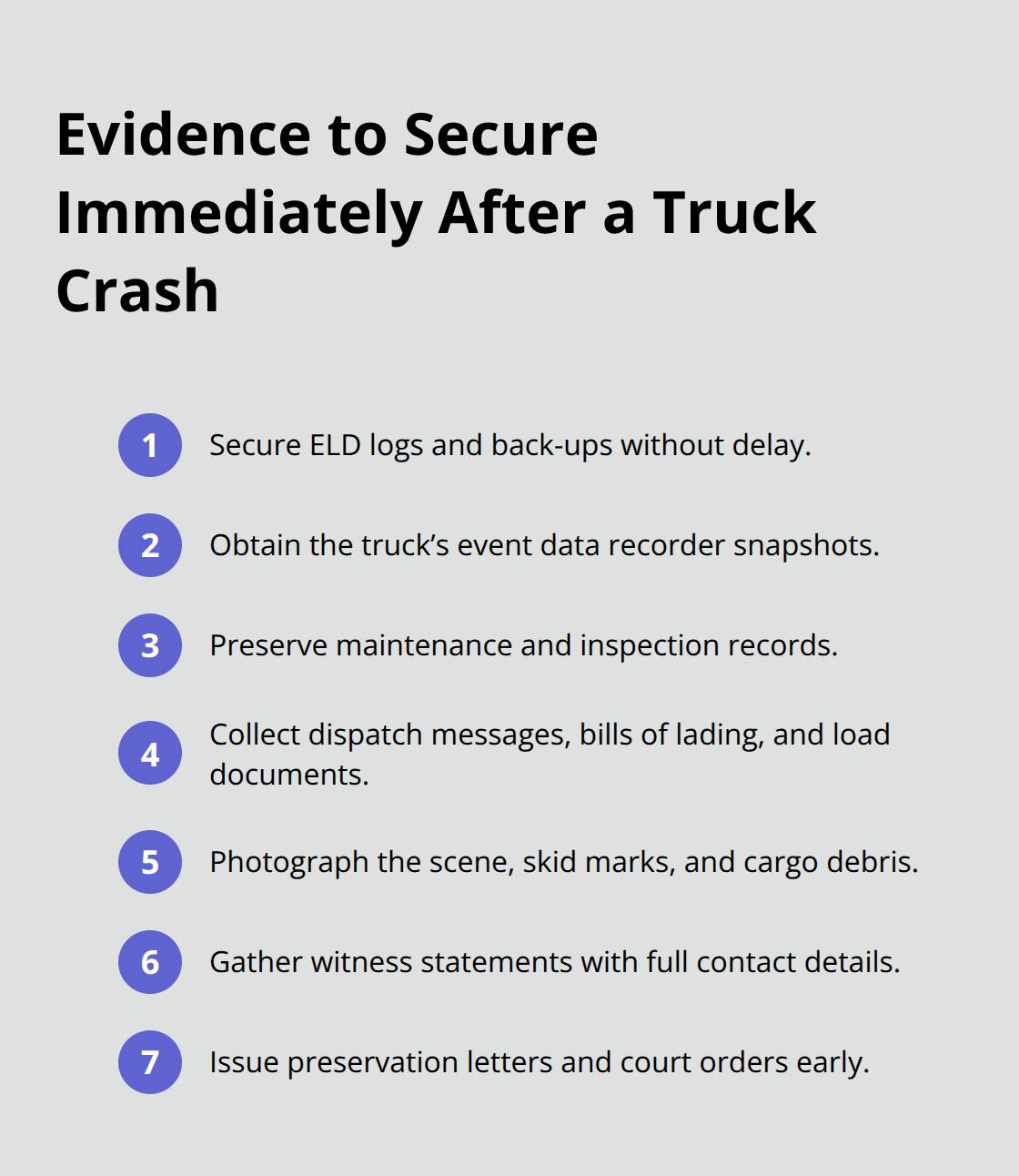
Event Data Recorder information from the truck itself captures pre-crash and post-crash conditions including speed, braking force, steering input, and warning system activation. Without immediate preservation, trucking companies can alter, delete, or claim hardware failure within days. Court orders securing the wrecked truck, the trailer, and all onboard recording systems must happen before repairs begin because once a truck leaves the shop, critical physical evidence vanishes.
Accident Scene Documentation and Witness Statements
Accident scene evidence requires systematic documentation before the wreckage moves. Photographs of tire marks, vehicle positions, cargo debris, and road conditions establish how the collision unfolded and challenge the defendant’s narrative. Witness statements collected at the scene often contradict later defense accounts, particularly regarding driver behavior before impact such as erratic lane changes, heavy braking, or excessive speed. Accident reconstruction experts produce detailed forensic analyses that correlate vehicle damage, debris scatter, and road evidence to determine speed, impact angle, and liability.
Hours of Service Violations and Maintenance Records
Hours of Service violations and maintenance failures demand investigation of driver qualification files, employment records, work schedules, drug and alcohol testing history, and maintenance logs. Red flags include tight delivery windows that pressure drivers to exceed safe hours, long warehouse detention times that compress driving schedules, and unusual log edits that suggest falsified records. Maintenance records reveal neglected brake repairs, tire issues, steering defects, or lighting problems that contributed to the crash.
Sacramento County Rear-End Collision Patterns
Sacramento County truck cases often involve rear-end collisions on congested corridors where overloaded or improperly maintained trucks fail to brake safely. I-5 near Natomas and Highway 99 through South Sacramento present particular hazards because heavy traffic compounds the stopping-distance challenges that large trucks face. Identifying whether the truck operator violated maintenance standards or exceeded weight limits becomes essential to establishing liability and determining which defendants bear responsibility for the victim’s injuries.
Sacramento County’s Truck Accident Landscape
How California’s Comparative Negligence System Affects Your Case
Sacramento County courts apply California’s pure comparative negligence system, which reduces damages by the plaintiff’s percentage of fault. Defense attorneys exploit this framework aggressively, arguing that shared responsibility diminishes what you recover. You need evidence that isolates the truck operator’s or company’s conduct as the primary cause of the collision. Sacramento County Superior Court has handled enough commercial vehicle disputes to recognize patterns in driver fatigue cases, maintenance negligence, and Hours of Service violations, but judges still demand meticulous documentation of federal FMCSA violations and their direct connection to the crash.
Accident Hotspots on Sacramento County’s Major Corridors
The major trucking corridors running through Sacramento County-I-5, I-80, Highway 50, and Highway 99-create predictable accident hotspots where rear-end collisions dominate. Truck stopping distances exceed what congested traffic allows, particularly on I-5 near Natomas and Highway 99 through South Sacramento. These corridors see consistent heavy truck volume, and the speed differentials between stopped or slowing traffic and approaching trucks amplify impact force, producing the most severe injuries in the region.
California’s Commercial Trucking Insurance Requirements
California’s commercial trucking insurance requirements far exceed standard auto policies. The California DMV Motor Carrier Permit program requires proof of financial responsibility before any commercial vehicle operates legally in the state, with minimum coverage around $1 million for most trucking operations-substantially higher than the $15,000 bodily injury minimum for passenger vehicles. Contact the California DMV Motor Carrier Permit Branch at (916) 657-8153 to verify what coverage level applied to the truck involved in your crash.
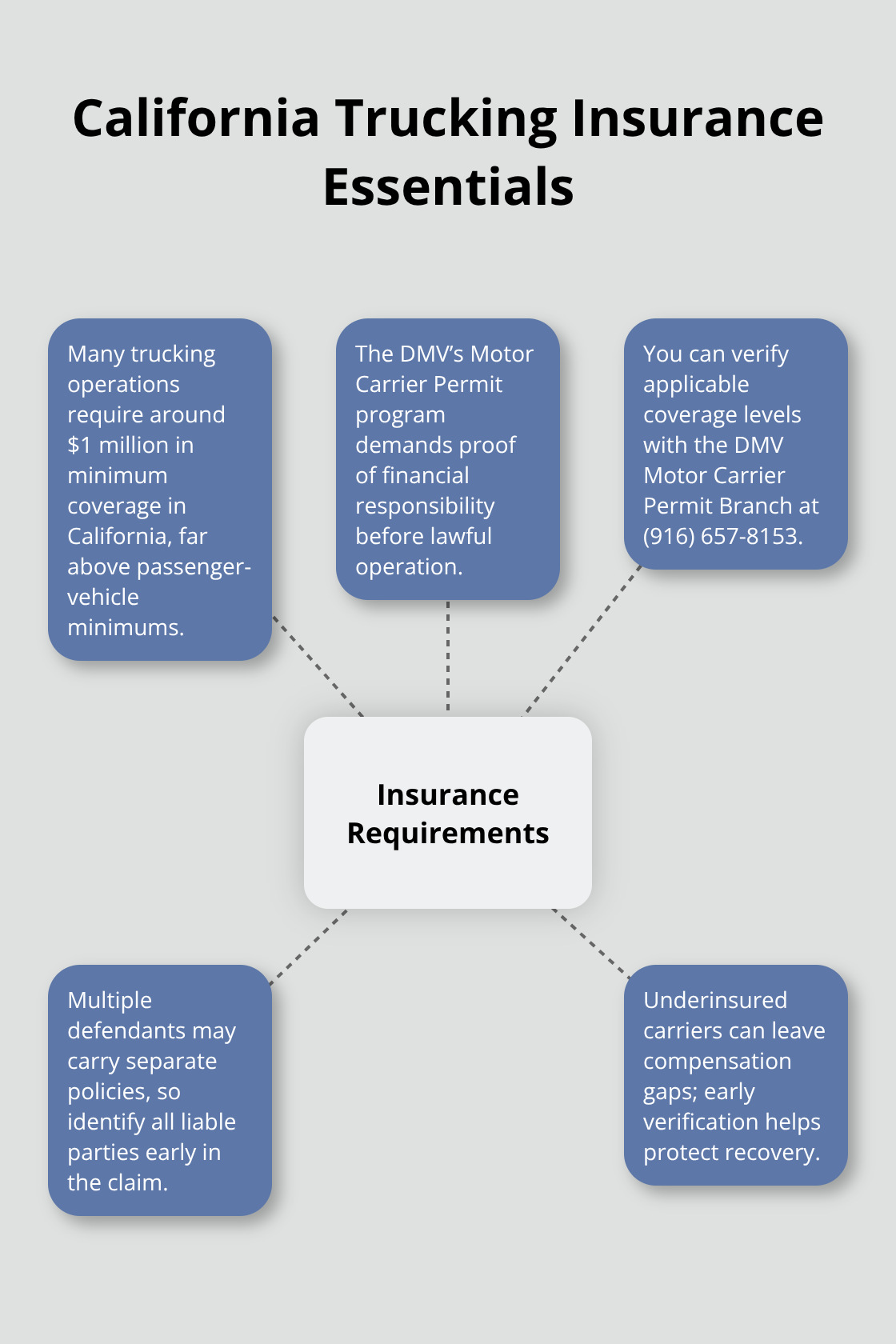
Underinsured carriers sometimes operate and create gaps in available compensation, so identifying all liable parties early in your claim protects against discovering later that a defendant carried insufficient coverage to compensate your losses fully.
Final Thoughts
Commercial truck accident claims operate under fundamentally different rules than standard car collisions. The federal regulations governing trucking operations, the catastrophic injuries that result from these crashes, and the multiple parties involved in liability create a legal landscape that demands specialized knowledge. Sacramento County residents facing truck accident claims need representation that understands both the physics of 80,000-pound vehicles and the federal framework that governs their operation.
A commercial truck attorney in Sacramento must act fast to secure Electronic Logging Device data before it disappears, obtain maintenance records that reveal negligence, and identify every liable party from the driver to the trucking company to cargo handlers. We at O’Brien & Zehnder Law Firm understand Sacramento County’s major corridors and the accident patterns that emerge on I-5, I-80, Highway 50, and Highway 99. We know how California’s comparative negligence system affects your recovery and how to isolate the truck operator’s conduct as the primary cause of your injuries.
If you suffered injuries in a truck accident across Sacramento County, contact O’Brien & Zehnder Law Firm for a consultation. The sooner you reach out, the sooner we can preserve critical evidence and begin building your case for full compensation.