
Sacramento County head-on collision claims often arise on the kinds of roads people drive every day without a second thought. A two-lane rural road through farmland, a curving stretch near the river, or a busy suburban street with a center turn lane can all become the scene of a crash when one driver crosses into oncoming traffic. Head-on collisions can be among the most serious crashes on the road, and the questions that follow are often about one thing: why was the other vehicle in your lane?
At O’Brien & Zehnder Law Firm, we help injured people across Sacramento County understand their rights after a crash so you can move forward with confidence. This guide explains the California lane and passing rules that usually decide fault in a head-on collision, how those rules are used to prove a claim, and the mistakes that can weaken your case.
How Head-On Collision Claims Actually Work in Sacramento County
A head-on collision claim is a negligence claim at its core. California Civil Code section 1714(a) provides that everyone is responsible not only for the result of willful acts but also for an injury occasioned to another by want of ordinary care or skill in the management of his or her property or person. In a head-on crash, the question is usually whether the other driver failed to use ordinary care by leaving their side of the road, and the California Vehicle Code supplies the rules that define where a driver is supposed to be.
The Basic Rule: Drive on the Right Half
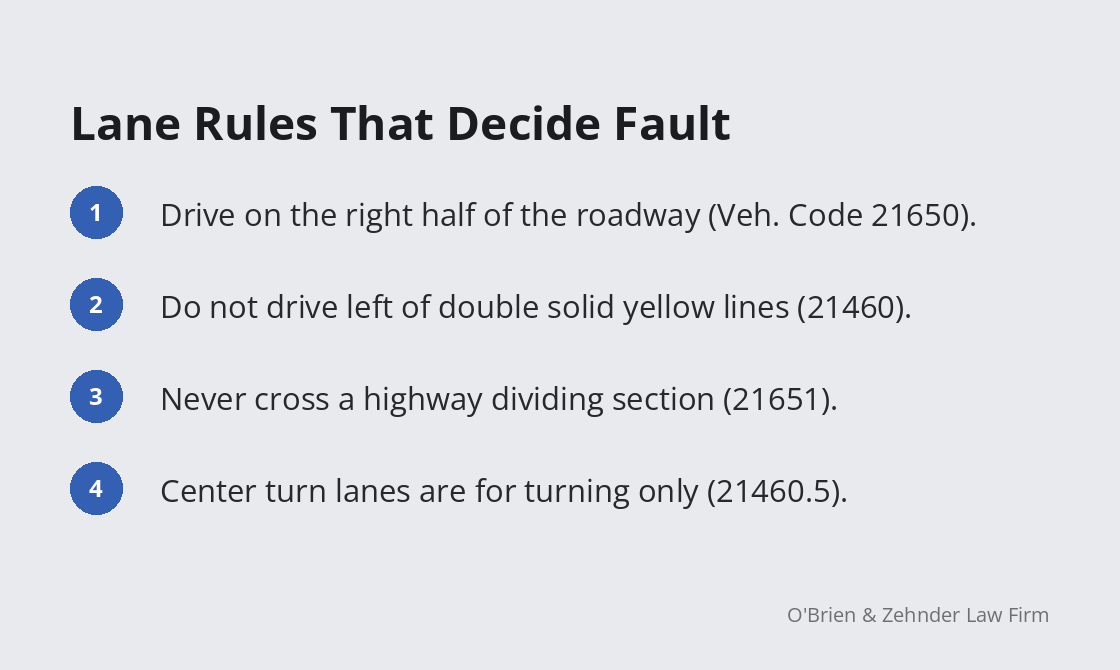
Vehicle Code section 21650 states that upon all highways, a vehicle shall be driven upon the right half of the roadway, subject to listed exceptions. Those exceptions include overtaking and passing another vehicle under the rules governing that movement, preparing for and making a lawful left turn, when the right half of the roadway is closed for construction or repair, on a roadway restricted to one-way traffic, and when the roadway is not of sufficient width. When a driver crosses the center of the road and none of those exceptions applies, that fact can be central to proving fault.
Double Yellow Lines and Center Markings
Vehicle Code section 21460(a) provides that if double parallel solid yellow lines are in place, a person driving a vehicle shall not drive to the left of the lines, except as permitted in that section. Where one of the double lines is broken, section 21460(c) allows a driver on the side with the broken line to cross over the double lines when overtaking or passing other vehicles. Section 21460(d) states that the markings do not prohibit a driver from crossing them when turning left at an intersection or into or out of a driveway or private road, or when making a lawful U-turn. These markings help show which driver was where they were allowed to be.
Divided Highways and Center Turn Lanes
On a divided highway, Vehicle Code section 21651 makes it unlawful to drive any vehicle over, upon, or across the dividing section, and unlawful to drive except to the right of an intermittent barrier or dividing section that separates opposing lanes of traffic. Many Sacramento County streets instead have a two-way left-turn lane in the center. Section 21460.5(c) states that a vehicle shall not be driven in a designated two-way left-turn lane except when preparing for or making a left turn or a permitted U-turn, and shall not be driven in that lane for more than 200 feet while preparing for and making the turn or while preparing to merge. A driver who uses the center lane as a travel lane can create exactly the kind of face-to-face conflict that leads to a head-on crash.
Proving Fault After a Sacramento County Head-On Collision
Because head-on collisions usually involve a vehicle in the wrong place, the evidence often focuses on how and why that happened. Passing maneuvers, curves, hills, and intersections come up again and again. California’s passing rules and its presumption of negligence work together to help injured people show what went wrong.
Unsafe Passing on Two-Lane Roads
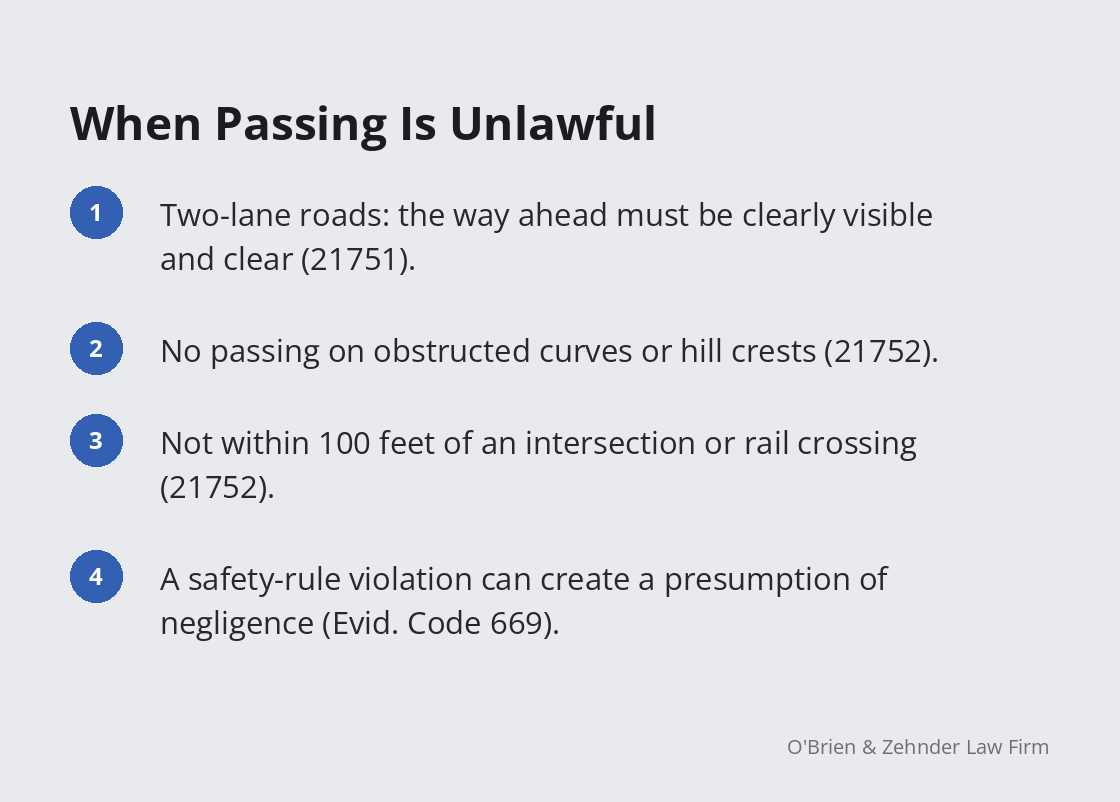
Vehicle Code section 21751 provides that on a two-lane highway, no vehicle shall be driven to the left side of the center of the roadway in overtaking and passing another vehicle unless the left side is clearly visible and clear of oncoming traffic for a sufficient distance ahead to permit the pass to be completely made without interfering with the safe operation of any vehicle approaching from the opposite direction. A driver who pulls out to pass without enough clear distance ahead, and then cannot get back in time, may have violated this rule.
Curves, Hills, Bridges, and Intersections
Vehicle Code section 21752 lists places where no vehicle shall be driven to the left side of the roadway. These include approaching or upon the crest of a grade or a curve where the driver’s view is obstructed within such distance as to create a hazard if another vehicle approaches from the opposite direction, when the view is obstructed upon approaching within 100 feet of any bridge, viaduct, or tunnel, and when approaching within 100 feet of or traversing any railroad grade crossing or any intersection. The section does not apply on a one-way roadway. Road geometry, sight lines, and the location of the crash can therefore matter as much as witness accounts.
The Presumption of Negligence
California Evidence Code section 669 can be especially important in head-on cases. It provides that the failure of a person to exercise due care is presumed if the person violated a statute, ordinance, or regulation of a public entity, the violation proximately caused death or injury to person or property, the injury resulted from an occurrence of the nature the statute was designed to prevent, and the injured person was one of the class of persons the statute was adopted to protect. Section 669(b) allows the presumption to be rebutted by proof that the violator did what might reasonably be expected of a person of ordinary prudence, acting under similar circumstances, who desired to comply with the law. Showing that the other driver broke a lane or passing rule can therefore shift the focus of the case.
What Weakens a Head-On Collision Claim
Even when the other driver was clearly in the wrong lane, claims can lose strength because of what happens in the days and weeks after the crash. Knowing the common pitfalls helps you protect both your health and your case.
Losing Evidence of Where the Vehicles Were
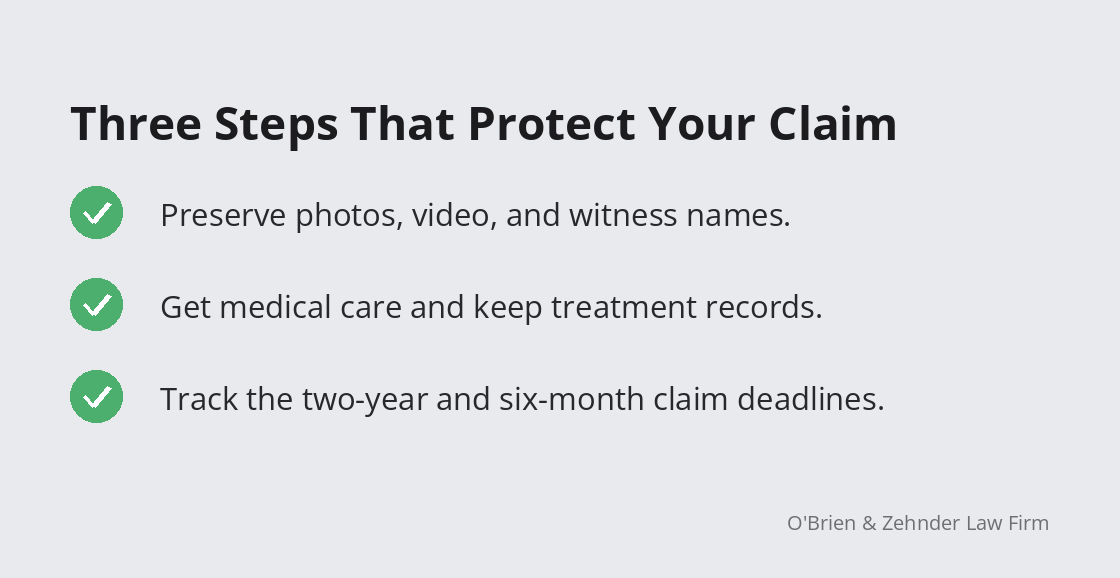
In a head-on collision, the location of each vehicle at the moment of impact is often the most important fact. Photographs of the scene, the road markings, the final resting positions of the vehicles, and any video from nearby cameras or dashcams can disappear quickly. Asking for copies of the traffic collision report, writing down the names of witnesses, and keeping any photos you or others took all help preserve the picture of what happened.
Assuming Shared Fault Ends the Claim
The other side may argue that you were speeding, distracted, or slow to react. Civil Code section 1714(a) recognizes that responsibility can be limited so far as an injured person has, willfully or by want of ordinary care, brought the injury upon himself or herself. That does not mean a claim disappears simply because both drivers are said to share some responsibility. Our guide to comparative fault in Sacramento County explains how shared blame is handled in California injury cases.
Missing Deadlines
California law sets firm time limits. Code of Civil Procedure section 335.1 provides a two-year period for an action for injury to, or for the death of, an individual caused by the wrongful act or neglect of another. When a public entity may be responsible, such as a government vehicle or a dangerous road condition, Government Code section 911.2 requires a claim relating to death or injury to person to be presented not later than six months after the accrual of the cause of action. Our guide to Sacramento County government claims explains that process in more detail.
Final Thoughts
Sacramento County head-on collision claims usually turn on a few clear rules. Vehicle Code section 21650 requires drivers to stay on the right half of the roadway, sections 21460 and 21460.5 govern center lines and two-way left-turn lanes, section 21651 protects divided highways, and sections 21751 and 21752 limit when and where a driver may pass on the left. Evidence Code section 669 can create a presumption of negligence when a driver violates one of these safety rules and causes the kind of harm the rule was meant to prevent.
The strongest claims are built early. Get the medical care you need, keep records of your treatment and recovery, preserve photos and witness information, and be careful about giving recorded statements before you understand your rights. Paying attention to the two-year limit and the much shorter public entity claim period protects your options.
If you were hurt in a head-on collision in Sacramento County, contact O’Brien & Zehnder Law Firm to speak with our team. We will review what happened and help you move forward with confidence.